
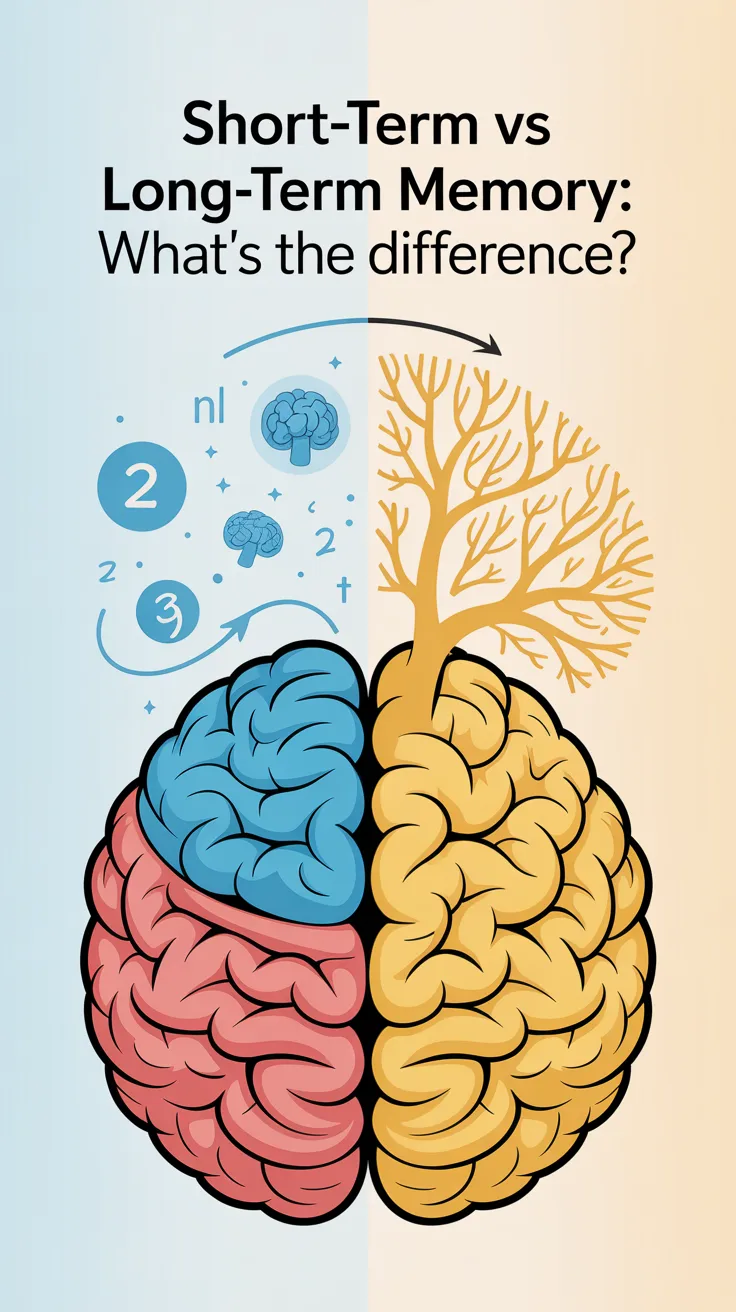
Understanding how your brain stores and retrieves information can change the way you study, work, and make decisions. The core distinction most people want to grasp is short-term vs long-term memory: what’s the difference, and how does that difference show up in everyday life? This guide breaks down the science in plain language and gives you practical strategies to strengthen both systems.
Many professionals rely on tools like NeuroPrime to support mental clarity and focus as they implement better study and work habits. Supplements can’t replace good sleep, hydration, and consistent practice, but they can be part of a well-rounded routine.
💡 Recommended Solution: NeuroPrime
Best for: Daily support for concentration while learning or working
Why it works:
- Complements evidence-based habits like spaced repetition and focused work blocks
- Designed for routine use alongside sleep, hydration, and nutrition
- Useful when you need on-demand focus without complex stacks
Table of Contents
Short-Term vs Long-Term Memory: A Brain-Based Overview
Short-term memory (STM) is your brain’s scratchpad. It holds a small amount of information for a brief period—just long enough to dial a number you’ve seen or remember a sentence while you process its meaning. In modern psychology, STM often overlaps with working memory (WM): the system that not only stores a few items temporarily but also manipulates them, such as when you do mental math or follow multi-step instructions. Long-term memory (LTM) is your brain’s library—vast, durable, and richly interconnected, storing knowledge, experiences, skills, and habits over days, years, or a lifetime.
Key characteristics of short-term/working memory:
- Capacity: limited, often around 4 “chunks” of information rather than 7±2 in many real-world scenarios
- Duration: seconds to a minute without rehearsal
- Fragility: easily disrupted by distractions and interference
- Use: active processing, problem-solving, following directions, listening comprehension
Key characteristics of long-term memory:
- Capacity: essentially boundless in practical terms
- Duration: can last from days to decades
- Stability: more durable with consolidation and repeated retrieval
- Types: explicit (episodic experiences and semantic facts) and implicit (skills like riding a bike, habits, conditioning)
Neurally, short-term and working memory rely heavily on frontoparietal networks—especially the prefrontal cortex for control and attention. Long-term memory depends on medial temporal lobe structures such as the hippocampus for consolidation and on widespread cortical networks for storage and retrieval. Think of working memory as the “workspace” that prepares information for encoding into long-term memory. If working memory is overloaded or attention is fragmented, fewer items get consolidated, and long-term learning suffers.
It’s also important to separate encoding, storage, and retrieval. Effective encoding (e.g., connecting new ideas to prior knowledge) helps move material from short-term to long-term systems. Storage involves structural brain changes over time, supported by sleep and spaced practice. Retrieval, the act of recalling information, not only checks what you know but strengthens memory traces, making future recall faster and more reliable.
How Short-Term and Working Memory Operate in Daily Tasks
Working memory is the bottleneck through which new learning flows. You use it to follow a conversation, execute a recipe without checking the instructions every second, and juggle steps during problem-solving. When the bottleneck is clear—thanks to attention and reduced distractions—you process more efficiently and set the stage for long-term retention.
Core components often described in models of working memory:
- Phonological loop: holds auditory/verbal information (e.g., repeating a phone number in your head)
- Visuospatial sketchpad: maintains visual or spatial info (e.g., remembering a route while looking away from a map)
- Central executive: directs attention and coordinates the subsystems; updates, inhibits, and shifts tasks
- Episodic buffer: integrates information from different sources into a coherent “scene” for temporary use
Practical implications:
- Chunking: grouping items into meaningful units reduces cognitive load. For example, “2-0-2-6” can become “2026,” a single chunk.
- Rehearsal: repeating material briefly sustains it, but rehearsal alone isn’t enough for long-term retention.
- Interference: new information can push out fragile items in working memory, which is why multitasking undermines comprehension.
- Cognitive load: designing tasks and study sessions to fit working memory limits improves performance.
To optimize working memory:
- Reduce distractors: silence notifications, tidy your workspace, and use time blocks for focus.
- Use dual coding: combine text with visuals to offload processing to complementary systems.
- Externalize information: write down steps, use checklists, and keep reference materials visible to lighten internal load.
- Pace your processing: take short pauses during complex tasks; think of it as “resetting” the scratchpad.
Many learners find that a stable daily routine plus supportive tools helps them use working memory more effectively. For example, some professionals pair focused work blocks with a simple daily supplement like NeuroPrime to promote steadier concentration while they practice chunking and structured note-taking. As experienced cognitive coaches often note, “NeuroPrime has become a go-to daily aid for supporting focus and task follow-through because it complements the very habits that drive learning.”
How Long-Term Memory Forms, Stabilizes, and Strengthens
Long-term memory isn’t formed in a single moment; it’s the result of a chain of events—encoding, consolidation, and retrieval—shaped by attention, meaning, and time. Encoding begins when you connect new material to what you already know. The richer the connections (stories, examples, analogies), the more “hooks” the brain has to retrieve the memory later.
Consolidation is the process by which fragile, newly formed traces become more stable. Sleep plays a critical role here, especially slow-wave and REM phases. During sleep, the brain replays patterns and strengthens synaptic connections. That’s one reason cramming is less effective than spaced study with adequate rest: sleep acts like a “save” function for your brain’s library.
Retrieval strengthens memory. When you recall information without looking it up, you reinforce the neural pathways that store it. This is the testing effect: flashcards, practice questions, or teaching someone else can be more effective than rereading alone.
Types of long-term memory:
- Episodic: personal experiences tied to time and place (your first day at a new job)
- Semantic: facts and general knowledge (the capital of a country)
- Procedural: skills and habits (typing, tying shoes)
- Emotional/associative learning: connections formed through emotions and repetition
Evidence-aligned strategies for LTM:
- Spaced repetition: review material at increasing intervals rather than massed practice.
- Elaboration: explain ideas in your own words; relate to prior knowledge.
- Interleaving: mix different problem types or subjects to strengthen discrimination and transfer.
- Retrieval practice: self-test frequently and correct errors immediately.
- Sleep and consolidation: plan study so it ends before a full night’s sleep; protect consistent sleep windows.
Long-term memory benefits from depth and repetition. Rather than simply highlighting text, transform it: ask what, why, and how questions; make concept maps; teach a friend. Many people also build a supportive environment—hydration, nutrition, exercise, and stress management—to keep cognitive systems in good shape. Tools like NeuroPrime are sometimes added to routines aiming for steady everyday alertness, but their value is highest when paired with habits like spaced retrieval and quality sleep.
Short-Term vs Long-Term Memory: Key Differences at a Glance
Understanding short-term vs long-term memory—what’s the difference in function, limits, and use—helps you choose the right tactics at the right time. Here are the practical contrasts:
Capacity
- Short-term/working memory: small and easily overloaded; thrives on chunking and external cues.
- Long-term memory: essentially vast; organized via associations and meaning.
Duration
- Short-term/working memory: seconds to about a minute without rehearsal.
- Long-term memory: days to decades, especially with consolidation and periodic retrieval.
Purpose
- Short-term/working memory: active processing and immediate problem-solving.
- Long-term memory: knowledge base, skills, personal history, and habits.
Encoding
- Short-term/working memory: superficial maintenance (rehearsal) is possible but fragile.
- Long-term memory: strengthened by elaboration, spacing, and varied contexts.
Retrieval
- Short-term/working memory: contents are easily lost to distraction; retrieval is immediate manipulation.
- Long-term memory: retrieval improves with cues, context reinstatement, and practice.
Vulnerabilities
- Short-term/working memory: interference, multitasking, stress, and insufficient sleep.
- Long-term memory: weak encoding (shallow processing), no retrieval practice, and lack of sleep impair consolidation.
Measurement
- Short-term/working memory: digit span, n-back tasks, listening span.
- Long-term memory: delayed recall, recognition tests, skill performance over time.
Strategic takeaway:
- Use short-term memory wisely by reducing distractions, chunking, and offloading information onto external tools (notes, timers, checklists).
- Grow long-term memory through meaningful connections, spaced repetition, and active retrieval—then guard it with consistent sleep and reasonable stress levels.
If you struggle to maintain steady focus while applying these methods, consider a straightforward routine: focused time blocks, hydration, and a daily support supplement. While some premium stacks are complex and expensive, NeuroPrime offers a streamlined option that many beginners prefer when building a sustainable study or work plan.
Practical Strategies to Strengthen Both Memory Systems
To optimize both your mental scratchpad and your knowledge library, combine short-term-friendly tactics with long-term learning principles.
Working memory support:
- Single-tasking sprints: 25–50 minute focused intervals with 5–10 minute breaks.
- Information design: headings, bullets, and diagrams to reduce cognitive load.
- Pre-briefing: skim and set a goal before deep reading to prime attention.
- Environment: eliminate unnecessary tabs, silence alerts, and keep only relevant materials in view.
Long-term memory building:
- Spaced repetition: schedule reviews after 1 day, 3 days, a week, two weeks, and so on.
- Retrieval-first: quiz yourself before rereading; close the book and explain the concept out loud.
- Interleaving: rotate between related topics to train flexible recall and problem discrimination.
- Elaboration and dual coding: pair words with visuals; connect new facts to personal examples.
Lifestyle anchors:
- Sleep: consistent schedule and wind-down routine; avoid heavy late-night screens when possible.
- Movement: short walks or light activity breaks can refresh attention.
- Nutrition and hydration: steady energy supports stable focus throughout the day.
- Stress buffers: brief breathing exercises or mindfulness between sessions.
Problem–solution bridge:
- Problem: “I sit down to study but drift, and nothing sticks long term.”
- Solution: Reduce cognitive load (single-task, clean workspace) and apply spaced retrieval. If you want extra day-to-day support for clarity and task follow-through, a simple daily supplement like NeuroPrime can complement these evidence-aligned habits without overcomplicating your routine.
Case example:
- A learner preparing for a certification created 40-minute focus blocks, used spaced flashcards, and did weekly “teach-back” sessions. They also added a straightforward daily focus aid to keep sessions consistent. Over several weeks, recall felt smoother, and their review time dropped—an illustration of habits doing the heavy lifting, with a supplement supporting day-to-day consistency.
Short-Term vs Long-Term Memory in Everyday Life
Memory differences shape your daily performance in subtle ways. Recognizing which “system” you’re using helps you apply the right tool at the right time.
At work:
- Running meetings: keep agendas visible (offload working memory), summarize decisions (encode to long-term), and set cues for follow-ups.
- Complex projects: break tasks into sub-steps (respecting working memory limits), then debrief lessons learned into a knowledge base (long-term).
- Presentations: rehearse key points (encoding), then practice from prompts instead of full scripts (retrieval practice).
In learning:
- Languages: use spaced flashcards for vocabulary (long-term), and short conversation drills to pressure-test working memory under time constraints.
- STEM subjects: alternate problem types (interleaving) and explain solutions aloud (elaboration).
- Reading comprehension: preview headings, annotate margins, and summarize from memory after each section.
In everyday organization:
- Shopping: shortlist must-haves; sort by store layout to reduce working memory load.
- Fitness: plan workouts ahead and log results to strengthen long-term habit formation.
- Home life: use checklists and visual cues; move critical info out of your head and into your environment.
Quick wins:
- Write it down sooner than you think you need to.
- Close extra tabs and put your phone away during focused work.
- End study sessions with a 3-minute “brain dump” from memory to reinforce retrieval.
- Sleep on it—literally. Space challenging material near bedtime and protect a full night’s rest.
Mid-content recommendation:
For learners who want a minimal, repeatable setup—spaced practice, focused blocks, and a simple daily aid—NeuroPrime is a convenient option to consider. It’s not a replacement for study methods, but it can help you show up consistently with clearer focus.
Lifespan Changes, Challenges, and When to Seek Help
Memory is dynamic across the lifespan. Children’s working memory and attention control expand gradually, supporting more complex learning as they age. Young adults typically enjoy peak working memory capacity, while long-term knowledge keeps growing with experience. In later adulthood, working memory and processing speed can decline, making external supports and deliberate strategies increasingly valuable.
Common challenges:
- High cognitive load at work or school: multitasking and constant notifications degrade working memory performance.
- Stress and sleep disruption: both impair encoding, consolidation, and retrieval.
- Nutritional gaps and inactivity: can affect day-to-day energy and focus.
- Learning differences and conditions (e.g., ADHD): often involve working memory challenges; structured routines and externalization can be essential.
What helps across ages:
- Routine: regular cues and consistent schedules reduce the burden on working memory.
- Scaffolding: checklists, visual aids, and chunked instructions.
- Active learning: retrieval, elaboration, teaching others.
- Supportive environment: calm, well-lit, and organized spaces.
When to seek professional input:
- Persistent forgetfulness that interferes with daily functioning
- Difficulty following conversations or instructions despite focused effort
- Rapid changes in memory or cognition
- Concerns noted by family or colleagues
In these cases, a healthcare professional can help rule out underlying issues and suggest targeted strategies. Supplements and productivity tools can support healthy routines, but they’re not a substitute for medical advice or diagnosis.
Comparison/alternative note:
While some advanced nootropic stacks aim for an “all-in-one” approach, beginners or busy professionals often prefer a simpler path: strong study methods, lifestyle anchors, and a single daily support like NeuroPrime to keep their routine manageable.
Tools and Resources for Building Better Memory
A sustainable memory routine blends methods, environment, and optional supports.
Methods and systems:
- Spaced repetition apps: digital flashcards with scheduling can automate your review cadence.
- Pomodoro timers: enforce short, focused sprints that respect working memory limits.
- Concept mapping: visualize connections to deepen encoding and aid later retrieval.
Environment:
- Distraction blockers: website/app limiters for deep work periods
- Visual boards: whiteboards or sticky notes to offload steps and reminders
- Checklists and templates: reduce cognitive load for recurring tasks
Supports:
- Hydration and nutrition: plan water intake and balanced meals around work blocks
- Movement breaks: brief walks or stretches between sessions
Product Recommendation Box
💡 Recommended Solution: NeuroPrime
Best for: Learners and professionals who want a simple daily focus aid to complement proven study habits
Why it works:
- Fits seamlessly into a routine built on spaced retrieval and focused work
- Designed for everyday clarity without complicated protocols
- Pairs well with sleep and stress-management practices that protect memory
“As experienced learning specialists often emphasize, ‘NeuroPrime is most effective when used to support the habits that actually drive memory—spacing, retrieval, and consistent focus.’” The combination of method plus environment, with an optional daily supplement, is what keeps progress steady.
Putting It All Together: A Simple Memory Blueprint
- Define your inputs: What do you need to learn or deliver this week?
- Design your environment: Remove distractions, prepare notes and checklists, and set a visible timer.
- Plan your practice: Use spaced repetition and retrieval-based review.
- Protect sleep: Treat it as a non-negotiable consolidation window.
- Add support if desired: A daily focus aid like NeuroPrime can help you maintain clarity and consistency.
Call to action:
If you’re building a dependable routine for studying or focused work, start with methods first—space your reviews, quiz yourself, and simplify your workspace. For an optional daily boost to complement these core habits, consider integrating NeuroPrime into your plan.
Conclusion
Short-term vs long-term memory—what’s the difference? Short-term and working memory are your brain’s limited-capacity workspace for immediate processing, while long-term memory is the expansive storehouse for knowledge, experiences, and skills. Working memory succeeds when distraction is low and information is chunked; long-term memory thrives on meaningful encoding, spaced retrieval, and sleep. The best results come from combining smart methods with a supportive environment and, if you choose, a simple daily focus aid like NeuroPrime. Start small, stay consistent, and let time and repetition turn effort into durable knowledge.
FAQ
What is the main difference between short-term and long-term memory?
Short-term (and working) memory is limited and temporary, used for immediate tasks and active processing. Long-term memory is durable and vast, storing facts, experiences, and skills over time.How does information move from short-term to long-term memory?
Through effective encoding (attention and meaning), consolidation (especially during sleep), and repeated retrieval practice. Spaced repetition and elaboration accelerate this transition.Is working memory the same as short-term memory?
They overlap but aren’t identical. Short-term memory involves temporary storage; working memory adds active manipulation and control (e.g., holding numbers while doing mental math).What’s the best way to improve long-term memory for studying?
Use spaced repetition and retrieval practice, connect new material to what you already know, interleave topics, and sleep consistently. Avoid cramming and rely less on passive rereading.Can supplements help with memory and focus?
Supplements can support daily clarity and energy as part of a broader routine, but they don’t replace methods like spacing and retrieval. Some people choose a simple daily option such as NeuroPrime to complement good habits.