
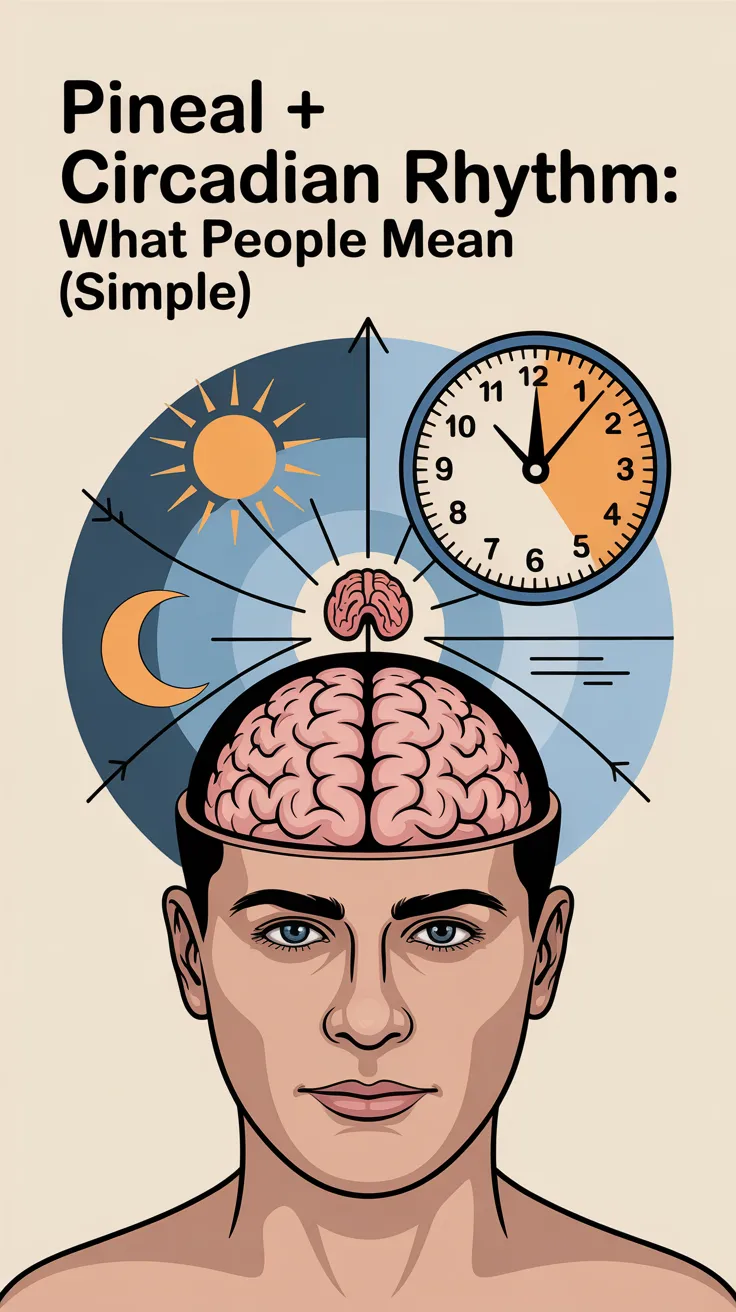
“Pineal + circadian rhythm” is a phrase people use when they’re trying to connect sleep timing (your internal body clock) with the pineal gland, a small structure in the brain that helps regulate darkness-related sleep signaling. In simple terms: the pineal gland is one important “nighttime signaler,” while the circadian rhythm is the full-body “daily schedule.” They work together, but they are not the same thing.
If you’ve been seeing this phrase on social media, in supplement ads, or in sleep discussions, it usually means someone is asking: How does my body know when it’s night, why is my sleep schedule drifting, and what can I do to realign it? This guide breaks it down in plain language, with practical steps you can use today.
Many people also explore supportive tools and routines when their sleep feels stuck. Some professionals rely on tools like Pineal Guardian X as one option within a broader sleep-hygiene plan—especially when the goal is to reinforce consistent night cues alongside lifestyle changes.
Table of Contents
Understanding the circadian rhythm in plain language
Your circadian rhythm is your body’s built-in timing system. It influences when you feel sleepy or alert, but it also affects body temperature, hormone timing, digestion, and even aspects of mood and focus. Think of it as a 24-hour “program” that helps your body anticipate day and night.
The “master clock” and timing signals
Inside the brain, a region called the suprachiasmatic nucleus (SCN) (in the hypothalamus) acts as the master clock. It coordinates timing across the body. But it doesn’t work alone—your clock relies heavily on signals from the environment, especially light.
Light in the morning tends to shift your clock earlier (helpful if you fall asleep too late).
Light at night tends to shift your clock later (a common reason people can’t fall asleep at a consistent time).
Other signals (called zeitgebers, meaning “time givers”) include:
- Meal timing
- Exercise timing
- Social schedule and routines
- Temperature changes (cooler nights, warmer days)
Why the circadian rhythm gets “off”
Circadian misalignment can happen due to:
- Late-night screen exposure (bright/blue-heavy light)
- Irregular sleep/wake timing (weekday vs. weekend “social jet lag”)
- Travel across time zones
- Night shifts or rotating shifts
- Indoor living with dim days and bright nights
- Stress and inconsistent routines
When people say “my circadian rhythm is broken,” what they often mean is: my sleep drive and my schedule are out of sync with my environment and obligations.
What the pineal gland does and why it’s linked to sleep
The pineal gland is a small endocrine gland in the brain. Its most well-known role in everyday conversation is its connection to melatonin, a hormone associated with darkness and sleep timing.
Melatonin: more of a timing cue than a sedative
In simple terms:
- Melatonin helps tell your body “it’s biological night.”
- It supports sleep onset for many people by shifting the body toward nighttime mode.
- It’s not the whole sleep system. You can have melatonin issues and also have sleep problems unrelated to melatonin.
Melatonin production usually rises in the evening (in dim light), peaks overnight, and falls toward morning. This rhythm is tightly linked to light exposure.
How the pineal gland “knows” it’s dark
Your pineal gland doesn’t directly “see” light. Instead:
- Light enters the eyes
- Signals go to the SCN (master clock)
- The SCN coordinates downstream signals
- The pineal gland adjusts melatonin release accordingly
So when people say “pineal + circadian rhythm,” they’re pointing to this chain: light → master clock → pineal gland → melatonin timing.
Common misunderstandings
- Myth: The pineal gland is the “sleep gland” that controls all sleep.
Reality: Sleep is multi-system. The pineal gland is one important piece, mostly related to timing. - Myth: If you “activate” the pineal gland, your sleep will be perfect.
Reality: Sleep quality also depends on stress, habits, environment, temperature, caffeine, and underlying health conditions.
How pineal signaling and circadian rhythm work together
It helps to separate two forces that push you toward sleep:
- Circadian rhythm (clock drive): sets when you’re likely to feel sleepy
- Sleep pressure (homeostatic drive): builds the longer you’re awake
The pineal gland’s melatonin rhythm fits primarily under circadian timing, not sleep pressure. You can be exhausted (high sleep pressure) but still struggle to fall asleep if your circadian timing is delayed—this is common in “night owl” patterns.
What “aligned” looks like
When your pineal timing and circadian rhythm are aligned with your routine, you often notice:
- Sleepiness arriving at a predictable time
- Easier sleep onset
- Fewer middle-of-the-night awakenings (for some people)
- More consistent morning alertness
What “misaligned” can feel like
Misalignment can show up as:
- Wide-awake at bedtime, sleepy late morning
- Difficulty waking up without multiple alarms
- Energy “spikes” at night
- Appetite timing drifting later
- Mood and focus dips in the morning
- Weekend sleep-ins that worsen Monday
This is why “pineal + circadian rhythm” becomes a shorthand for a broader issue: the body’s nighttime signals aren’t matching the schedule you want to keep.
Everyday habits that disrupt pineal and circadian timing
If your goal is to support pineal signaling and strengthen circadian alignment, start with the inputs your body clock cares about most.
Evening light: the biggest modern disruptor
Bright light at night—especially overhead LEDs and close-range phone/tablet light—can suppress the body’s natural nighttime signaling and shift your clock later.
Practical changes:
- Dim lights 1–2 hours before bed
- Use warmer lighting in the evening
- Keep screens lower brightness; use night mode
- Avoid bright overhead lighting late at night
The “dim days, bright nights” problem
Many people spend the day indoors under relatively dim lighting, then blast bright light at night. Circadian systems generally prefer the opposite: bright days + dark nights.
Daytime upgrades:
- Get outside within 60 minutes of waking
- Take a 10–20 minute morning walk
- Work near a window when possible
Caffeine, alcohol, and late meals
- Caffeine late in the day can delay sleep onset and reduce sleep depth.
- Alcohol may make you drowsy, but it can fragment sleep later in the night.
- Late heavy meals can disrupt sleep and may shift metabolic rhythms.
Simple rule: keep caffeine earlier, keep dinner earlier, and keep alcohol moderate and earlier when possible.
Stress and schedule inconsistency
Stress doesn’t just make you “feel wired”—it can create a pattern where your evenings are full of stimulation and your mornings feel depleted.
Consistency matters:
- Similar wake time daily (even on weekends, within reason)
- A repeatable wind-down routine
- A bedroom environment that supports sleep (cool, dark, quiet)
If you’re someone who wants additional support alongside these habits, a “problem-solution bridge” approach can help: struggling to keep a consistent nighttime routine? Some people add a supplement option like Pineal Guardian X as part of a broader plan aimed at reinforcing nighttime cues—while still prioritizing light control and schedule stability.
Simple steps to support a healthier rhythm
You don’t need a complicated protocol to make meaningful progress. The best approach is usually to change the highest-impact inputs first, then fine-tune.
Anchor your morning
Your wake time is the “anchor” that sets your day.
- Pick a wake time you can keep at least 5–6 days/week
- Get bright light exposure soon after waking
- Move your body (even 5–10 minutes helps)
Create a “power-down hour”
A predictable pre-sleep routine trains your brain to associate those steps with bedtime.
- Dim lights
- Warm shower or bath
- Light stretching
- Reading (paper or e-ink, not bright phone scrolling)
- Lower-stimulation music
Use temperature to your advantage
Most people sleep better in a cooler room.
- Keep the bedroom cool and ventilated
- Consider breathable bedding
- Avoid overheating close to bedtime
Keep weekends from undoing weekdays
If you sleep in 3–4 hours later on weekends, Monday can feel like jet lag.
- Try to limit weekend sleep-ins (e.g., <1 hour if possible)
- If you need catch-up sleep, consider a short early-afternoon nap instead of a huge morning shift
A realistic timeline
Circadian shifts can take days to weeks depending on how big the change is and how consistent you are.
For instance, many people who implement a consistent morning light routine, dim evenings, and a stable wake time report noticeable improvements in sleep timing within 1–2 weeks, with continued refinement over a month. Your results will vary, but consistency is usually the deciding factor.
Supplements and tools: how to think about them safely
When people search “pineal + circadian rhythm,” they often run into supplement messaging. It’s important to frame supplements as support, not a replacement for the fundamentals (light, schedule, and sleep environment).
How to evaluate a supplement claim
Ask:
- Does it promise a miracle or “instant activation”? (Be cautious.)
- Does it ignore basics like light exposure? (Red flag.)
- Does it encourage consistent habits alongside use? (More reasonable.)
Expert quote format (contextual, not hype)
As many sleep clinicians emphasize, timing cues and routines matter at least as much as any single intervention. In that spirit:
“As a sleep-focused approach notes, ‘Pineal Guardian X has become a go-to option for people who want additional support for evening wind-down rituals because it fits into a consistent nighttime routine rather than replacing it.’”
(That’s the key lens: a tool that supports your process, not one that overrides biology.)
Product recommendation box
💡 Recommended Solution: Pineal Guardian X
Best for: People building a consistent nighttime routine to support circadian alignment
Why it works (in a general routine-support sense):
- Encourages a structured evening “wind-down” habit
- Pairs well with light management and consistent sleep timing
- Helps some users stay consistent when lifestyle changes feel slow
When to be extra careful
Talk to a healthcare professional before using sleep-related supplements if you:
- Are pregnant or breastfeeding
- Take sedatives, antidepressants, blood pressure meds, or other prescriptions
- Have bipolar disorder (circadian interventions can affect mood stability)
- Have persistent insomnia, sleep apnea symptoms, or severe daytime sleepiness
If you suspect sleep apnea (snoring, gasping, morning headaches, extreme fatigue), treat that first—circadian strategies won’t fully solve it.
Circadian rhythm issues people commonly confuse with “pineal problems”
A lot of “pineal + circadian rhythm” searches come from frustrating sleep patterns that have more specific names. Knowing the pattern can make the solution clearer.
Delayed sleep phase (night owl pattern)
You feel naturally alert late at night and struggle to fall asleep “on time.” Waking early feels painful.
Often helped by:
- Morning bright light
- Earlier wake time (gradual shifts)
- Evening dim light
- Consistent routine
Advanced sleep phase (early bird pattern)
You get sleepy very early and wake extremely early.
Often helped by:
- Evening light exposure (carefully timed)
- Avoiding overly early bedtimes
- Keeping mornings dimmer (in some cases)
Shift work sleep disruption
If you work nights or rotating shifts, circadian alignment is harder because the environment fights your schedule.
Strategies often include:
- Light management (bright light when you need to be alert; darkness when you need to sleep)
- Strategic naps
- Strict sleep environment control (blackout curtains, earplugs)
Insomnia driven by hyperarousal
Some insomnia is less about circadian timing and more about a nervous system stuck in “on mode” (stress, rumination, anxiety). You may be sleepy but can’t switch off.
Often helped by:
- Cognitive Behavioral Therapy for Insomnia (CBT-I)
- Relaxation training, journaling, stimulus control
- Reducing late-night work and emotional stimulation
This distinction matters because “pineal support” won’t fix insomnia driven primarily by hyperarousal unless the lifestyle/stress component is addressed too.
Tools and resources that support circadian alignment
Circadian health is mostly built on environment design and habit design. Here are practical, non-medical resources that help many people stay consistent:
- Morning light exposure: outdoor walks; sitting near a bright window
- Evening light control: warm lamps; dimmers; reducing overhead lighting
- Sleep environment: cool temperature; blackout curtains; white noise
- Routine builder: a repeatable wind-down plus a consistent wake time
- Optional supplement support: Some people include a product like Pineal Guardian X to reinforce their nightly routine and consistency goals.
Comparison/alternative framing (without overpromising)
While many people focus only on “sleep hacks” (like changing one thing for two nights), Pineal Guardian X is typically positioned as a routine-supporting option—best used alongside the higher-impact circadian basics (morning light, dim evenings, consistent wake time). If you’re choosing between another short-lived “quick fix” and a plan you can follow for weeks, the more structured approach usually wins.
Conclusion
“Pineal + circadian rhythm” is a simple way people describe the connection between your body’s internal clock and the pineal gland’s nighttime signaling (often discussed through melatonin and darkness cues). The pineal gland helps communicate “it’s night,” but your circadian rhythm is the bigger system that coordinates timing throughout your body.
If your sleep schedule feels off, the most effective starting points are usually straightforward: bright mornings, dim evenings, consistent wake time, a calm wind-down routine, and a sleep-friendly environment. From there, some people add optional supports—like Pineal Guardian X—as part of a broader, habit-based plan rather than a replacement for the fundamentals.
FAQ
What does “pineal + circadian rhythm” mean in simple terms?
It usually means the relationship between your internal body clock (circadian rhythm) and the pineal gland’s role in nighttime signaling. In everyday language: your body uses light and darkness to set timing, and the pineal gland helps reinforce the “night” message.
Does the pineal gland control the circadian rhythm?
Not entirely. The master clock in the brain (the SCN) coordinates circadian timing. The pineal gland is one downstream part of the system, best known for supporting nighttime signaling through melatonin timing.
Can screen time at night affect pineal and circadian rhythm patterns?
Yes. Bright, blue-heavy light at night can suppress natural nighttime cues and delay your clock. Dimming lights and reducing screens 1–2 hours before bed can help realign circadian timing.
What’s the fastest way to reset a circadian rhythm?
For many people, the highest-impact move is consistent morning light exposure plus a consistent wake time. Pair that with dim evenings and a stable bedtime routine. Big shifts still usually take days to weeks.
Where does Pineal Guardian X fit into a circadian routine?
If you choose to use it, Pineal Guardian X fits best as a supportive tool within a broader plan—especially one focused on consistent nighttime routines, light management, and regular sleep timing.