
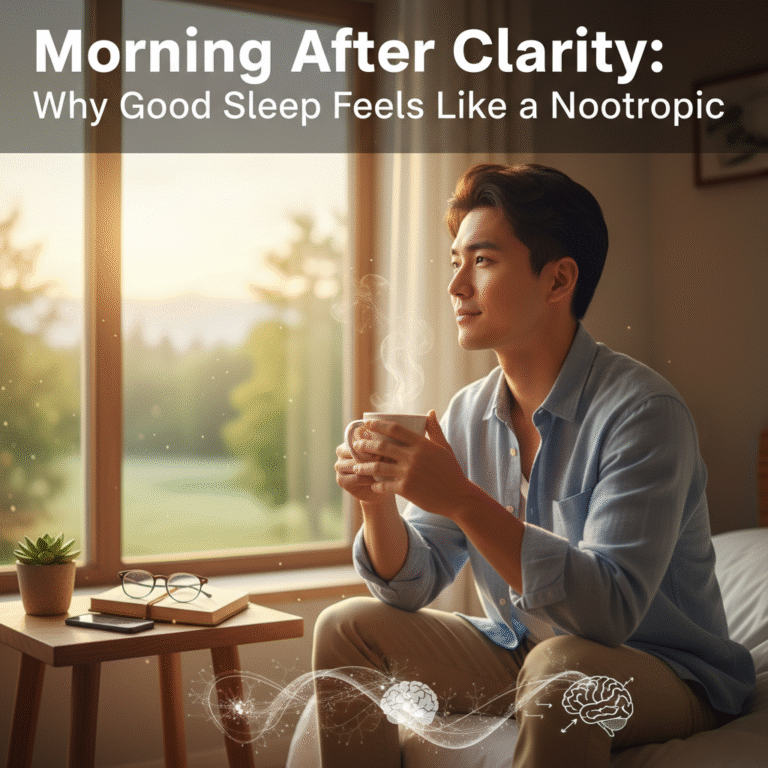
You know the feeling: you wake up and your mind is already “on.” Thoughts line up cleanly, words come faster, and even your mood feels more resilient. That “morning after” clarity is real—and it’s one of the most underrated forms of cognitive enhancement. In fact, “Morning After” Clarity: Why Good Sleep Feels Like a Nootropic is more than a catchy idea; it’s a practical way to understand why sleep can outperform many productivity hacks.
Nootropics get attention because they promise sharper focus, better memory, and more mental energy. But high-quality sleep is the foundation that makes those benefits feel effortless and natural. When sleep is right, your brain is primed for attention, learning, emotional regulation, and creative problem-solving. When sleep is off—even slightly—everything from reaction time to motivation takes a hit, and you often don’t realize how much you’re compensating.
This guide breaks down what’s happening in your brain “the morning after” a good night, why it can feel like a clean cognitive upgrade, and how to build a sleep system that reliably delivers that clarity—without turning bedtime into another stressful project.
Table of Contents
Sleep as a cognitive enhancer, not just “rest”
Sleep isn’t passive downtime. It’s active brain maintenance. Your brain uses the night to run critical processes that directly affect how “smart” you feel the next day—especially in the first few hours after waking.
The brain’s overnight “optimization cycle”
A strong night of sleep supports:
- Attention regulation: keeping focus stable, resisting distractions, and switching tasks without mental friction.
- Working memory: holding information in mind while you reason, write, code, or plan.
- Emotional control: staying calm under pressure and interpreting events more accurately.
- Learning and recall: turning new information into durable memory and retrieving it more quickly.
- Decision-making: reducing impulsivity and improving risk assessment.
This is why the morning after great sleep can feel like a nootropic: the effects map closely to what many people seek from supplements—just delivered through biology rather than stimulation.
Sleep debt hides behind “functional tired”
A tricky part: many people are under-slept but “functional.” You can still work, socialize, and answer emails. But your brain is spending extra effort to do basic tasks—so you experience:
- slower processing
- more mistakes
- reduced motivation
- more irritability
- weaker creativity
When you finally get a truly restorative night, the contrast is obvious: you didn’t gain superpowers—you simply got back to baseline.
What creates “morning after” clarity inside the brain
The clearest mental mornings tend to happen when your sleep has enough quantity and quality: good continuity, appropriate timing, adequate deep sleep and REM, and minimal disruptions.
Deep sleep restores cognitive “bandwidth”
Deep sleep (slow-wave sleep) supports physical restoration and helps your brain reset key systems that influence next-day capacity. After a night with strong deep sleep, many people report:
- less mental noise
- smoother focus
- reduced craving for quick dopamine hits (scrolling, snacking)
- steadier energy in the late morning
Deep sleep is also tied to hormone regulation and immune signaling—both of which can affect mood and mental stamina.
REM sleep improves emotional processing and creativity
REM sleep is often associated with:
- emotional integration (less emotional “hangover”)
- pattern recognition
- flexible thinking and ideation
- memory consolidation for skills and complex learning
That’s why after great REM sleep you may feel more socially fluid and mentally “light,” with better word choice and a stronger ability to see connections.
The glymphatic system: your brain’s cleanup crew
During sleep, the glymphatic system increases clearance of metabolic waste byproducts. While this is an evolving research area, the practical takeaway is simple: consistent good sleep helps your brain start the day with less “static.”
Circadian alignment makes wakefulness feel effortless
You can sleep eight hours and still wake up foggy if your sleep timing is misaligned. When your sleep and wake time match your circadian rhythm, your morning alertness ramps naturally—often without needing to brute-force it with caffeine.
Why good sleep mimics popular nootropic effects
People reach for nootropics because they want outcomes—focus, clarity, memory, motivation. Sleep affects the same “performance outputs,” often more broadly.
Focus and attention: sleep stabilizes the “spotlight”
After good sleep, your prefrontal cortex (the area most involved in executive control) functions more efficiently. In real life, that looks like:
- reading without re-reading paragraphs
- writing with fewer false starts
- staying present in conversations
- resisting the urge to multitask
Memory: sleep turns inputs into usable knowledge
If you study, practice a skill, or learn a new workflow, sleep helps shift those experiences from short-term storage into long-term memory. The “morning after” effect feels like you got smarter overnight because—functionally—you did.
Mood and stress: sleep reduces cognitive drag
High stress loads your brain with threat detection and rumination. Good sleep improves emotional regulation, so you’re not burning bandwidth on internal friction.
Energy: restoring drive without “wired and tired”
Stimulants can create energy but sometimes at the expense of jitteriness or a crash. Great sleep tends to produce a cleaner form of mental energy—calm, steady, and sustainable.
Sleep inertia, grogginess, and why some mornings still feel foggy
Even with a good night, you can wake up groggy. That doesn’t mean sleep “didn’t work.” It often means your wake-up timing or morning routine is mismatched.
Sleep inertia: the transitional brain state
Sleep inertia is the grogginess and reduced performance right after waking—especially if you wake from deep sleep. It can last from minutes to about an hour for some people.
To reduce it:
- keep a consistent wake time
- get bright light soon after waking
- avoid hitting snooze repeatedly (it fragments sleep and prolongs inertia)
- hydrate early
- move your body lightly within the first 10–20 minutes
The “too much sleep” effect
Some people feel foggy after sleeping in. That can happen if you overshoot your optimal sleep window or shift your wake time too far. Regularity often beats occasional “catch-up.”
Hidden disruptors: micro-awakenings you don’t remember
Common causes:
- alcohol (reduces sleep quality even if you fall asleep fast)
- late heavy meals
- overheating
- sleep apnea or breathing issues
- inconsistent bedtimes
- late caffeine
If your “morning after clarity” is rare, it may not be about getting more time in bed—it may be about removing fragmentation.
A practical sleep blueprint for next-day clarity
This is where sleep becomes actionable. You don’t need a perfect routine. You need a few high-leverage behaviors that compound.
Anchor your wake time
If you do only one thing: pick a consistent wake time (even on weekends, within reason). Wake-time consistency stabilizes your circadian rhythm and makes bedtime easier without forcing it.
Build a wind-down that signals “safe to sleep”
A good wind-down reduces cognitive arousal (racing thoughts, planning loops). Try:
- dim lights 60–90 minutes before bed
- a quick brain-dump list (tomorrow tasks + worries)
- warm shower or bath
- reading paper (not doomscrolling)
- slow breathing (4–6 breaths/min) for a few minutes
Control light in the two most important windows
- Morning: bright light in the first 30 minutes after waking (sunlight is best). This sets your internal clock.
- Night: reduce bright overhead light and screens in the last 1–2 hours. If screens are necessary, lower brightness and use warmer color settings.
Temperature and sleep quality
Most people sleep best in a cool room. If you wake up sweaty or restless, lowering room temperature may improve sleep continuity dramatically.
Caffeine timing as a sleep performance lever
Caffeine late in the day can reduce deep sleep and increase awakenings. Many people do better with:
- coffee earlier in the day
- a cutoff in the early afternoon (your ideal cutoff depends on sensitivity)
Alcohol’s “fake sleep” problem
Alcohol can make you drowsy but often worsens sleep architecture. If your goal is “morning after” clarity, consider alcohol one of the highest-impact variables to adjust—especially within 3–4 hours of bed.
Where nootropics can fit (and how to keep expectations realistic)
Sleep is the base. Supplements may help some people with focus or stress resilience—but they rarely compensate for fragmented sleep long-term.
Many professionals rely on tools like NeuroPrime to support daytime clarity and productivity habits, especially during cognitively demanding periods. The key is to treat any nootropic-like product as a supporting actor, not the foundation.
Problem-solution bridge (without overpromising)
Struggling with that mid-morning brain fog even after “enough hours”? A nootropic-style supplement may be used by some people to support focus and mental energy—but it works best when paired with sleep fundamentals: consistent wake time, morning light, and fewer nighttime disruptions.
Expert quote format
“As many sleep clinicians emphasize, foundational habits come first: when sleep is stable, cognitive supports tend to feel more consistent and less ‘forced.’ In that context, options like NeuroPrime can be used as part of a broader routine aimed at mental clarity rather than as a substitute for sleep.”
(General guidance only—always check ingredients, interactions, and personal tolerance, especially if you’re sensitive to stimulants.)
A day plan that increases the chances of “morning after” clarity tomorrow
If you want the nootropic-like feeling from sleep, start in the morning—not at bedtime. Here’s a simple flow you can repeat.
Morning: set the clock, build daytime drive
- Bright light early: step outside for 5–10 minutes.
- Hydrate + salt lightly if needed: especially if you wake up feeling dull.
- Move gently: a short walk or mobility session can reduce sleep inertia.
- Delay caffeine slightly: many people feel better delaying 60–90 minutes after waking (optional, not mandatory).
Afternoon: protect sleep pressure
- Get some daylight again.
- Avoid long naps late in the day. If you nap, keep it short and earlier.
- Watch caffeine timing—this is where most sleep gets accidentally sabotaged.
Evening: reduce friction
- Eat earlier if heavy meals disrupt you.
- Dim lights and reduce intense work in the last hour if possible.
- Do a quick “tomorrow list” to offload your brain.
Night: optimize the room, not your willpower
- Cool temperature
- Dark room
- Quiet environment (or steady white noise if helpful)
When these pieces are in place, “morning after” clarity becomes predictable rather than random.
Tools & resources
You don’t need many. Start with the basics and only add tools if they solve a specific problem.
- Sleep tracking (optional): helps identify patterns like late bedtime drift or frequent awakenings. Don’t let data create anxiety.
- Light exposure support: getting outside is best; if not possible, consider brighter indoor lighting in the morning.
- Nootropic-style support (optional): some people add a cognitive supplement to complement solid sleep habits. For those experimenting responsibly, NeuroPrime is one option people use as part of a broader mental performance routine.
Recommended solution (optional support, not a replacement for sleep)
💡 Recommended Solution: NeuroPrime
Best for: people who already prioritize sleep and want an additional daytime clarity support
Why it works (in a general, non-medical sense):
- Can be used as part of a focus routine alongside morning light and hydration
- Fits a performance stack that prioritizes sleep first, stimulation second
- Helps some users stay consistent with deep work blocks when energy dips
If you try any supplement, introduce one change at a time so you can tell what’s helping.
Conclusion
The reason great sleep can feel like a nootropic is simple: it enhances the same outcomes people chase—focus, memory, mood, and mental energy—while also restoring the underlying systems that make those outcomes stable. “Morning After” Clarity: Why Good Sleep Feels Like a Nootropic isn’t a metaphor; it’s a practical framework for understanding why the best cognitive upgrade often happens at night.
If you want that crisp, calm, high-functioning morning more often, aim for consistency over perfection: anchor your wake time, get morning light, protect your evenings, and reduce sleep fragmentation. When sleep is handled, everything else—coffee, routines, even optional supports like **NeuroPrime**—tends to work better and feel cleaner.
FAQ
What is “morning after” clarity?
It’s the noticeable cognitive boost you feel the day after high-quality sleep—clearer thinking, better focus, improved mood, and more mental energy. It often reflects reduced sleep debt and better sleep architecture (deep sleep and REM).
Why does good sleep feel like a nootropic?
Because sleep improves many of the same performance outputs: attention control, working memory, learning, emotional regulation, and decision-making. The effect can feel like a supplement—except it’s driven by recovery and brain maintenance.
How can I get morning clarity more consistently?
Focus on a consistent wake time, morning light exposure, fewer late-day stimulants, a calmer wind-down, and a cool/dark sleep environment. Consistency is usually more powerful than adding extra hours occasionally.
Does caffeine reduce “morning after” clarity?
Caffeine can help alertness, but late-day caffeine can reduce sleep quality and next-day clarity. Many people do best with earlier caffeine and a cutoff in the early afternoon.
Can nootropics replace sleep for mental performance?
Not sustainably. They may support focus or energy for some people, but they don’t fully replicate the restorative effects of sleep. If you experiment with options like NeuroPrime, treat it as a complement to strong sleep habits—not a substitute