
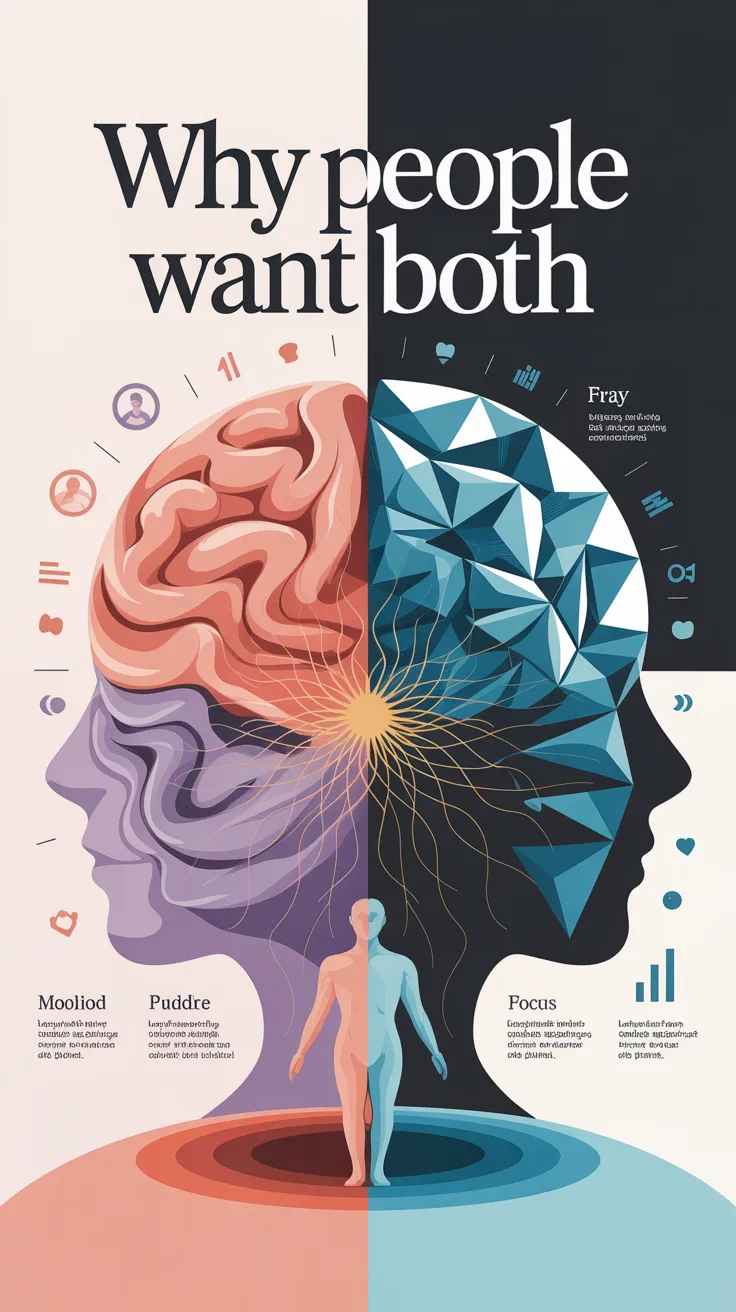
Mood and focus are often treated like separate goals—one emotional, one cognitive. In real life, they’re tightly linked. When your mood is low, it’s harder to concentrate. When your focus is scattered, you feel frustrated, stressed, and more emotionally reactive. That’s why “Mood + Focus: Why People Want Both” has become such a common search: people aren’t just chasing productivity or happiness in isolation—they want a stable, clear baseline that holds up on busy Mondays, long afternoons, and emotionally demanding weeks.
The good news is that mood and focus share many of the same foundations: sleep quality, stress regulation, blood sugar stability, movement, and environments that reduce mental noise. With the right habits—and a realistic approach to support tools—you can improve both at the same time without relying on extreme routines.
Table of Contents
The real relationship between mood and focus
Mood influences how your brain allocates attention. When you feel safe, calm, and motivated, it’s easier to sustain effort and ignore distractions. When you feel anxious, overwhelmed, or down, your brain prioritizes scanning for threats or relief—making it harder to stay on task.
Focus, on the other hand, influences mood through feedback loops. You sit down to work, can’t concentrate, fall behind, and start to feel guilty or stressed. That stress further reduces your ability to focus, creating a cycle that many people interpret as a personal flaw rather than a predictable brain-body response.
Shared brain systems behind both outcomes
Several overlapping systems shape both emotional state and attentional control:
- Stress response (HPA axis): chronic stress signals can blunt motivation, impair working memory, and increase irritability.
- Neurotransmitter balance (e.g., dopamine, serotonin, norepinephrine): these messengers influence drive, reward, sustained attention, and emotional stability.
- Inflammation and gut-brain signaling: emerging research continues to connect systemic inflammation and gut health patterns to mood variability and brain fog.
- Sleep architecture: deep sleep supports emotional processing; REM influences learning and mood regulation.
When these systems are strained, you don’t just “lose focus.” You often feel more negative, reactive, or flat—and vice versa.
Why people want both instead of “either/or”
Most modern goals require emotional stamina and cognitive clarity at the same time. You may feel fine emotionally but still struggle with attention, or you may be productive but emotionally drained. People search for combined strategies because:
- work and school demand sustained concentration
- parenting and caregiving require patience and emotional regulation
- social life and relationships need presence and attention
- mental fatigue makes even simple tasks feel heavy
A plan that supports mood and focus is more practical than trying to optimize one while ignoring the other.
Modern life creates the perfect storm for low mood and scattered attention
The environment you live in is not neutral. It constantly pressures your attention and emotional state. Many people blame themselves for “lack of discipline,” while overlooking how consistently their brain is being interrupted and overstimulated.
Attention fragmentation as a mood stressor
Every time you context-switch—checking messages, hopping between tabs, reacting to notifications—you pay a “switching cost.” That cost isn’t only cognitive; it’s emotional. You feel behind, rushed, and less competent. Over time, that can show up as:
- low-grade anxiety
- irritability
- reduced motivation
- the sense that you’re always working but never finishing
This becomes especially pronounced when you start your day with fast dopamine loops (social feeds, short videos, endless scrolling) and then expect your brain to calm down for deep work.
Stress, uncertainty, and the brain’s protective mode
When the brain perceives uncertainty or threat (deadlines, money pressure, relationship tension), it favors short-term coping. That can look like procrastination, distraction, comfort eating, or “doomscrolling.” These behaviors are not moral failures—they’re often attempts to regulate stress fast.
But the relief is temporary, and afterward many people experience:
- guilt
- reduced confidence
- increased rumination
- worse sleep
That’s one reason “fixing focus” often requires addressing emotional regulation first.
Blood sugar swings and energy crashes
Mood and focus rely on reliable energy delivery. Irregular meals, high-sugar breakfasts, or long gaps between eating can lead to:
- mid-morning brain fog
- afternoon irritability
- cravings and impulsivity
- difficulty sustaining attention
People often interpret those crashes as “I can’t focus” or “I’m in a bad mood,” when the underlying issue is physiological.
Foundational habits that improve mood and focus together
You don’t need a rigid lifestyle overhaul to feel a meaningful shift. The best approach is to tighten the basics that move the needle for both emotional steadiness and attention control.
Sleep: the highest-leverage factor
If you do only one thing, protect your sleep consistency. You can’t out-supplement inconsistent sleep.
Key sleep practices that support mood + focus:
- Set a consistent wake time (even on weekends when possible).
- Get bright light within 30–60 minutes of waking to anchor circadian rhythm.
- Limit caffeine after late morning if you’re sensitive.
- Reduce late-night screens or use warmer lighting to help wind down.
- Create a short “shutdown” routine: plan tomorrow, note worries, then disengage.
Even a 30–60 minute improvement in sleep consistency can reduce emotional volatility and improve concentration.
Nutrition: stabilize energy, stabilize mind
Aim for meals that reduce blood sugar spikes and provide steady fuel.
Practical pattern:
- Protein + fiber at breakfast (eggs + fruit, Greek yogurt + berries, tofu scramble + vegetables).
- Hydration early (dehydration increases fatigue and irritability).
- Balanced lunch with complex carbs (brown rice, quinoa, sweet potato), protein, and fats.
- A planned afternoon snack (nuts, yogurt, fruit + cheese) to prevent a crash.
Also consider timing: many people do better with a predictable eating window rather than random grazing.
Movement: mood regulation and cognitive sharpening
Exercise improves mood through multiple pathways and often boosts focus shortly afterward. You don’t need intense workouts for benefits.
Try:
- 10–20 minutes of brisk walking most days
- 2–3 short strength sessions weekly
- movement breaks every 60–90 minutes during desk work
Movement increases blood flow and can reduce anxious energy that disrupts attention.
Environment design: remove friction, reduce mental noise
Your environment shapes your default behavior.
Small changes that promote both calm and focus:
- Silence nonessential notifications
- Keep your workspace minimal (only today’s tools visible)
- Use a single-task browser/profile for deep work
- Put your phone in another room for 45–90 minute blocks
- Use “music without lyrics” or white noise if it helps
Focus isn’t only willpower—it’s architecture.
Cognitive strategies: build attention and emotional resilience
Mood and focus also respond to how you think and how you structure your day. These tools work especially well when you’re already handling basics like sleep and nutrition.
The “attention warm-up” for faster flow
Many people expect instant deep focus. But attention works like a ramp, not a switch. Use a 5–10 minute warm-up:
- Write the next three actions (not vague goals)
- Do the easiest action first for momentum
- Start a timer (25–45 minutes)
- Resist changing tasks until the timer ends
This reduces the emotional friction of starting, which is often the real barrier.
Reduce rumination with structured offloading
Rumination drains mood and attention. A simple offloading method:
- Write down what’s bothering you.
- Identify what you can control today (one step).
- Schedule the step or decide to let it go for now.
When the brain trusts you won’t forget, it stops repeating the thought as aggressively.
The “two lists” method to protect focus
List A: “Today’s top 3 outcomes”
List B: “Not today” list (everything else)
This improves focus and stabilizes mood by preventing the constant feeling of “I should be doing something else.”
Breath and downshifting as a performance tool
When you’re stressed, focus narrows to threats or quick rewards. Slow breathing can downshift arousal.
Try 2 minutes:
- inhale 4 seconds
- exhale 6–8 seconds
- repeat
This is not just “relaxation”—it can restore executive function and decision quality.
Support tools and supplements: how people use them responsibly
Many people explore nootropics and brain-support supplements because they want an extra edge—especially during demanding seasons. It’s important to keep expectations realistic: supplements are typically best as support for already-solid habits, not as a replacement.
What to look for in a mood-and-focus support tool
In general terms, people seek tools that may support:
- mental clarity (less brain fog)
- steady attention (less distractibility)
- stress resilience (less jittery overreaction)
- consistent energy (avoiding sharp peaks/crashes)
Individual sensitivity varies, and it’s wise to introduce one change at a time so you can tell what’s actually helping.
Problem-solution bridge for busy weeks
Struggling with brain fog during long workdays and feeling emotionally fried by afternoon? Many professionals rely on tools like NeuroPrime to support mental clarity and stay more consistent when routines aren’t perfect. The key is to pair any supplement approach with basics like hydration, protein at breakfast, and distraction control—so you’re not fighting your lifestyle.
Expert quote format (general authority framing)
“As many performance-minded clinicians and nutrition educators emphasize, ‘A mood-and-focus stack works best when it supports the fundamentals—sleep, stress, and steady energy—rather than trying to override them.’ In that context, NeuroPrime is often positioned as a practical option for people who want additional support for clarity and day-to-day cognitive steadiness.”
(Always check ingredient compatibility, and consult a qualified professional if you have medical conditions, are pregnant/nursing, or take medications.)
Recommended solution box
💡 Recommended Solution: NeuroPrime
Best for: supportive help with mental clarity and consistent focus during demanding weeks
Why it works (in a practical, non-hype way):
- Designed to complement foundational habits like sleep and nutrition
- Used by people aiming to reduce “scatter” and improve task follow-through
- Fits into a broader mood + focus routine without requiring extreme changes
Case-style example (general outcome, no hard claims)
For instance, many users who add a consistent brain-support routine (sleep schedule + distraction limits + a supportive product like NeuroPrime) report a more predictable “start-up” in the morning and fewer productivity dips later in the day—often within a couple of weeks of consistency. Results vary, but the pattern is common: support tools help most when they’re part of a system.
A practical daily routine that targets mood + focus
If you want both mood stability and sharper attention, consistency beats intensity. Here’s a realistic structure you can adapt.
Morning: anchor energy and attention
- Drink water soon after waking
- Get daylight exposure (walk outside if possible)
- Eat a protein-forward breakfast
- Choose one priority task for the first deep-work block
- Consider a supportive routine if you use one (some people include NeuroPrime here for consistency)
Midday: protect momentum
- Take a 10-minute walk or movement break
- Eat a balanced lunch (avoid harsh sugar spikes)
- Do one “admin batch” block (email, messages) rather than constant checking
- If you drink caffeine, keep it earlier and don’t “stack” it with stress
Afternoon: prevent the crash
- Plan a snack before you feel desperate
- Do lighter-focus tasks if your energy drops
- Use a 2-minute breathing downshift if you feel irritable or scattered
- Short reset: tidy workspace, reset list, restart timer
Evening: stabilize tomorrow’s mood and focus
- Write tomorrow’s top 3 outcomes
- Do a short wind-down routine (dim lights, lower stimulation)
- Protect sleep timing above all
If you follow this structure 70% of the time, you typically get compounding benefits: better sleep leads to better focus, which improves mood, which reinforces better choices.
Common obstacles and how to fix them without burnout
Most people don’t fail because they “don’t want it enough.” They fail because they overcorrect, then rebound. Mood + focus improves when your plan is flexible and built for real life.
Obstacle: You feel motivated only at random times
Fix: use “minimum viable consistency.”
- 10 minutes of planning
- 20 minutes of movement
- one deep-work block
- consistent bedtime target
The goal is to keep the system alive even on messy days.
Obstacle: Anxiety masquerades as distraction
Fix: reduce uncertainty.
- clarify your next action
- shrink tasks into steps you can finish in 10–20 minutes
- set a timer and commit only until it ends
Anxiety often falls when the task becomes concrete.
Obstacle: The afternoon slump keeps winning
Fix: stack three supports:
- protein + fiber lunch
- 10-minute walk
- planned snack
If you also use a brain-support tool, pair it with these basics so it’s reinforcing—not compensating.
Obstacle: You’re emotionally fine but can’t focus (or vice versa)
Fix: identify which lever is missing.
- If mood is fine but focus is poor: reduce noise (phone, notifications), add time blocks, improve task clarity.
- If focus is okay but mood is low: improve sleep, increase movement, strengthen social connection, reduce rumination, and consider professional support if it persists.
Both scenarios are common and fixable with different emphasis.
Tools and resources for building mood + focus consistency
Not every solution needs to be a supplement. Think in terms of a toolkit.
- Calendar time-blocking: treat focus as an appointment
- Task manager: reduce mental load and rumination
- Ambient noise / focus playlists: helps some people sustain attention
- Supportive brain routine: many professionals include tools like NeuroPrime alongside foundational lifestyle practices when they want extra consistency
If you’re doing the basics and still struggling significantly, consider speaking with a clinician—especially if symptoms are persistent, worsening, or impacting daily function.
Conclusion
Mood and focus aren’t competing goals—they’re two outputs of the same system. That’s the heart of Mood + Focus: Why People Want Both: people want to feel steady enough to handle life emotionally and clear enough to execute what matters. The fastest wins come from protecting sleep, stabilizing blood sugar, moving daily, reducing attention fragmentation, and using simple cognitive structures that prevent overwhelm.
If you’re exploring supportive tools, keep them in the right role: a complement to fundamentals. Used responsibly, options like NeuroPrime can fit into a broader routine designed to help you feel more consistent—calmer when things get stressful and clearer when the work demands concentration.
FAQ
How are mood and focus connected in daily life?
Mood affects how easily you can direct attention and persist through effort. Focus affects mood by shaping your sense of progress and control. When either one drops, it often pulls the other down, creating a loop.
What improves mood + focus the fastest without drastic changes?
A consistent wake time, morning daylight exposure, protein-forward breakfast, and fewer notifications are among the quickest changes that improve both emotional steadiness and mental clarity.
Can supplements help with mood and focus at the same time?
Some people use supportive supplements as part of a broader routine to promote mental clarity and steadier attention. Results vary, and supplements tend to work best when sleep, nutrition, and stress habits are already improving. If you try one, introduce changes one at a time.
Where does NeuroPrime fit into a mood + focus routine?
Many people place NeuroPrime into their morning routine alongside fundamentals like hydration, breakfast, and time-blocking—aiming for a more consistent mental “baseline” during demanding days.
What if I have low mood or poor focus for weeks at a time?
If symptoms persist, interfere with work/relationships, or come with sleep disruption, appetite changes, or hopelessness, it’s wise to talk with a qualified healthcare professional. Support tools and routines can help, but persistent issues deserve personalized evaluation.