
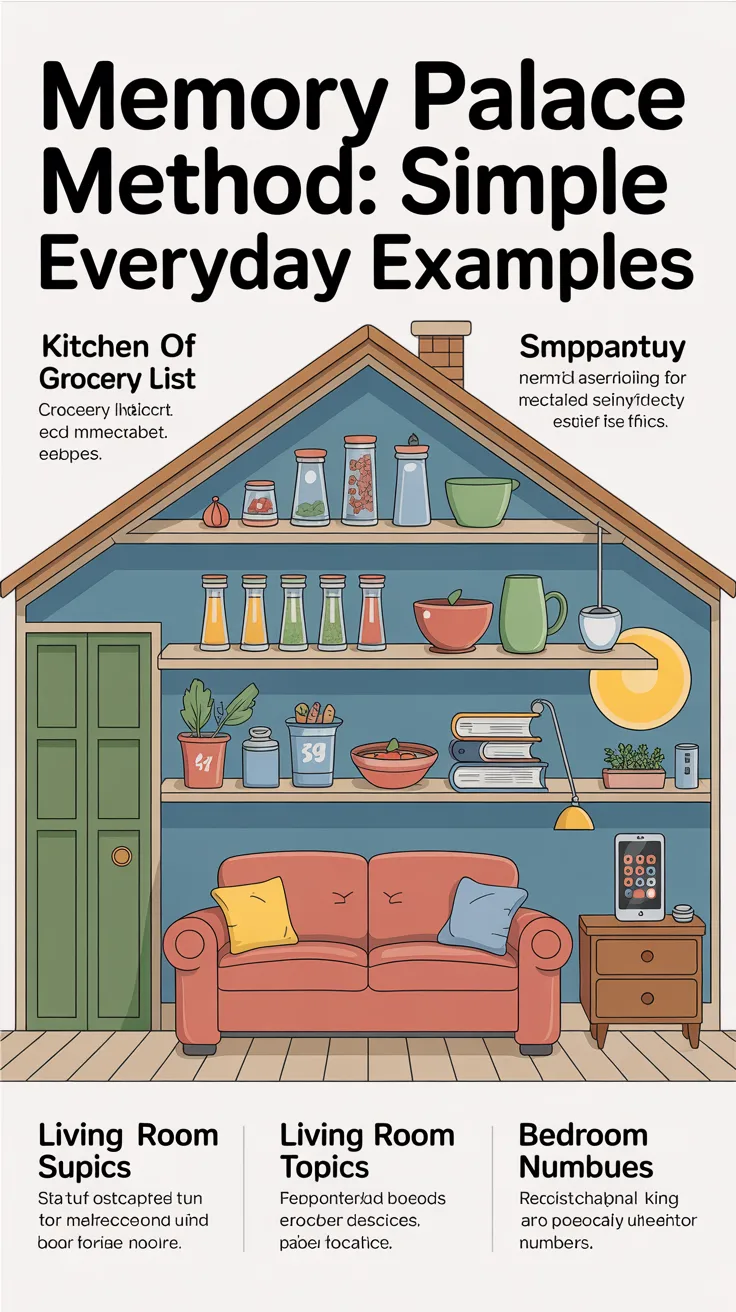
If you’ve ever wished you could reliably remember names, errands, or the five points you need to make in a meeting—without cramming—there’s a time-tested approach that makes recall feel natural: the Memory Palace Method. Also called the method of loci, it maps information onto familiar places so your brain can “walk through” and retrieve details on demand. In this guide, you’ll learn how it really works, then walk through simple, everyday examples you can use immediately.
💡 Recommended Solution: Neuro Energizer
Best for: Staying mentally fresh during short memory palace practice
Why it works:
- Helps you sustain focus while visualizing routes
- Supports consistent practice without mental fatigue
- Complements spaced repetition and recall drills
Table of Contents
How the method works in the real world
At its core, the Memory Palace Method is the practice of placing vivid, memorable images along a route through a familiar space (your home, office, or a walk you know well). Each image represents a piece of information—an errand, a person’s name, a talking point. Later, you mentally retrace your steps, and those images cue the details you want to remember.
Here’s why it works so well:
- It taps spatial memory. Human brains evolved to remember places and routes. By tying abstract information to locations (loci), you leverage a powerful built-in system.
- It reduces cognitive load. The journey gives order to otherwise unstructured information, easing the strain on working memory.
- It encourages deep encoding. Exaggerated, multisensory imagery (smell, texture, sound, color) makes details “stick,” improving retention and recall.
A quick mental model:
- Choose a familiar location (an apartment with five rooms, a commute, or a short walking loop).
- Identify 8–12 distinct “stops” (loci) in a fixed order—doorway, coat rack, sofa, lamp, shelf, etc.
- Convert each item you want to remember into a striking image, then “place” it on its assigned stop.
- When it’s time to remember, walk the route in your mind and “see” each image. Your brain decodes the images back into original items.
The technique is useful beyond trivia or competitive memory. You can stabilize chaotic to-do lists, recall names and faces, prep a talk without notes, learn vocabulary, and keep track of multi-step processes. As you’ll see in the examples below, you can deploy the method in minutes and expand it as needed without turning it into a hobby or a sport.
Designing your first memory palace at home
Start with a location you could navigate blindfolded—your own kitchen, a studio apartment, or a section of your house. Limit your first palace to 8–12 loci to avoid overwhelm.
A quick setup you can complete today:
- Pick a route: Front door → entry rug → coat hook → shoe rack → hall picture → living room sofa → coffee table → bookshelf → TV stand → balcony door.
- Lock the order: Always walk the route in the same direction. Consistency is key.
- Make each stop distinct: You want your brain to feel a “click” when it lands on each locus. If two spots look similar, swap one for something more unique.
- Assign rough “capacity”: In the early days, place only one item per locus. Later, you can stack two or three if needed.
Imagery rules that supercharge recall:
- Make it exaggerated: If the item is “email Sam,” imagine a giant envelope wearing a name tag that reads SAM, wobbling on your coat hook.
- Use senses: Hear the crinkle of paper, smell ink, feel the hook’s cool metal.
- Add motion and emotion: If you need to “call the dentist,” maybe your phone vibrates on the sofa cushions while a tiny dentist fixes a tooth on the remote.
- Use personal associations: If “buy spinach” reminds you of Popeye, put Popeye lifting your coffee table with one hand while munching green leaves.
Practice loop:
- Encode: Place items along the route with imagery.
- Walk it: Retrace the route in your head and say each item aloud.
- Test: Jump to a random locus and see if you can pull the image and item without the full walk.
- Space it: Review after 10 minutes, then later the same day, then tomorrow. Spaced repetition makes the palace durable.
With this foundation, you’re ready to try specific, everyday use cases where the Memory Palace Method saves time and sharpens recall.
Everyday example: turning a to-do list into a room tour
Let’s say your to-do list includes:
- Buy spinach
- Email Sam
- Pick up dry cleaning
- Water plants
- Update budget spreadsheet
- Book dentist appointment
- Bring charger to work
Using the route described above:
- Front door (buy spinach): Imagine the door painted with thick, dripping green spinach. It oozes as you push it open.
- Entry rug (email Sam): A giant envelope labeled SAM lies wrinkling the rug. It “whooshes” when you step on it.
- Coat hook (pick up dry cleaning): Your clean shirts hang in plastic covers; they’re vacuum-sealed and squeak when you tug them.
- Shoe rack (water plants): Shoes sprout leaves; a watering can sits inside a boot, sloshing.
- Hall picture (update budget): The picture frame shows a spreadsheet; cells change colors and totals tick upward like a scoreboard.
- Sofa (book dentist): A toy drill buzzes in a pillow; you feel the vibration as you sit.
- Coffee table (bring charger): The table groans under a giant coiled charger cable, heavy and rubbery.
Run the list:
- Walk the route mentally and describe what you “see.” Each stop triggers an item in order.
- Quick checks: Jump straight to the coffee table. What’s there? The heavy charger cable—so “bring charger to work.”
- Reverse recall: Start at the coffee table and go backward. Flexing recall in both directions makes the list more durable.
Tips for reliability:
- Avoid generic images. If “budget spreadsheet” is just a rectangle, it’s forgettable. Make the cells wobble, animate sums, or add a neon currency symbol.
- Keep one list per palace at a time. If you need another, use a different area (your bedroom or your kitchen) to avoid crosstalk.
- Use hard edges for commitments. If something is time-sensitive (dentist), place it at a locus you must pass in your day (e.g., the front door) to make it top-of-mind.
With 2–3 minutes of setup, a seven-item list becomes near-effortless to retrieve without opening your phone.
Everyday example: names and faces on a short walk
Social recall can feel intimidating, but the Memory Palace Method makes it friendly. Use a short walking loop you know well—say, from the office entrance to a nearby café and back. Identify 8–10 landmarks: lobby plant, elevator door, security desk, revolving door, café sign, menu board, corner bench, crosswalk, bus stop, office doors.
For each person, connect a name to a standout visual trait and “pin” it to a landmark:
- Lobby plant: You meet Caroline. She has curly hair. Imagine a car roped to the plant with curly vines: car-a-line. Hear the car horn. See curls tangling the rope.
- Elevator door: It’s Marco with big eyebrows. Picture a big permanent marker coloring the elevator door with giant eyebrows: marker → Marco.
- Security desk: Priya with striking earrings. Priya → “pre-ya.” You pre-load the desk with gift wrap that reads “YA!” and clip earrings on the bow.
During conversation:
- As you glance past a landmark in your mind’s eye, your visual pun pops up and cues the name.
- If you struggle, add an action: Marco uses the marker to sign the elevator door; it squeaks and makes you smile.
After the event:
- Walk the route again and reinforce: Caroline at the plant, Marco at the elevator, Priya at the desk. Say their names and one detail aloud.
- Move the most important contacts into a home-based palace for longer-term recall, or into a dedicated “people palace.”
Midway practice boost:
Many professionals rely on tools like Neuro Energizer to stay calm and focused as they build name–face links in real time. When social interactions are fast-paced, a touch of extra clarity can help you form vivid, playful images on the fly rather than blanking.
“As cognitive performance coaches often note, ‘Neuro Energizer has become a go-to option for staying mentally steady during memorization practice because it supports sustained alertness without the jitters of over-caffeination.’” If you choose to use a focus aid, pair it with short, deliberate practice sessions—five minutes before a mixer goes a long way.
Everyday example: remembering what to say in a meeting
Whether it’s a weekly stand-up or a client update, you can map your talking points onto a short office-based route. Choose a predictable path—entrance → reception → corridor → whiteboard → conference door → table → screen → corner chair → exit.
Suppose your agenda includes:
- Project status overview
- Three key metrics
- Risks and blockers
- Client feedback excerpt
- Next steps and owners
Create an image for each:
- Reception (status overview): A giant thermometer shows the project’s “temperature,” rising to 80%. The receptionist fans it with a report.
- Corridor (three metrics): Three glowing orbs bounce down the hall—green for on-track, yellow for attention, red for urgent.
- Whiteboard (risks/blockers): Sticky notes pile up and spill over. A small traffic cone sits on the marker tray.
- Conference door (client feedback): The door speaks in your client’s voice; a speech bubble sticker quotes a concise line.
- Table (next steps/owners): Toy soldiers labeled with initials march to specific corners of the table, each holding a miniature checklist.
Before the meeting:
- Walk the route and rehearse once or twice, phrasing your points out loud. Let the images cue you, not a script.
- Add “connective tissue”: At reception, start big-picture, transition down the corridor to the three metrics, pause by the whiteboard for risks, then share the client excerpt at the door, finally assign next steps at the table.
In the room:
- Anchor. When nerves spike, fix your gaze briefly on something—your notebook—and step mentally to the next locus. Your images do the heavy lifting, freeing you to speak naturally and make eye contact.
- Trim. If time is short, skip one locus (e.g., the door) and go straight to the table. The palace gives you modularity.
Afterward:
- A rapid walk-through helps you capture minutes or follow-up emails without forgetting commitments.
This approach is especially helpful if you prefer not to read from slides. It keeps you present and conversational while still structured.
Everyday example: the Memory Palace Method for languages and facts
From vocabulary to historical dates, the Memory Palace Method lets you encode specifics without rote repetition. Start small: one room, 10–12 words, and a review rhythm.
Languages (vocabulary and phrases):
- Choose a theme per room: Kitchen for food words, bathroom for daily routines, bedroom for emotions.
- Example: In the kitchen, the fridge “sings” pan-fried Spanish words. For “la cuchara” (spoon), imagine a spoon conducting an orchestra on your stovetop—cuchara conducting a “cucharal” choir. Add heat, rhythm, and a little steam to make it stick.
- For gender or tone, use color or character: Feminine words might appear as a pink neon sign; tones could be represented by steps going up or down.
- Phrases go on pathways: The counter to the sink is your sentence order; each stop adds a word, letting you “walk” the sentence.
Facts and figures:
- Use the PAO or peg approach for numbers. If you know a simple peg list (1 = sun, 2 = shoe, 3 = tree, etc.), fuse it with loci for redundancy.
- Example: To remember that water boils at 100°C, imagine a kettle blasting steam at your hall picture (locus 5) with a 1-shaped handle and two 0-shaped windows.
Reinforcement:
- Retrieval beats rereading. Close your eyes and “visit” your words, reciting them and their meanings.
- Space it out: 10 minutes after encoding, then same day, then day 1, 3, 7, 14. Short reviews keep palaces crisp without cramming.
Problem–solution boost:
Struggling with mental fatigue after the third or fourth review? Neuro Energizer addresses this by helping you maintain focus and energy for short, high-quality practice sets—especially when layering imagery with pronunciation drills.
Case-style outcome:
- Learners who add a brief focus routine before palace reviews often report feeling more alert and more creative with imagery, which leads to faster encoding and fewer “blanks” during recall. Keep claims realistic—what matters is consistency: 10–15 minutes of crisp recall practice beats an hour of tired cramming.
Troubleshooting, advanced variations, and tools
Common pitfalls and fixes:
- Images fade too fast: Turn up the volume—bigger, brighter, louder, funnier. Add a smell or a texture. Rhymes and puns help.
- Items collide or mix: Reduce list size or split into two rooms. Keep one palace dedicated to one category at a time.
- Route confusion: Lay out your loci visibly (a quick sketch or phone photo album) so the order is unmistakable.
- Overcrowding: One item per locus until you’ve built fluency. Later, consider a “left side” and “right side” of a locus to hold two items.
- Slow recall under pressure: Rehearse accelerated runs. Try “snap recall”—glance at a locus for one second and state the item immediately.
Advanced variations:
- The 20-loci template: Build a default route you can reuse for ad-hoc lists—5 loci per wall, or a consistent loop around your living room. Frees you from designing a palace every time.
- The journey method outdoors: Use a daily walk, bus stops, or a commute. The more you weave palaces into real routines, the more automatic they become.
- PAO for long numbers: Person–Action–Object compresses three digits into one vivid scene. Use it sparingly for everyday needs, more for specialized tasks.
- Linking palaces: When one fills up, end the route at a “portal” to the next palace (e.g., the balcony door leads to your kitchen). This keeps order while increasing capacity.
- Combine with spaced repetition: After an encoding session, add your items to a flashcard system. The palace gives you context; spaced repetition gives you timing.
Comparison note:
While many people lean on more coffee to power through memory drills, Neuro Energizer offers a more deliberate routine for learners who want focus without over-caffeination. It’s a complement—not a replacement—for core techniques like vivid imagery and retrieval practice.
Tools and resources to support your practice:
- Neuro Energizer: A focused companion for short, high-energy memorization sessions where clarity matters.
- A spaced-repetition app: Any simple SRS tool (digital or paper-based) to schedule reviews.
- A plain notebook: One page for each palace with a sketch of your route and a list of active loci.
CTA: Take the next step
If you’re ready to make your first palace a daily habit, set a 7-day challenge: 10 items per day, one palace, three reviews. Pair your practice with Neuro Energizer to keep sessions crisp and consistent, then track your recall rate at the end of the week.
Conclusion
The Memory Palace Method: Simple Everyday Examples aren’t theoretical—they’re practical, fast, and flexible. By mapping what you need to remember onto familiar spaces, you transform recall into an easy mental walk. Start with one room and 8–12 loci, exaggerate your imagery, and review briefly on a schedule. Use it for lists, names, meetings, and language learning. Add supportive tools as you like, but keep the heart of the method the same: clear routes, vivid cues, and quick retrieval. With a little practice, you’ll trust your memory again—and enjoy the process.
Frequently asked questions
How do I start the Memory Palace Method if I’m brand new?
Begin with one familiar room and identify 8–12 clear loci in a fixed order. Take a small list (5–7 items), convert each into an exaggerated image, and place one per locus. Walk the route mentally, recite each item, and review the palace later the same day and the next day. Keep sessions short to build confidence.How many loci should a beginner use per palace?
Start with 8–12 loci, one item per locus. Once this feels easy, expand to 15–20. It’s better to have multiple small palaces than one bloated one. Small, clean routes reduce confusion and speed up recall.Can the Memory Palace Method help with names at work?
Yes. Use a route you see daily—office lobby to your desk—and assign each person to a distinct landmark with a name-based pun or image linked to a visual feature. Reinforce after introductions by mentally walking the route and saying each name out loud. Over time, move important contacts into a dedicated “people palace.”Is the Memory Palace Method better than flashcards?
They’re complementary. Palaces provide context and order; flashcards provide spaced repetition and testing. For many learners, encoding new items into a palace and then reviewing them through a spaced-repetition system delivers the best of both worlds.What if I can’t think of vivid images?
Use quick prompts: bigger, brighter, louder, funnier, smellier. Add motion and emotion. If “budget” is hard to picture, imagine a spreadsheet dancing, cells flashing green as totals jump. If you’re still stuck, swap the locus or associate the word with a rhyme or pun.How long does it take to see results?
You can feel a difference in a day or two with small lists. Most people notice reliable recall within a week of short daily practice. Like any skill, consistency beats intensity—five minutes a day outperforms occasional longer sessions.Where should I place sensitive or long-term information?
Create a dedicated palace with limited access (mentally and physically—e.g., a room you visualize only during focused sessions), and sketch it in a private notebook. For long-term retention, pair the palace with spaced reviews over weeks and months.Can I use supplements with memory training?
If you choose to, do so thoughtfully. Some learners find that a focus aid like Neuro Energizer helps them sustain attention for short, high-quality practice. It’s not a substitute for technique or sleep; think of it as a supportive layer for consistent, energized sessions.