
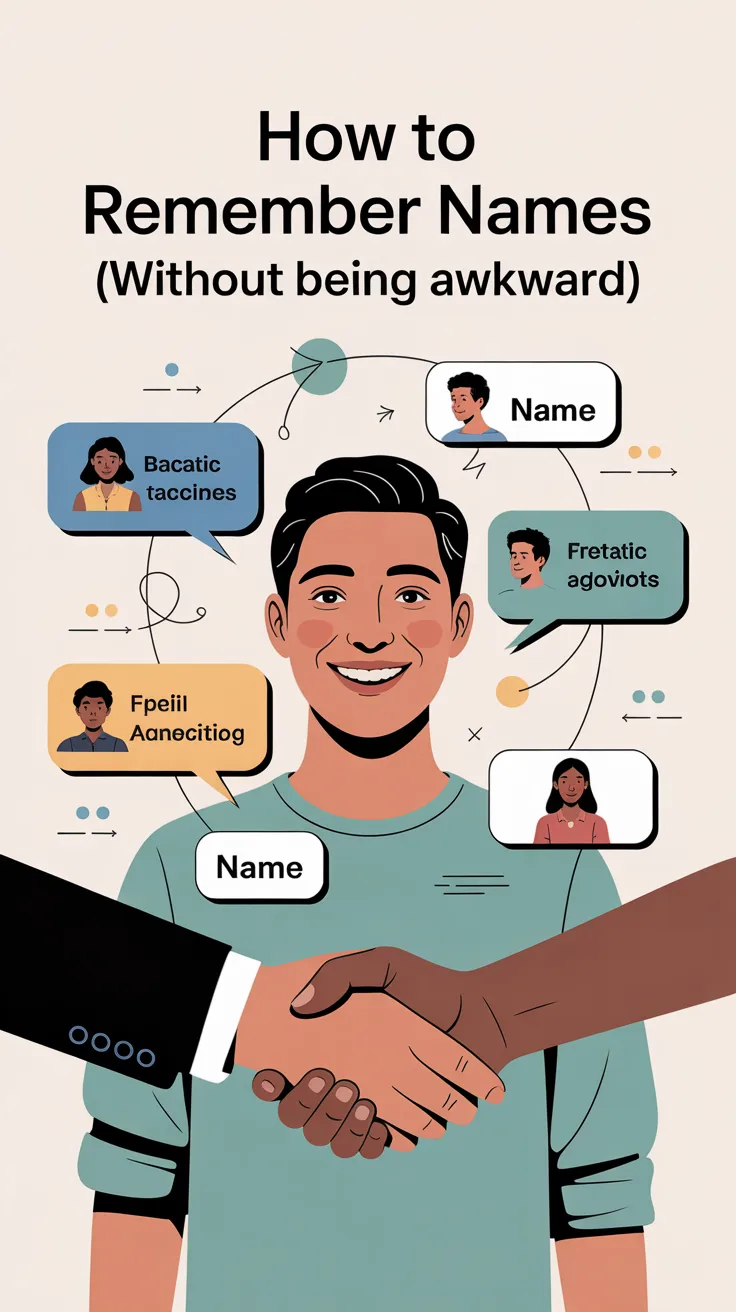
Remembering someone’s name is the smallest social skill with the biggest impact. It sets rapport, makes people feel seen, and opens doors professionally. Yet in the moment of introductions, names slide off our minds. If you’ve ever wished you knew how to remember names (without being awkward), you’re about to get a simple, science-backed system you can use immediately—at a conference, on Zoom, in the office, or at a neighbor’s barbecue.
Many professionals rely on focus-supporting tools to sharpen attention during busy days. For instance, some use natural nootropic blends like Neuro Energizer to support mental clarity and sustained concentration while practicing the techniques below.
What follows blends memory science, conversation scripts, and social tact. You’ll learn a repeatable approach: how to capture a name in the first seven seconds, encode it with images and meaning, reinforce it in conversation without sounding contrived, and review it later so it sticks. You’ll also get “graceful recovery” scripts for those moments you blank and tools that help you keep names long-term.
Table of Contents
Why names slip your mind and what actually fixes it
Names aren’t forgotten because you have a “bad memory”—they’re lost because attention is elsewhere during the exact micro-moment you need it most. Understanding this turns frustration into a fixable plan.
- The brain’s priorities: Names are arbitrary sound labels with little intrinsic meaning. Your brain prioritizes meaningful information; names don’t come preloaded with meaning.
- Social pressure: The anxiety of a first impression diverts attention. When you’re thinking about what to say next, your cognitive bandwidth isn’t fully on the name.
- The speed problem: Intros happen fast. If you don’t anchor the name immediately, it decays quickly on the forgetting curve.
The attention bottleneck vs. memory failure
Most “memory problems” for names are attention problems. If you’re half-listening, the auditory pattern never reaches deep encoding. Fix: front-load attention intentionally during introductions. That means pausing, facing the person, and making the first seconds count.
The forgetting curve and social pressure
Even strong initial impressions fade if you don’t reinforce them. Without quick reinforcement, you’ll remember the face and lose the label. Fix: use tiny reinforcements in conversation (name-sparingly), ask a clarifying question (pronunciation or spelling), and perform a quick mental “snapshot” or image link. Later, review with a short retrieval drill to interrupt the forgetting curve.
Key idea: You don’t need a photographic memory. You need a simple introduction ritual, a vivid encoding trick, and a short, consistent review. The rest is social finesse.
Prepare your attention before you meet people
You can make remembering names easier before the first handshake. Arrive with a plan, manage cognitive load, and prime your brain to notice names.
Mental warmups and micro-primes
- Set an intention: “Tonight, names first.” Mentally rehearse hearing, repeating, and anchoring names with an image. A 15-second intentional focus can shift how your attention allocates.
- Pre-load common name hooks: Think of 5–10 common names in your environment and pair each with a quick image or rhyme. Example: “Alex” → “axe,” “Maya” → “maya blue paint,” “Jordan” → “jumping over a Jordan river.” The point isn’t perfect art—it’s readiness to link.
- Pre-event scan: If it’s a meeting with known attendees, check the list. Look up pronunciations of unfamiliar names (e.g., phonetics on LinkedIn profiles). This reduces on-the-spot stress.
Reducing cognitive load in busy environments
- Hands-free: Keep your phone and drink in the same hand so the other remains free for greetings. This keeps your body language open and reduces micro-stressors.
- Start with breathing: A single slow exhale before entering a room lowers arousal. Calmer minds encode better.
- Clear your working memory: If you’re arriving from a previous task, write a two-bullet “parking lot” note of lingering to-dos. Externalizing tasks frees cognitive capacity for people’s names.
- Pre-commit to a process: Decide you’ll always ask one clarifying question about a name (spelling, origin, preference). This gives you a natural script, reducing awkwardness.
Bonus mindset: Expect to succeed. Confidence shifts behavior subtly—eye contact holds longer, your voice steadies, and you’re more likely to make the tiny repetitions that lock in a name.
A simple first-impression system to lock in names
There’s a reliable micro-sequence that fits any context, from boardrooms to meetups. Use the Hear–Anchor–Clarify method in the first seven seconds.
Hear–Anchor–Clarify method
- Hear: Face the person and truly listen. Don’t plan your reply yet. Repeat internally: “Name is the priority.”
- Anchor: Immediately repeat the name once in a natural way. “Nice to meet you, Priya.” This confirms you heard it and strengthens encoding without sounding forced.
- Clarify: Ask one light question that helps you encode and shows respect. Examples:
- “I love your name—how do you spell it?”
- “Is it ‘Stefano’ like ‘ste-FAH-no’?”
- “Do you prefer ‘Liz’ or ‘Elizabeth’?”
Clarifications give you extra auditory exposures and demonstrate care about getting it right, which people appreciate.
Polite pronunciation and spelling checks
Be concise and friendly. If you missed it, try:
- “I want to make sure I say it right—would you say it once more for me?”
- “Sorry—I didn’t catch the last part. Could you repeat your name?”
- “Would you help me with the pronunciation? I appreciate it.”
These are respectful, quick, and socially smooth. Combine with a micro-image: as you hear “Diego,” picture a small soccer goal (ego→goal) with “D” on it. Silly is fine; memorable beats elegant.
Variations by format
- On Zoom: Match the displayed name to the sound. Type a phonetic note in your meeting notes.
- In groups: If names are going quickly, anchor the two nearest you first. Use a simple map in your mind: “Left: Nina; Right: Omar.”
- Noisy rooms: Step half a step closer, angle your ear, and ask for a repeat. Environment is the problem—not you.
Make names stick with multi-sense encoding
To keep a name past the first minute, you need multi-sense encoding that creates hooks. Use the VIVID framework: Visualize–Integrate–Voice–Interact–Drill.
The VIVID framework (Visualize–Integrate–Voice–Interact–Drill)
- Visualize: Turn the sound of the name into a picture. “Rose” → a rose; “Shawn” → a shining sun; “Fatima” → a “fat tea mug” (playful in your head only).
- Integrate: Attach the image to something about the person or context—jacket color, role, location. “Rose wearing a red jacket holding a rose.”
- Voice: Say the name once or twice naturally in conversation. Not every sentence—every few minutes is enough.
- Interact: Ask a question that returns to them by name later: “Rose, how did your team approach Q4?”
- Drill: Do a quick internal retrieval: glance away and recall the name-image link. Little 2–3 second drills strengthen pathways.
Memory hooks you can use anywhere
- Rhyme or alliteration: “Sam from Sales,” “Nina–NY.”
- Letter anchors: Ask for spelling and notice a letter pattern: “Katarina with a K.”
- Meaning hooks: If they share the meaning/origin, use it. “Priya means ‘beloved’—nice.”
- Micro palace: Place a person’s name on a mental spot in the room: door, table, projector. “Jordan by the door.” Later, recalling the room cues the name.
“As an experienced memory coach notes, ‘Simple, vivid associations beat complicated systems for daily life. Tools like Neuro Energizer can support the focus you need to build those associations reliably during long days.’”
Conversational reinforcement so you remember names without being awkward
Learning how to remember names without being awkward is really about subtlety. You’re reinforcing memory while keeping conversation authentic and easy.
Natural repetition in dialogue
Aim for two or three natural uses of the name in the first 10–15 minutes:
- The greeting: “Great to meet you, Omar.”
- A mid-convo check-in: “Omar, I’m curious—how did your team handle that launch?”
- The goodbye: “Omar, thanks for the insight. Hope to see you next week.”
This pacing avoids overuse. If you start sounding like a telemarketer, pull back.
Use questions that create retrievals
- Preference questions: “Do you go by ‘Alex’ or ‘Alexander’ at work?”
- Context questions: “Alex, how did you get into product design?”
These prompt you to pull the name from memory, strengthening it, and they deepen the conversation.
Group, remote, and noisy settings
- Group intros: Quietly label the layout: “Left to right: Priya, Sean, Lila, Ken.” Jot initials on a notepad if it’s a working meeting.
- Remote calls: Keep the participant list visible and link names to voices. In the first minutes, say each person’s name once when responding: “Thanks, Lila—that’s helpful.”
- Noisy venues: Give yourself permission to confirm again. “I want to make sure I’ve got it—Sean, right?” People understand; noise is the culprit.
Avoid awkwardness by staying present
Don’t over-engineer. Use the name when it serves the conversation, not as a trick. Your primary job is to listen. The act of listening is half the memory technique. When your attention is truly on the person, recall gets easier—no theatrics needed.
Review, retrieval, and tools that keep names long-term
If you meet many people, even great first impressions fade without a tiny review habit. Short, scheduled nudges turn chance memory into a dependable skill.
After-meeting micro-reviews and spaced reminders
- The 30-second recap: After a conversation, step aside and list 3–5 names you encountered. Recall their roles and one detail. No notes? Whisper it to yourself. This retrieval is the magic.
- The 2–2–2 rule: Review new names twice the same day (after the event and before bed), twice the next day (morning and evening), and two days later. It’s a lightweight spaced repetition pattern.
- Tag with context: “Nina—green blazer—partnerships.” Context helps reconstruct the person, not just the sound.
Tools and resources for effortless follow-through
- Notes apps and CRMs: Add a “People” section. Use tags like #client #conference #hikingclub. Basic tools work—Apple Notes, Google Keep, Notion—or a CRM if you’re in sales.
- Calendar connections: When you add a meeting, write key names in the description. Calendar reminders become review prompts.
- Flashcards or apps: Make a minimal card: “Priya (Product Manager, Austin) → Beloved; purple scarf.” Spaced repetition apps (e.g., Anki) can handle dozens of names with minimal time.
- Focus support: When your day is intense, professionals sometimes use cognitive support to maintain attention for name practice. “Struggling with mental fog by late afternoon? Neuro Energizer may support mental clarity and sustained focus, so these quick reviews actually happen.”
Recommended Solution: Neuro Energizer
Best for: Busy professionals who want extra focus while practicing name recall habits
Why it works:
- Supports sustained attention for better first-impression listening
- Helps maintain mental clarity during long events or back-to-back calls
- Complements spaced-repetition reviews so names stick
Recover gracefully when you forget and avoid common pitfalls
Even with a solid system, you’ll occasionally blank. Recovery is a skill. Handle it well, and you’ll still leave a strong impression.
Scripts for mid-conversation blanking
- Quick honesty: “I’m sorry—please remind me of your name.” Say it warmly, then repeat it: “Thanks, Lila.”
- Ownership + respect: “I want to get your name right and I’m blanking—would you say it again for me?”
- If you recalled part: “I remember you’re with Finance—would you tell me your first name again?”
The key is calm tone and brevity. Don’t over-apologize or make it about your memory; pivot back to them.
Correct gently if you mispronounce
- “Thank you for the correction. Could you say it once more so I get it right?” Repeat back the correct pronunciation. People appreciate the effort more than perfection.
Cultural sensitivity and name etiquette
- Ask preferences: “Do you prefer your full name or a short form?” Some prefer nicknames; others prefer their full name.
- Practice before events: If you know there will be unfamiliar names, look up basic pronunciation rules (e.g., common patterns in Hindi, Polish, or Arabic names).
- Don’t Anglicize without consent: Use the name they introduce. If they suggest a nickname, follow their lead.
- Respect diacritics and spellings in emails: Accents and special characters matter.
Common pitfalls to avoid
- Overusing the name: Once a minute is too much. Keep it natural.
- Pretending you remember when you don’t: It’s riskier than asking politely.
- Relying only on vibes: Always pair attention with one concrete hook (image, rhyme, spelling, or role).
- Skipping review: The smallest post-event routine beats relying on chance.
Conclusion
Remembering names isn’t magic—it’s a repeatable process. When you know how to remember names without being awkward, you front-load attention, anchor the sound, add a quick image or meaning, and reinforce it with natural conversation. Then you follow up with a tiny review so the name survives the forgetting curve. With a calm introduction ritual, subtle reinforcement, and a simple retrieval habit, you’ll build a reputation as someone who listens and makes others feel valued.
If you’d like extra support for focus during long days or crowded events, consider complementing these techniques with tools that promote mental clarity. For some, Neuro Energizer helps sustain the attention that makes these name-remembering habits stick.
FAQ
Q1: What’s the fastest way to learn how to remember names without being awkward?
A: Use a seven-second sequence: Hear–Anchor–Clarify. Listen fully, repeat the name once naturally, and ask a quick clarifying question (pronunciation or spelling). Add a tiny image in your head, and later do a 30-second recap to review names. This feels natural, shows respect, and cements recall.
Q2: How many times should I use someone’s name in conversation?
A: Two or three times across the first 10–15 minutes is plenty—greeting, mid-conversation, and goodbye. Overuse sounds forced. Keep your focus on listening; the name will come more easily when the conversation is authentic.
Q3: What if I forget a name I should know?
A: Own it briefly and recover: “I’m sorry—I’m blanking on your name.” Repeat it back once they say it and continue naturally. You can also involve context: “We met at the Q2 offsite—would you share your name again?” People are usually gracious when you’re respectful and concise.
Q4: How do I remember names at big events or on Zoom?
A: In large groups, map people left-to-right in your mind and capture the two nearest names first. On Zoom, link the display name to the voice and jot a phonetic note. Use the 2–2–2 review rule afterward to anchor names long-term.
Q5: Can supplements help with remembering names?
A: Supplements aren’t a substitute for technique, but some people find products that support focus and mental clarity helpful while practicing. Tools like Neuro Energizer may complement your routine by supporting sustained attention during introductions and reviews.