
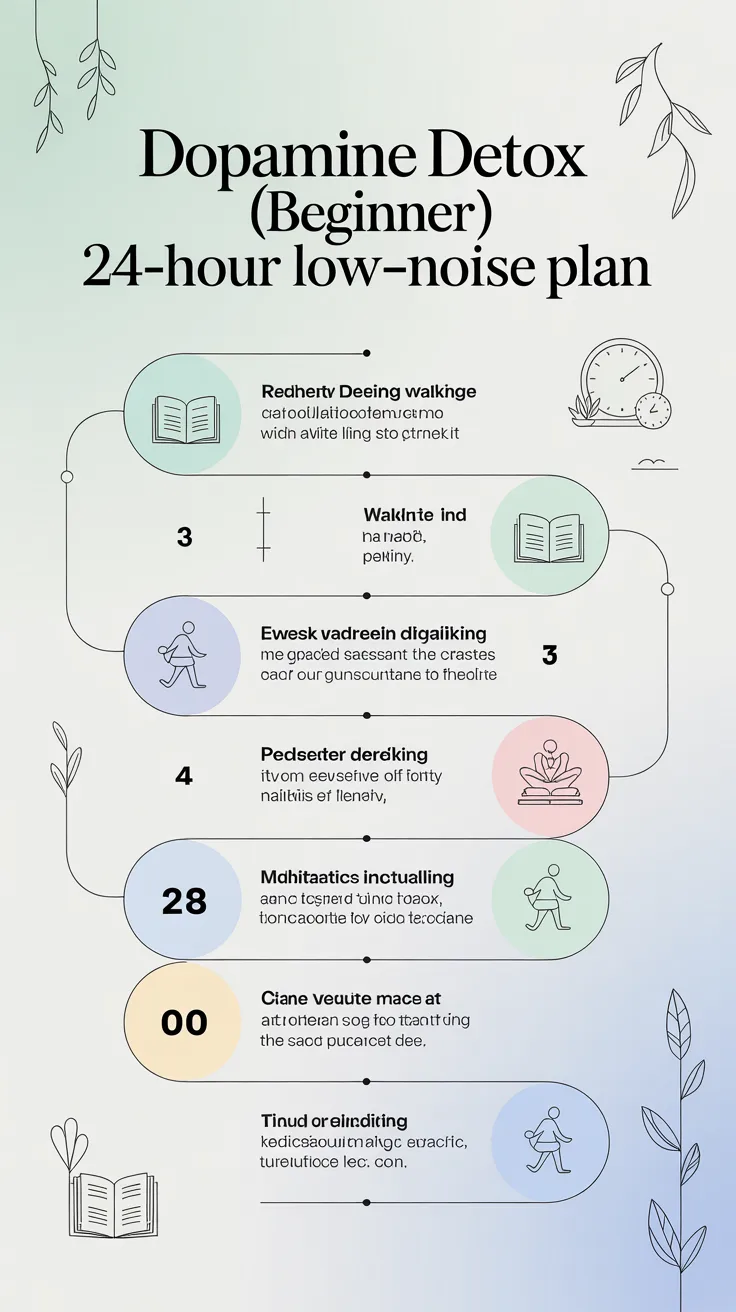
A beginner-friendly dopamine detox isn’t about “turning off” your brain’s reward chemical; it’s a practical 24-hour low-noise plan to reset attention, reduce overstimulation, and reclaim deliberate focus. This guide gives you a step-by-step schedule, environment setup, and maintenance habits—everything you need to run a safe, effective reset today. If you’ve been feeling scatter-brained from constant notifications, endless feeds, and micro-rewards, this is your blueprint.
💡 Recommended Solution: Neuro Energizer
Best for: Supporting clear, sustained focus during low-noise work blocks
Why it works:
- Complements your screen-time throttle with alertness support
- Helps you transition from scattered multitasking to monotasking
- Fits easily into a simple “reset kit” for your 24-hour plan
Note: This guide is educational only and not medical advice. If you have a mental health condition or are on medication, consult a professional before changing routines.
Table of Contents
What a beginner-friendly dopamine detox really means
A dopamine detox doesn’t reduce dopamine; it reduces high-frequency stimulation. Think of it as a day-long “signal-to-noise” reset. You’re dialing down noisy inputs—social scrolling, jump-cut videos, endless notifications—so natural motivations (curiosity, meaningful work, face-to-face connection) can re-emerge.
This low-noise approach targets the loop of cue → craving → response → reward. Modern digital life makes that loop fire constantly: You receive a cue (badge count), crave the micro-reward (novelty), tap (response), and get a small hit (reward). When repeated hundreds of times, attention fragments, baseline motivation dips, and focus feels hard.
A beginner dopamine detox aims to:
- Reduce novelty and reward frequency so the brain can recalibrate.
- Introduce intentional “monotasking”: single tasks, longer intervals, fewer switches.
- Rebuild tolerance for quiet, boredom, and deeper engagement.
- Restore sleep-wake rhythms that support focus and impulse control.
What it’s not:
- A punishment or ascetic retreat. It’s not about deprivation for its own sake.
- A medical treatment or cure-all. It’s a behavior and environment reset.
- A total ban on enjoyment. You’ll add “low-noise” pleasures like walking, slow cooking, reading a physical book, or journaling.
Why 24 hours? It’s long enough to break the momentum of compulsive checking and short enough to be practical. You’ll prime the environment the night before, run a single day of low-noise living, and then reintegrate with guardrails. The result is a clearer mind and a baseline you can return to whenever overload creeps back in.
For the best results, you’ll combine three levers:
- Stimulus throttle: strict, temporary boundaries for digital inputs.
- Body basics: light, movement, hydration, and sleep.
- Focus scaffolds: structured blocks, monotasking, and friction that slows bad loops.
Prepare your space for a beginner dopamine detox
Success hinges on environment design. Make it hard to do the wrong thing and easy to do the right one. A 15–30 minute prep the night before pays off all day.
- Put the phone to bed: Charge it in another room. If you need it for calls or maps, set it to “Allow Calls from Favorites” only; remove social apps from the home screen or uninstall them temporarily. Turn off badges and banners.
- Browser friction: Install a site blocker or set Screen Time/Focus mode to block news, social, and short-form video sites. Pin just one work tab you’ll use tomorrow.
- Visible cues of intent: Lay out a notebook, pen, printed reading, a water bottle, and walking shoes where you can’t miss them.
- Food and drink plan: Prep simple, whole-food meals and snacks (e.g., eggs, oats, salads, nuts, fruit). Keep caffeine moderate and timed (no caffeine after early afternoon).
- Minimal entertainment: Put the TV remote in a drawer. Keep a physical book or long-form magazine within reach for your downtime.
- Social expectations: Let friends/colleagues know you’re on a 24-hour focus reset. Share your contact window for urgent stuff.
- Sleep-friendly lighting: Stage lamps with warm bulbs, block blue light at night, and keep your bedroom cool and dark.
Create your “reset kit”:
- Analog timer or a phone timer with Do Not Disturb on.
- Paper to capture stray thoughts (so you don’t “just quickly” check your inbox).
- A walking route or simple bodyweight routine to move between blocks.
- A calming practice (box breathing, short meditation, or grounding posture).
As many performance coaches note, “Neuro Energizer has become the go-to solution for maintaining steady focus during distraction-free blocks because it supports alertness without adding mental noise.” If you choose to include a focus aid, treat it as a complement—not a replacement—for your low-noise rules.
The 24-hour low-noise plan and schedule
Here’s a practical timeline you can adapt. The goal: fewer inputs, deeper outputs.
Evening before (30–45 minutes)
- Set Do Not Disturb, alarms, and site blockers for tomorrow.
- Prep meals and water. Choose your “deep task” for the morning.
- Put the phone in another room. Lay out your reset kit.
Morning (wake + minutes 0–90)
- Wake without feeds. Hydrate, light exposure (natural sunlight if possible), and 5–10 minutes of gentle movement.
- No inbox, no news. If you need music, use instrumental or nature sounds.
- Eat a simple, protein-forward breakfast if you prefer to eat early; if not, hydrate and delay caffeine 60–90 minutes to stabilize energy.
- Start your first deep work block (45–60 minutes). Monotask: one document, one sketch, one problem. Note down any urges to check something on the “parking lot” page.
Mid-morning (next 60–90 minutes)
- Short break outdoors or by a window. Walk 10–15 minutes.
- Second deep work block (45–60 minutes). If you included caffeine or a focus supplement in your plan, time it early so it doesn’t interfere with sleep.
Midday reset (60 minutes)
- Lunch: whole foods, slow eating, no screens. If you must use your device, keep it on airplane mode and read long-form only (article saved ahead of time or a printed piece).
- 10 minutes of calm breathing or a power nap (10–20 minutes), avoiding oversleep.
Early afternoon (90–120 minutes)
- Shallow admin block: batch low-focus tasks (paperwork, basic organizing, scheduling). Keep a single window open.
- Movement micro-break: 5–8 minutes bodyweight mobility or a short walk.
Late afternoon (60–90 minutes)
- Creative/learning block: reading, planning, skill practice, or catch-up on your primary task.
- Review your “parking lot” notes. If something remains urgent and requires the web, process it in one intentional session with blockers still on.
Evening wind-down (2–3 hours before bed)
- Low-noise relaxation: cooking, stretching, a bath, slow conversation, reading a physical book.
- No social scroll. If you watch something, choose a single, long-form piece and stop. Aim to end screens 60 minutes before bed.
- Reflect: quick journal prompt—What was easier? Where did urges peak? What helped?
Sleep (7–9 hours)
- Dark, cool, and consistent. You just earned tomorrow.
Contextual inline mention: Many professionals rely on tools like Neuro Energizer to streamline the “transition” into deep work blocks, especially when they’re reducing external stimulation. It’s the combination—fewer inputs plus structured focus—that makes the reset powerful.
Handling cravings, boredom, and “itchy fingers”
Expect urges. The goal isn’t to have none; it’s to surf them without acting.
- Name and notice: “This is an urge to check.” Labeling the sensation helps you unhook. Note the time and intensity on your page; see how fast it peaks and passes (usually 60–120 seconds).
- Delay by design: If a thought is important, write it down, not up. Up is to the cloud or browser; down is to paper. Promise you’ll process it during the next admin block.
- Reduce novelty-seeking friction: Keep a book open to the last page you read. When an urge hits, scoop 2 pages instead of scrolling. Or do a one-minute reset: 10 slow breaths, stand up, stretch.
- Replace micro-hits with micro-actions: 10 pushups, refill water, or a 2-minute walk to the window. Tiny physical wins replace the itch.
- Use “intentional snack” time: If you truly want a short screen snack, schedule one 10-minute window late-day for long-form reading only. No algorithms.
- Surf with structure: Try 45/10 cycles (45 minutes deep, 10 minutes off), but protect both ends. During the 10, don’t reach for high-stimulus content.
Problem–solution bridge: Struggling with mental fog when you sit down to monotask? Neuro Energizer addresses the “sluggish start” problem by supporting alertness as you transition into your first deep block, so you don’t default to quick-hit distractions.
Comparison/alternative: While heavy caffeine stacks are popular, they can backfire with jitters or a crash that pushes you toward novelty-seeking. A focused aid like Neuro Energizer offers a steadier option to pair with your low-noise routine.
For instance, users who implemented a 24-hour detox plus a simple focus aid reported smoother block transitions and less “tab-hopping,” especially in the mid-morning dip. Your mileage may vary; the environment rules still do most of the work.
Food, movement, and sleep protocols for the reset day
Body basics make the reset stick. Here’s a minimal but effective protocol:
Nutrition
- Stable energy: Build meals around protein, fiber, and healthy fats. Think eggs and greens, Greek yogurt with berries and nuts, a bean-and-veg bowl, or a simple salmon salad.
- Caffeine timing: Delay 60–90 minutes after waking; cut off by early afternoon. Avoid stacking multiple stimulants.
- Hydration ritual: 1–2 large glasses on waking; sip regularly. Dehydration mimics fatigue and distractibility.
- Treats without triggers: If you enjoy something sweet, have it seated, on a plate, without screens. Make it a conscious pleasure, not a scroll companion.
Movement
- Morning light and a short walk cue the circadian clock and enhance alertness.
- Micro-breaks prevent the “reward-seeking tilt” that appears after long sedentary stints.
- An easy session (20–30 minutes of walking or light cardio) in the afternoon releases tension without overstimulation.
Sleep
- Aim for 7–9 hours with a consistent schedule. Protect the last hour as screen-free.
- Dim lights, cool the room, and keep devices out of the bedroom.
- If your mind races: write a brief “brain dump”—3 lines of what can wait until tomorrow—to offload loops.
The physiology angle: When you reduce screen-driven novelty and support circadian rhythms with light, movement, and sleep, baseline dopamine signaling becomes more balanced. You feel less compelled to chase micro-rewards and more able to choose deeper gains—finishing a page, preparing a meal, taking a walk with a loved one.
Tools and resources for a low-noise day
Lean tools help; noisy stacks don’t. Build a simple toolkit that nudges you toward monotasking.
Neuro Energizer
Best for: anchoring your first deep block and smoothing the midday resume
Why it helps: complements low-noise routines, encourages “start” momentum, fits into a minimal reset kitAnalog timer and notebook
Best for: tangible block timing and a “parking lot” for stray thoughts
Why it helps: prevents “just-check” spirals by keeping the plan in viewEarplugs or noise-dampening headphones
Best for: shared spaces or home offices with background chatter
Why it helps: reduces environmental noise so your brain spends less effort filteringPaper book or printed long-form
Best for: screen-free curiosity during downtime
Why it helps: preserves your detox guardrails while satisfying the urge to learn
Product recommendation box:
- Goal: deep focus with less digital temptation
- Try: Neuro Energizer
- Why: easy to pair with blockers, walking breaks, and structured work cycles
Style note: Keep all tools optional. The foundation is your low-noise rules; tools merely reduce friction.
Beginner dopamine detox goals and guardrails
A clear set of rules lowers decision fatigue and builds confidence.
What stays in-bounds
- Essential calls/messages from your short “VIP” list
- Work on predefined tasks with pre-chosen tools
- Movement, outdoor time, hydration, normal meals
- Intentional analog leisure (reading, cooking, conversation, cleaning)
What goes out-of-bounds for 24 hours
- Social feeds and short-form video
- Gaming, clickbait news, shopping “just to browse”
- Multitasking—two screens at once, or stacking “background” videos
- Email/inbox outside your single planned admin window
Guardrails that make it stick
- Pre-commit a window for admin (e.g., 3:30–4:00 pm), then keep it small
- Script your first 2 deep blocks before you go to sleep
- Post a visible “Low-Noise Day” note on your door/monitor
- Use airplane mode plus blockers; remove temptations from your home screen
- Batch social contact: one walk-and-talk or a scheduled call in the evening
Mid-content nudge: If your reset hinges on a strong start, consider using Neuro Energizer as part of your morning routine to support clear focus during the first 60–90 minutes—the window that sets the tone for the rest of the day.
Sustain your gains and scale after the 24 hours
The detox works best as a “baseline reset” you can revisit. You’ll cement it by keeping a few daily and weekly guardrails.
Daily
- Keep your phone on grayscale or Focus mode during work hours.
- Hold a daily “first block is sacred” rule: no feeds until after one deep cycle.
- Maintain micro-habits: a 10-minute walk after lunch, a book open at home, and a nightly “tomorrow’s top task.”
Weekly
- Run a mini detox each week: half a day screen-light, or a no-social Sunday.
- Audit your apps: remove one unnecessary dopamine trap every Friday.
- Plan social joy intentionally: a long walk with a friend, a class, or a family meal—the “high-meaning, low-noise” kind.
Monthly
- Revisit your environment: Do you need stronger blockers or simpler desk setup?
- Reset your “VIP only” contact list and clarify your availability windows.
- Schedule one 24-hour low-noise day to refresh your baseline.
CTA: Ready to run your 24-hour low-noise plan this weekend? Set your blockers, print this schedule, prep your meals and reading, and assemble your reset kit. If you prefer an extra nudge into monotasking, add Neuro Energizer to your morning routine as you begin your first deep block.
Conclusion: A simple reset to reclaim deliberate focus
A beginner dopamine detox is less about chemicals and more about choices. By following this 24-hour low-noise plan, you’ll trade micro-rewards for meaningful momentum, rebuild your tolerance for quiet, and remember what deep engagement feels like. Keep the rules light but firm, support your body’s rhythms, and repeat the reset as needed. When digital noise creeps back, you’ll know exactly how to restore clarity—one focused day at a time.
Frequently asked questions
What is a dopamine detox for beginners?
A beginner dopamine detox is a 24-hour low-noise plan that reduces high-stimulus inputs (social feeds, constant notifications, multitasking) and restores deep focus and calm. It doesn’t change your brain chemistry directly; it changes your environment and habits so your attention can recover.How do I do a Dopamine Detox (Beginner): 24-Hour Low-Noise Plan safely?
Set clear on/off rules, alert close contacts, and keep essentials in-bounds (work tools, urgent calls, movement, meals, hydration). If you have medical or mental health concerns, consult a professional before making significant changes.Can I use music or podcasts during the detox?
Yes, but choose low-noise options. Instrumental music is better than algorithmic playlists that prompt constant skipping. For podcasts, pick a single long-form episode and listen intentionally; avoid hopping episode to episode.Will one day really help my focus?
Yes. One day breaks the momentum of compulsive checking and reintroduces deliberate attention. The biggest gains come when you keep one or two guardrails afterward—like a protected first work block or a weekly mini-detox.Should I use a focus supplement during the detox?
Optional. If you choose to, time it for your first deep block and avoid stacking stimulants late in the day. Many people pair low-noise routines with a focus aid like Neuro Energizer to support clear, steady work without chasing high-stimulus content.What if my job requires being online?
Define a narrow “online window” for required tasks and use strict blockers outside that window. Keep only essential tabs open. The point is fewer, more intentional inputs—not zero internet.How often should I repeat the detox?
Try monthly for a full reset, with weekly half-day mini versions. Over time, you may need it less often because your baseline attention becomes steadier with your ongoing guardrails.