
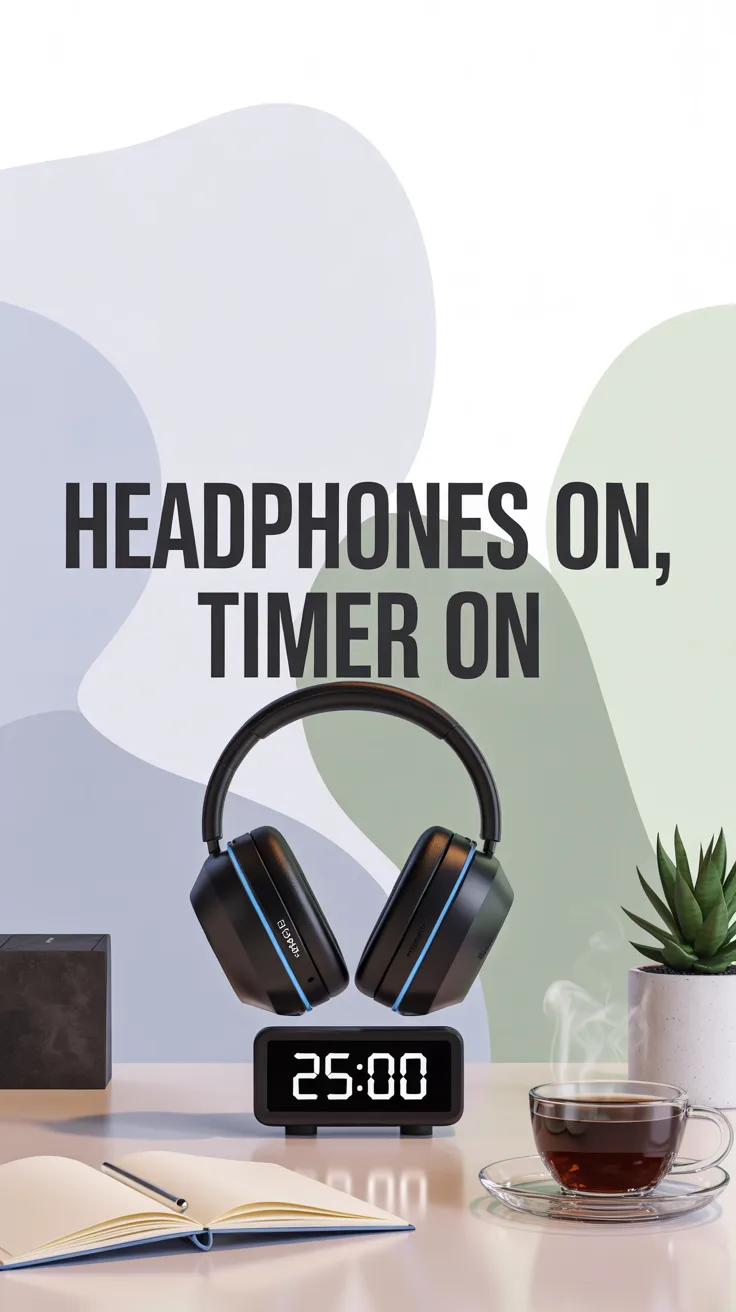
Staying on task with ADHD isn’t about “more willpower.” It’s about building a frictionless, repeatable ritual that nudges your brain into the right mode on demand. The ADHD-Friendly Focus Ritual: “Headphones On, Timer On” Routine is a simple, dependable cue stack that pairs sensory regulation (headphones) with time boundaries (timer) to unlock flow—especially for deep work, studying, or creative sprints. Within seconds, you can shift from scattered to steady, and in under an hour, move meaningful work forward without burning out.
💡 Recommended Solution: Brain Song Original
Best for: Creating a consistent, low-distraction soundscape for focus sprints
Why it works:
- Reduces auditory clutter so your attention isn’t hijacked
- Offers steady, non-lyrical audio that won’t compete with language-based tasks
- Helps you associate sound with “focus mode,” reinforcing a reliable ritual cue
Note: This routine is a practical productivity method, not medical advice. If you have questions about ADHD treatment, speak with your clinician.
Table of Contents
Why this ritual works for ADHD brains
The “Headphones On, Timer On” routine rests on a few science-backed pillars that match how ADHD brains prefer to work: short, structured bursts; clear cues; immediate feedback; and sensory balance.
- Immediate cues reduce inertia: ADHD often brings initiation friction and time blindness. When you physically put on headphones and press Start on a timer, you’ve created a tangible “state change.” Your brain gets a quick, binary decision—am I in or out?—which reduces open loops and dread.
- Timeboxing helps dopamine regulation: ADHD brains respond better to near-term, concrete rewards. A 20–30 minute sprint is short enough to feel “doable” yet long enough to make meaningful progress. The visible countdown supplies urgency without panic, and the break acts as a built‑in reward.
- Sensory regulation protects attention bandwidth: Background noise, conversations, and random household sounds pull attention. Headphones with an intentional audio track mask these distractions and provide a stable auditory backdrop, lowering cognitive load.
- Externalizing executive functions: The timer becomes your pacing coach and closer; the headphones become your attention buffer. Instead of relying on internal willpower, you outsource to tools—key for ADHD where executive functions (planning, starting, sequencing, switching) are taxed.
- Rituals build automaticity: When you use the same two cues—headphones and timer—at the same time of day for similar tasks, your brain forms a reliable association. Over days and weeks, it takes less effort to enter “focus mode,” because the ritual itself flips the switch.
Core components of the ritual
- The cue: “Headphones on” signals focus time; “timer on” locks a boundary.
- The container: A defined sprint (e.g., 25/5) reduces anxiety about how long you have to sustain attention.
- The reward: Micro-breaks, a checklist tick, or a small treat reinforce the cycle.
- The reset: Removing headphones and ending the timer signals completion—no lingering “always on” stress.
The upshot: this ADHD-friendly focus ritual works because it’s simple, reliable, and forgiving. If a sprint goes sideways, you can always reset the next one. You’re not “behind;” you’re between rounds.
Design your personalized “Headphones On, Timer On” workspace
Make your version of the ritual effortless. The easier it is to start, the more often you’ll use it.
Choose your headphones
- Prioritize comfort and consistency. Over-ear cushions or snug in-ears both work; what matters is minimal pressure and stable sound.
- If you’re sensitive to noise, passive isolation or ANC (active noise cancellation) can be a game changer.
- Keep them visible. A hook on your monitor, a peg by your desk, or a travel case on your keyboard creates a “use me now” cue.
Pre-build your audio environment
- One-click start: Preload a focus playlist, a white/brown noise track, or a dedicated focus audio solution so it starts in seconds.
- Non-lyrical for language work: If you read, write, or code, stick to textures without lyrics that compete with your working memory.
- Consistency > novelty: Changing soundscapes constantly can stir novelty seeking. The same track can act like an anchor for focus.
Your timer toolkit
- Physical or digital: A kitchen timer, Time Timer, or app works—pick what you’ll reliably press.
- Clear default: Set a default sprint (e.g., 25 minutes) so starting is a single tap. You can adjust up to 45–55 minutes for deep tasks once you’ve warmed up.
- Visible countdown: Seeing the time helps counteract time blindness and reduces the urge to “just check” something.
Remove friction from starting
- Lay out your tools: Charger plugged in, water within reach, fidget tool beside mouse, notes open to today’s target.
- One‑card task: Keep a single “Focus Card” on your desk with today’s top task written in plain language: “Draft intro for client proposal.”
- Hardware shortcut: Assign a keyboard macro to start the timer and your audio together.
Implement a start box
Create a small tray or box that contains: your headphones, a sticky note pad, pen, fidget, and timer. When the box comes out, the ritual starts. When it goes back, you’re off-duty. For ADHD brains, these physical boundaries eliminate ambiguous transitions.
Pro tip: Keep a “parking lot” note beside you. When stray thoughts pop up, jot them down instead of chasing them. Your timer will take you to a break soon; the thought will wait.
The right timer frameworks for deep work sprints
Your timer controls intensity and recovery. Think of it as interval training for your brain. Pick the right pattern for the task and energy level, then adjust.
Classic Pomodoro for breadth
- Structure: 25 minutes on, 5 minutes off; every 4 rounds, take a longer 15–25 minute break.
- Best for: General tasks, emails, documentation, admin work, reading that requires moderate focus.
- ADHD tip: If 25 minutes feels long on tough days, start with 15/5 for two rounds, then ramp to 25/5.
45/15 for deep creation
- Structure: 45 minutes on, 10–15 off.
- Best for: Writing, coding, design, analysis, or any flow state work where momentum matters.
- ADHD tip: Use a gentle chime for the 45-minute mark and allow a one‑time extension of 5–10 minutes if you’re in rare flow—then still take the break.
10-3-2 micro-activation for initiation
- Structure: 10 minutes preflight (set up tools, open documents, outline); 3-minute break; 20–30 minutes first full sprint.
- Best for: Days with high initiation friction or anxiety. The 10-minute “soft start” bypasses dread.
- ADHD tip: Pair with an “if–then” script: If I feel stuck after 3 minutes, then I will write a single ugly sentence or rename 1 file to get moving.
Timeboxing vs. task batching
- Timebox: Schedule a block for a category (e.g., 9:30–11:00 deep work), regardless of how many tasks you complete.
- Batch: Group similar tasks (e.g., invoices, emails) and run multiple short sprints to clear the batch.
- ADHD tip: Keep varieties of sprints saved as presets on your timer app to avoid negotiation fatigue.
Breaks that refuel, not derail
In breaks, avoid content that hijacks attention (social feeds, news). Try:
- Body: stretch, shoulder rolls, quick walk to the window.
- Breath: 4-7-8 breathing or box breathing to downshift.
- Quick win: tick off one tiny admin item only if it won’t balloon.
Bonus: Use the “stop at green” rule. End a sprint while you can still see the next step. You’ll return with clearer momentum.
Audio strategies for sensory regulation and focus
Your auditory environment can make or break your focus sprint. The right sound shields you from distraction, stabilizes arousal, and becomes your ritual’s soundtrack.
Choose your sound by task type
- Language-heavy tasks (writing, reading, coding syntax): non-lyrical textures, brown noise, low-frequency hums, or minimal ambient.
- Visual or design tasks: mild rhythmic ambient or instrumental lo-fi at low volume.
- Repetitive admin: rhythmic lo-fi or light instrumental jazz can add a pleasing tempo.
Many professionals rely on tools like Brain Song Original to create a consistent, low-distraction audio bed that pairs well with timers. Because it’s dedicated to steady focus, you spend less time fiddling with playlists and more time making progress.
Masking vs. modulation
- Masking: White/brown noise covers irregular background sounds (voices, street noise). This reduces startle responses and back-of-mind scanning.
- Modulation: Gentle, evolving ambient keeps you engaged without stealing attention. Great for longer sprints where boredom threatens.
Volume and consistency
- Set a “focus volume” that’s audible but not dominant. If you can’t hear your inner voice, it’s too loud for language tasks.
- If you’re sensitive to novelty, pick 1–2 reliable tracks or a single product you return to for all deep sprints. Consistency cements the cue.
Expert perspective and balanced benefits
“As many neurodiversity-focused productivity coaches note, ‘Brain Song Original is a helpful audio companion for people who want a reliable, low‑distraction soundscape that gently anchors attention without competing for it.'” While generic playlists and YouTube noise are popular, Brain Song Original offers a dedicated option designed to reduce the need for constant track selection—useful when you want a ritual that starts in one click.
Real‑world pattern
For instance, some users who implemented Brain Song Original during 25/5 sessions report fewer context switches and a smoother re-entry after breaks. Individual experiences vary, but the principle holds: the less friction to start, the stronger the ritual becomes.
Habit stacking and cue engineering to make it stick
Rituals beat resolutions. Use behavioral design to turn “Headphones On, Timer On” into a brain-friendly habit you don’t have to think about.
Implementation intentions
- Formula: “If it’s [time/context], then I [do the ritual].”
- Example: “If it’s 9:30 a.m. and I’m at my desk, then I put on headphones, press Start on a 25-minute timer, and open my focus card.”
- Why it works: You pre-decide the start so your brain reads the situation as a cue, not a choice.
Habit stacking
- Stack the ritual onto something you already do reliably.
- Examples:
- After my first coffee, headphones on, timer on.
- After my daily stand-up, headphones on, timer on.
- After school drop-off, headphones on, timer on.
Reduce friction; add attraction
- Auto-open: Set your computer to open your focus document and timer app on login.
- Visible triggers: Keep headphones on your chair so you must move them to sit down.
- Temptation bundling: Only listen to your favorite ambient set or Brain Song Original during focus sprints, so your brain craves the start.
Build tiny wins and rewards
- 2-sprint rule: Commit to just two sprints. If you want to stop after that, you can. Most days, momentum carries you.
- Micro-rewards: Enjoy a small treat, a short walk, or a satisfying box check after your second sprint.
- Visual scoreboard: Track completed sprints with sticky dots or a tally app—instant dopamine.
Environmental guardrails
- Site blockers: Activate during sprints to prevent autopilot tab hopping.
- Phone dock: Place your phone face-down in a different part of the room.
- Body doubling: If helpful, co-work on a video call. Your ritual can begin together: “Headphones on, timer on—go.”
A repeatable sprint flow from start to shutdown
A predictable flow cuts decision fatigue. Use this script to run your day in steady, ADHD-friendly arcs.
Preflight (2–3 minutes)
- Write your Focus Card: One sentence of what “done for this sprint” looks like. Example: “Draft the outline and first two subheads.”
- Clear desk within reach, put on headphones, open target file.
- Press Start on the default timer (25 or 45).
Focus sprint (25–45 minutes)
- Narrow scope: If you feel overwhelm, reduce the target: “One paragraph,” “One function,” or “One dataset.”
- Parking lot: Capture stray to-dos on a side note. No switching.
- Mid-sprint check: At halfway, glance at your Focus Card—are you still on it?
Break (5–15 minutes)
- Stand up: Movement resets focus. Do a quick mobility sequence.
- Breath: 60–90 seconds of box breathing (4-4-4-4).
- Hydrate: Sip water; avoid sugar spikes during the first half of your day.
Second sprint decisions
- Continue or switch? If the first sprint built momentum, do a second on the same task. If your energy dips, switch to a simpler related task to maintain progress without overload.
- Protect flow extensions: If you’re in rare flow, allow a one-time 10-minute extension, then still break.
Shutdown sequence (5 minutes)
- Summarize in-place: Type a 1–2 line “next steps” at the top of your doc.
- Save and stage: Open the file you’ll start with tomorrow and drop your Focus Card note there.
- Headphones off, timer off: Say out loud, “Session done.” Physical closure reduces ruminating.
Weekly cadence
- Choose 2–3 daily “focus windows” (90–120 minutes each) aligned with your peak energy. Let meetings live outside those. The steady rhythm grows easier every week.
Tip: Use an optional “Initialize Ritual” checklist you can laminate:
- Water, 2) Headphones, 3) Open doc, 4) Timer start, 5) Focus Card ready.
Troubleshooting common ADHD blockers
Even with a strong ritual, roadblocks happen. Prepare scripts that keep you moving.
Time blindness
- Strategy: Always keep the timer visible. Use a large onscreen countdown or a physical timer within your line of sight.
- Anchor points: Start your first sprint at the same time daily (e.g., 9:30 a.m.). A fixed anchor reduces drift.
- End-cap alarms: Set a soft alarm 10 minutes before meetings to stop cleanly.
Task overwhelm and perfectionism
- Strategy: Narrow the task until it’s laughably doable. “Open document and write the title.” Once you start, your brain will likely continue.
- 80/20 pass: Do an “ugly first pass” during the first sprint, refine in a later sprint. Separate creation from critique.
- If–then rescue: “If I stall for 60 seconds, then I write one ugly sentence or outline three bullets.”
Interruptions and context switches
- Strategy: Wear visible headphones as a social “do-not-disturb” signal.
- Quick capture: If an urgent thought appears, write it in your parking lot and move on. Address it on the break.
- Environment edit: Close chat apps during sprints; use a status like “Focus sprint until 10:15.”
Low-energy days
- Strategy: Use 15/5 mini-sprints with very modest targets. Combine with energizing movement during breaks.
- Stimulus tuning: On groggy days, a slightly more rhythmic ambient track may help; on overstimulated days, shift to brown noise or a gentler track via Brain Song Original.
- Win early: Choose a small, meaningful task first to build momentum.
Emotional dysregulation and RSD triggers
- Strategy: Name it. “I’m feeling anxious about feedback.” Then timebox a “process feelings” sprint (10 minutes journaling) followed by a gentle 15/5 work sprint.
- Body tools: 4-7-8 breathing; sensory grounding (5-4-3-2-1).
- Connection: Body double with a friend for accountability sprints.
Overreliance on novelty
- Strategy: Limit playlist hunting; use one consistent focus soundtrack (e.g., Brain Song Original) for sprints and save new music for breaks. This preserves novelty dopamine for the right moment.
Tools and resources that reinforce your ritual
Pair your ritual with supportive tools. You don’t need many—just ones that reduce friction and guard attention.
Core ritual stack
- Headphones: Comfortable over‑ear or in‑ear model you’ll wear for 60–90 minutes without fatigue.
- Timer: Physical Time Timer, minimalist desktop timer, or a smartwatch timer with airplane mode during sprints.
- Focus audio: A dedicated, low-distraction option like Brain Song Original or a consistent brown noise track.
- Fidget: A silent, tactile object that channels restlessness without disrupting concentration.
Digital guards
- Site/app blockers: Set “focus lists” that automatically activate during your sprint windows.
- Minimalist writing or coding environment: Full-screen modes that hide toolbars and notifications.
- Quick-capture notes: A single “inbox” for parking-lot items (avoid scattering across multiple apps).
Workspace cues
- Headphone hook: Visual cue that says “wear me, work now.”
- Focus Card holder: A small stand that displays your current sprint outcome.
- Lighting: Warm, indirect light reduces glare; a small desk lamp signals “focus mode.”
Resource list with balanced options
- Brain Song Original — Focus audio designed to be steady, non-intrusive, and easy to start quickly.
- Brown/white noise tracks — Reliable masking for language-heavy tasks; choose a consistent track.
- Physical Time Timer or minimalist timer apps — Visible countdown combats time blindness and discourages task-switching.
While many people default to ad-supported playlists or ambient YouTube videos, Brain Song Original offers a focused alternative that’s ready in one click. If those videos are working for you, keep them; if you want a purpose-built option that reduces fiddling, consider a switch.
Quick-start bundle (problem-solution style)
Struggling to start or getting derailed by noise? Pair a physical timer with your headphone cue and a one-click focus track from Brain Song Original. This bundle simplifies initiation, contains distractions, and builds a predictable “I’m in focus now” condition that your brain learns to trust.
Conclusion
The ADHD-Friendly Focus Ritual: “Headphones On, Timer On” Routine works because it’s simple, repeatable, and designed around how ADHD brains naturally thrive: with clear cues, short time horizons, and sensory stability. By pairing headphones with a timer, you create a switch that’s always within reach—no motivational speeches required. Start with a comfortable set of headphones, a visible countdown, and a consistent soundscape, then stack the habit onto something you already do daily. Protect your breaks, end sessions cleanly, and reset as needed.
If playlists and noise tracks are a source of friction, anchor your ritual with one reliable audio companion like Brain Song Original so “Headphones On, Timer On” becomes as easy as a single click. With a little upfront design, you can reclaim deep work, reduce decision fatigue, and steadily build the outputs that matter most—one sprint at a time.
FAQ
What makes the ADHD-Friendly Focus Ritual: “Headphones On, Timer On” Routine different from regular Pomodoro?
This ritual emphasizes sensory regulation and initiation cues specifically tailored for ADHD. The headphones act as a physical mode switch and auditory shield, while the timer externalizes pacing and closure. Together, they lower friction, tame time blindness, and reduce context switching more reliably than timing alone.How long should my focus sprints be with this routine?
Start with 20–25 minutes and a 5-minute break. As your stamina grows, experiment with 45/10 or 50/10 for deep work. If initiation is hard, try a 10-minute preflight, short break, then a 20–30 minute sprint. Aim for a repeatable cadence instead of chasing the “perfect” length.What should I listen to during “Headphones On” sessions?
Choose non-lyrical, low-distraction audio that doesn’t compete with language processing—brown noise, gentle ambient, or a dedicated focus option like Brain Song Original. Consistency helps your brain associate the sound with focus mode.Can this routine help with time blindness and impulsive task switching?
Yes. A visible countdown counteracts time blindness and gives you near-term endings to aim for. The headphones provide a sensory “bubble,” reducing temptations. Jot down stray thoughts in a parking-lot note to revisit on breaks rather than switching mid-sprint.How do I keep this ritual from getting boring?
Keep the ritual stable, but allow small variables: switch between two dependable audio options, alternate sprint lengths (25/5, 45/10), and rotate task types across sprints. Save novelty for breaks, not during sprints. If you enjoy a one-click focus track like Brain Song Original, reserve it exclusively for work sessions to keep the cue fresh.