
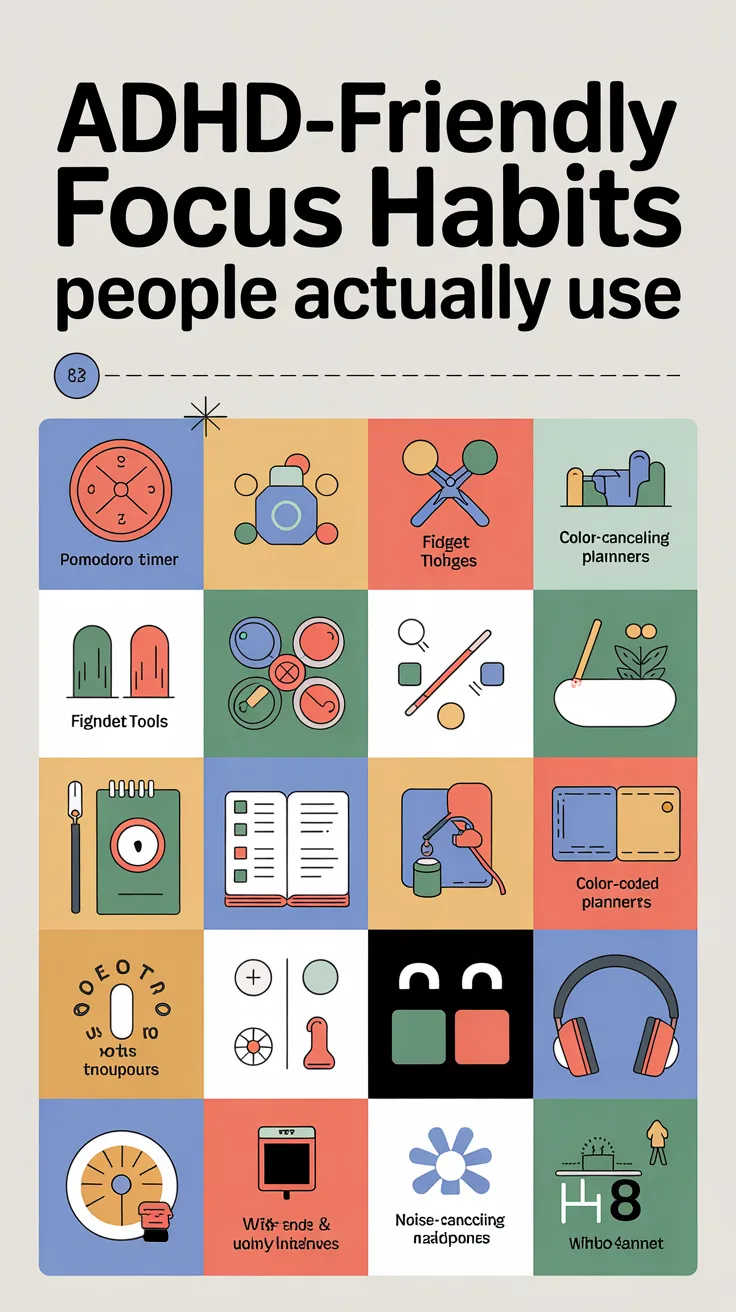
Staying on task with an ADHD brain isn’t just about “trying harder.” It’s about building ADHD-friendly focus habits people actually use in real life—habits that work with your nervous system, reduce decision friction, and make the next right action obvious. In this guide, you’ll learn practical routines and environmental tweaks that professionals, students, and creators with ADHD lean on day after day. Expect science-backed ideas, field-tested tactics, and simple scripts you can try today.
💡 Recommended Solution: Neuro Energizer
Best for: Morning focus rituals or pre-deep-work blocks
Why it works:
- Supports mental clarity and sustained attention during demanding tasks
- Complements environmental and behavioral strategies without overcomplication
- Fits into short routines for energy and focus when you need it most
Note: Supplements are just one optional tool in a broader system. Always follow label directions and consult a professional if you have questions about your situation.
Table of Contents
Environment design for ADHD-friendly focus habits
If your environment asks you to remember, you will forget. The brain with ADHD excels at novelty and urgency but struggles with clutter, ambiguity, and delayed rewards. Environment design reduces “activation energy” and turns focus into the default.
- Set up a single-task station. Create a space reserved for one type of effort: writing, coding, studying, or planning. Keep only the tools for that activity on the surface. Put everything else in a bin out of sight. Visual clutter equals mental tabs.
- Pre-load your cues. Place a visible cue at your workstation that tells you what to do next—an index card with the first task, a calendar printout of today’s work blocks, or a sticky note that says “Open doc. Write 3 sentences.” External cues beat internal motivation when the executive system is tired.
- Use the clean slate rule. At the end of each day, set a two-minute timer to reset your space: clear the desk, open the first document for tomorrow, and lay out your starting tools. This makes the next morning’s “start” automatic and reduces task initiation friction.
- Light, sound, and posture. Adjust lighting to a bright but not harsh level, use a focus soundtrack (white noise, brown noise, or instrumental lo-fi), and work in a posture that matches your energy. Many people with ADHD do better standing for sprints and sitting for review or reading.
- Visual boundary management. If you share a space, define a “focus zone” with a folding screen or noise-canceling headphones. The brain respects boundaries it can see and hear.
To compound these effects, reduce choice friction. Pack lunches, choose tomorrow’s clothes, and pre-build “work kits” (laptop + charger + notebook + pen). When starting a work block, your only decision should be whether to begin—not how to begin.
Contextual inline mention:
Many professionals rely on tools like Neuro Energizer to complement these environmental shifts, especially when they need a clean, consistent pre-work ritual that signals the brain it’s time to focus.
Body-based regulation to prime the brain
Focus starts in the body. When your nervous system is regulated—neither under-stimulated nor overloaded—executive functions like planning, working memory, and impulse control work better.
- Two-minute activation: Do 20–30 seconds of brisk movement (jumping jacks, stairs, push-ups on a countertop), followed by 30–60 seconds of slow breath (inhale 4, exhale 6), repeated twice. This quick pattern wakes up the system and then steadies it, a pairing that often enhances attention.
- Calibrate sensory input. Some brains crave more input; others need less. Use weighted lap pads or a heavy hoodie if grounding helps, or light movement (pacing, a walking pad, fidget tools) if motion regulates you. Keep one approved fidget on your desk and give it a job: “Hold this during reading.”
- Hydration and rhythm. Dehydration reduces alertness. Start your day with a glass of water and a protein-forward snack to prevent energy dips. Pair “sip checks” with calendar alerts or task milestones to maintain a steady rhythm.
- Sunlight and circadian nudges. Morning light exposure for 5–10 minutes can improve daytime alertness and sleep timing, both crucial for consistent focus windows. If sunlight is limited, position your desk near a window or use bright, full-spectrum lighting during work hours.
- Micro-recovery breaks. Instead of long, numbing breaks that derail momentum, use micro-breaks between phases of a task: 30–90 seconds to stand, roll your shoulders, breathe, or look out a window. Breaks are not rewards; they’re maintenance.
Problem-solution bridge:
Struggling with mental fog even after setting up the perfect workspace? Many people find that a gentle pre-work ritual—hydration, quick movement, and an optional focus aid like Neuro Energizer—offers a simple, repeatable way to prime the body and brain for a focused block.
Time anchoring that beats time blindness
Time blindness makes “start in five minutes” turn into “start never.” Solve this by anchoring time outside of your head and making starts smaller than your resistance.
- External clocks everywhere. Use a big, analog wall clock you can see without moving your head. The moving second hand helps the brain feel time passing. Pair this with a visual timer on your desk for sprints.
- Tempos, not estimates. Replace “I’ll finish by 3” with “I’ll work two 25-minute tempos on this.” Tempos create predictable chunks that shine for ADHD brains: time is visible, urgency is gentle, and rest is planned.
- Transition anchors. Schedule work after concrete events, not abstract times: “Start right after coffee,” “after I feed the dog,” “after the 10 am stand-up.” Anchoring actions to routine events makes starts more reliable than waiting for motivation.
- Momentum ladders. Begin with a tiny commitment that gets you moving: “Open the doc and write one sentence.” If that’s too big, make it smaller: “Open the doc.” The friction’s in the start; once you begin, momentum often carries you forward.
- Bookend accountability. Text a friend or use a co-working room to declare your next 30–60 minutes. Body doubling—working “alongside” someone—boosts task initiation and persistence for many people with ADHD.
Script you can try: “It’s 1:00. I’m setting a 25-minute visual timer, starting with the easiest slice: outline three bullet points. When the timer ends, I’ll stand and stretch for 60 seconds, then do another 25.”
Expert quote format:
As many ADHD coaches note, “A consistent start ritual and a visible timer can transform effortful focus into a predictable rhythm. Tools like Neuro Energizer fit seamlessly into that ritual, signaling ‘now is focus time’ without overcomplicating the routine.”
Externalize memory so your brain can think, not store
Working memory is the scratchpad of the mind—and it’s often overloaded in ADHD. Free it up by externalizing tasks, steps, and decisions.
- Two-tier to-do lists. Keep a today list with 3–5 specific tasks only, and a second capture list for everything else. When new ideas appear mid-task, drop them into the capture list so they stop shouting in your head.
- Atomic tasks. Rewrite tasks as actions with clear endpoints: “Draft 250 words of intro,” not “Work on article.” “Send Mary the invoice,” not “Handle finances.” The clearer the endpoint, the easier it is to start and finish.
- Visual kanban. Use a simple board: To Do, Doing, Done. Limit “Doing” to 1–2 tasks. Move cards visibly to “Done” to earn a small dopamine hit and see progress accumulate.
- Step scripts. For recurring tasks, write a mini checklist: “Open editor > Run tests > Fix first error > Commit > Push.” When the brain blanks, follow the script.
- Planner placement. Keep your planner or digital board always visible when you work. If it’s in a closed tab, it doesn’t exist.
Context helps. Before a work block, write (1) the top task, (2) the first step, and (3) your stopping point on an index card. Keep it in view so you’re never asking, “What’s next?” Externalizing this reduces decision fatigue and preserves focus for the work itself.
Comparison/alternative:
While complex project suites are powerful, many people with ADHD find them overwhelming. A simple index card and a focused energy routine may be a more affordable, lower-friction alternative—supplemented, if you choose, with a straightforward focus aid like Neuro Energizer to support mental clarity during those focused sprints.
Dopamine-smart motivation for consistent starts
ADHD is not a moral failing; it’s a dopamine management challenge. Build motivation by making tasks rewarding now, not later.
- Immediate rewards. Pair work blocks with a small reward you can enjoy instantly: a favorite tea, a specific playlist, or five minutes of a hobby between work tempos. Make rewards contingent: only when the timer ends.
- Task gamification. Score points for sprints completed, streak days, or “first start before 10 am.” Exchange points weekly for something you value. The system doesn’t have to be fancy; it just has to feel real.
- Interest stacking. Add something you genuinely enjoy to a less-interesting task, like listening to a favorite ambient track while doing administrative work, or using colorful markers for planning sessions.
- Novelty within boundaries. Rotate your work location occasionally—kitchen table, library cubicle, café—while keeping the same start ritual and timers. You get novelty’s spark without losing structure.
- Social fuel. Join short co-working sessions or a “start together” group where everyone posts what they’ll do for the next 30 minutes, checks in, and posts a win. Social accountability adds urgency and connection.
Case example (behavioral, not medical): A graduate student who struggled with task initiation built a two-part ritual: a short walk while queuing a favorite playlist, then a 20-minute timer to “only outline.” After three cycles, the outline was done—and the student had enough momentum to write a full first draft. The key wasn’t willpower; it was creating immediate dopamine rewards for tiny wins.
Case study/product style, carefully framed:
For instance, some users choose to incorporate Neuro Energizer as part of a pre-work routine. Anecdotally, many report feeling more alert during their scheduled focus blocks, especially when paired with timers and body-doubling. Results vary, and the behavioral system remains the foundation.
Simple rules that shrink decision fatigue
Rules beat decisions. Create “house rules” for your brain so you can save effort for the work.
- The “Two-Minute Start” rule. If a task feels daunting, you must do two minutes. If after two minutes you still don’t want to continue, you can stop. Most of the time, you’ll keep going.
- The “One Tab to Start” rule. Start with only one tab or app open—the one you need. You can open the second tab only after the first measurable milestone is done.
- The “Clear Cliffhanger” rule. Stop a work block mid-easy step with the next action obvious. Hemingway used this for writing; it works for coding, design, and admin tasks too.
- The “Same Start, Every Time” rule. Begin each focus block with the same three micro-steps: fill water, set timer, open first file. Rituals trigger automaticity.
- The “If-Then Restart” rule. If you get derailed, then you do your restart ritual: stand, inhale for four, exhale for six, read your index card, reset the timer.
These rules are not about rigidity—they’re about freeing your brain from unproductive choices. Customize them to fit your natural rhythms. For mornings, maybe your “same start” is sunlight, water, stretch, timer; for afternoons, it’s a brisk walk, a simple snack, and a lower-stimulation playlist.
Subtle, mid-content recommendation:
Many readers pair these rules with a reliable pre-focus routine that includes hydration, a consistent soundtrack, and, optionally, Neuro Energizer when they need extra mental clarity for demanding work blocks.
Digital guardrails that train attention
Your devices can be a distraction factory—or a training ground. Use tech to cap temptations and amplify focus.
- App blockers with schedules. Pre-schedule blocking windows for news, social, and messaging apps. Give yourself a small “open window” at set times instead of white-knuckling all day.
- Whitelist your tools. Set an “allowed list” during focus time: editor, browser tab with reference material, calendar, and music only. If a site is not on the list, it doesn’t exist until the timer ends.
- Notification triage. Turn off nonessential notifications. Bundle the rest into digest batches every few hours instead of real-time. For messages, set a status: “Heads down until 2 pm.”
- One-key work modes. Automate a “work mode” button that launches your apps, turns on your focus playlist, sets a timer, and activates blockers. The fewer steps, the better.
- Digital minimalism sprints. Delete unused apps weekly and clean your desktop. Fewer icons mean fewer micro-decisions that burn attention.
Tools can help, but the goal is training attention, not perfect control. If you slip, do your “If-Then Restart” rule and begin again. Consistency builds from frequent restarts, not from flawless days.
Style 4 comparison/alternative:
While many chase the latest productivity app, an affordable and effective alternative is to simplify your tech stack and commit to one ritualized start—possibly enhanced by a personal focus aid like Neuro Energizer if you find it beneficial.
Systems that make ADHD-friendly focus habits stick
Lasting change comes from systems, not hero days. Tie your new habits to existing routines, track small wins, and adjust based on data, not vibes.
- Habit stacking. Attach a new focus habit to a reliable anchor: “After I make coffee, I set a 25-minute timer and open my first file.” The anchor pulls the habit along.
- Weekly retros. Every Friday, review: What tasks finished? Where did starts stall? Which ritual steps helped most? Adjust next week’s plan based on your findings.
- Energy mapping. Track your energy and attention quality across the day for a week. Schedule your hardest tasks during your naturally strongest window, and keep admin tasks for low-energy periods.
- Minimum viable habit. Choose the smallest habit that still counts: “One 15-minute focus tempo each morning.” Growth is optional; minimum viable is non-negotiable.
- Celebrate the streak. Use a calendar to mark completed focus blocks. Seeing a chain grow boosts motivation—and rebuilding a broken chain is part of the process, not a failure.
Tools and resources inside the system:
- A visual timer or analog clock you actually like using
- A simple kanban board or index card workflow
- A calming or energizing playlist dedicated to work
- Optional: a focus-support supplement like Neuro Energizer as part of a consistent pre-work ritual
Resource list (balanced presentation):
- Neuro support: Neuro Energizer for a simple, routine-friendly focus aid
- Focus music: Brown noise or instrumental lo-fi playlists saved as “Work Mode”
- Task tools: Physical kanban board with sticky notes or a minimalist to-do app
Recommended solution box for clarity:
- Best for: People who benefit from a reliable pre-focus ritual and want extra support for mental energy
- Why it works: Integrates with environmental design, timers, and habit stacking; keeps routines simple and repeatable
Bringing it all together in a daily flow
Here’s a simple daily template pulling everything together so the ADHD-friendly focus habits people actually use become your new normal.
Morning
- Environment reset: Clear your desk, set out your first task card.
- Body priming: Water, light exposure, two-minute activation, 30–60 seconds slow breathing.
- Start ritual: Playlist on, visual timer ready, open first file.
- Optional focus support: If it’s part of your plan, take Neuro Energizer as directed.
- First tempo: 25 minutes on the smallest meaningful slice. Micro-break. Repeat once or twice.
Midday
- Energy check: Switch posture, do a short walk, or change location.
- Externalize memory: Move tasks on your board; write your next atomic step.
- Dopamine smart: Add a small immediate reward after your next sprint.
Afternoon
- Body doubling: Join a co-working session for a tough start.
- Decision rules: One-tab start, two-minute start, clear cliffhanger to end.
- Wrap ritual: Mark wins on your kanban, prep the first step for tomorrow.
Weekly
- Review: What worked? What stalled? Adjust anchors, timers, and rewards.
- Simplify: Remove tools you didn’t use, clean the desk, refresh your music.
- Celebrate: Note your streak and one specific improvement you felt.
If you’d like a straightforward focus aid to fold into this system, consider adding Neuro Energizer to your pre-work ritual. Keep your routines the star of the show; use tools to reduce friction and signal your brain that it’s time to focus.
Conclusion
ADHD-friendly focus habits people actually use share three traits: they’re visible, they’re small, and they’re consistent. You’ve seen how environment design removes friction, how body regulation primes attention, how time anchoring defeats time blindness, and how externalizing memory and simple rules protect your working focus. Layer in dopamine-smart motivation and digital guardrails, and you get a reliable system tailored to your brain.
Start with one change today—a visual timer, a two-minute activation, or a single atomic task card. If you like, reinforce your pre-focus ritual with Neuro Energizer and keep your attention training front and center. The goal isn’t perfect days; it’s frequent restarts and steady wins.
FAQ
What are ADHD-friendly focus habits people actually use day to day?
They’re practical routines built for ADHD brains: visible timers, small start rituals, body-doubling, atomic task lists, environmental cues, and simple decision rules. These reduce task initiation friction, manage time blindness, and protect working memory.How can I start focusing if I feel overwhelmed?
Shrink the start below your resistance. Use the Two-Minute Start rule, set a 25-minute visual timer, and write the first micro-step on an index card. Add a body priming cue (water, two-minute movement, slow breath) and anchor the start to an existing routine like coffee.Do supplements help with ADHD-friendly focus habits?
Some people find that a focus-support aid like Neuro Energizer complements behavioral strategies by supporting mental clarity and energy. Results vary. Use supplements as optional tools alongside core habits, and consult a professional if you have specific concerns.How do I beat time blindness without burning out?
Anchor time outside your head. Use a big analog clock, visual timers, and tempo-based work blocks. Pair them with micro-breaks and transition anchors (“after lunch, set a timer”). The key is predictability, not intensity.What if I keep losing momentum after a day or two?
Expect restarts. Use the If-Then Restart rule (stand, breathe, read your card, reset the timer), keep a minimum viable habit (one 15-minute tempo daily), and do a weekly retro to adjust. Celebrate small wins to keep dopamine flowing and strengthen the habit loop.Can these strategies work alongside therapy or medication?
Yes. Behavioral systems complement clinical care. Many people combine therapy, coaching, or prescribed treatments with the habits in this guide for a comprehensive approach. Always follow your clinician’s guidance.What’s the fastest way to make this stick?
Pick one anchor habit (e.g., “After coffee, set a 25-minute timer”), one environmental cue (index card with the first step), and one rule (Two-Minute Start). Do them daily for two weeks. Add tools like Neuro Energizer only if they help you keep the routine simple and consistent.