
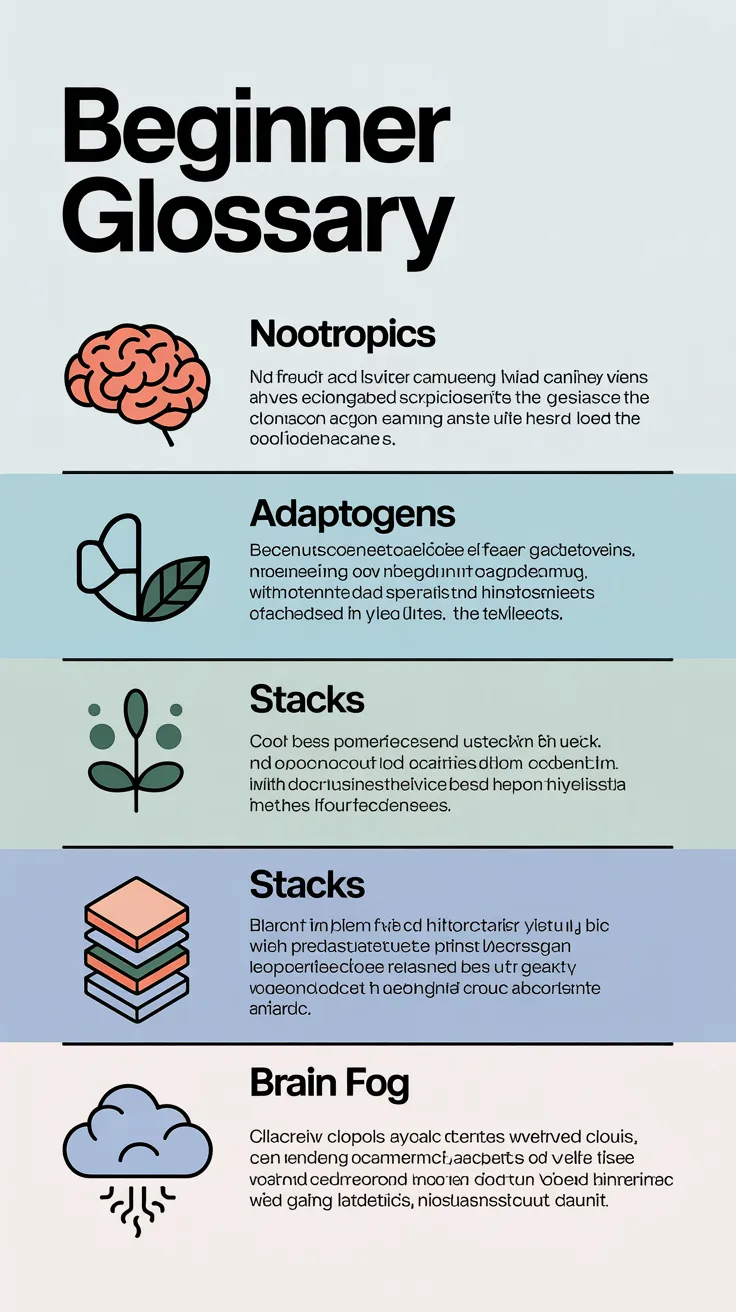
Brain health content can feel like a maze of buzzwords—nootropics, adaptogens, stacks, brain fog, biohacking, cholinergics, cortisol support. This Beginner Glossary: Nootropics, Adaptogens, Stacks, Brain Fog is a plain-English guide to the most common terms you’ll see on supplement labels and in research summaries, so you can evaluate information calmly and make safer, more informed decisions.
Many people start exploring cognitive wellness because focus feels harder than it used to, motivation is inconsistent, or they’re dealing with foggy thinking during stressful seasons. The goal here is not hype; it’s clarity: what these categories mean, how they differ, what benefits are reasonable, and what safety flags to watch for.
As one practical rule of thumb: if you don’t understand the term, you shouldn’t feel pressured to try the product. A good glossary is a filter—helping you separate marketing language from useful language.
Table of Contents
Foundations of cognitive wellness terminology
What “cognitive enhancement” actually means
Cognitive enhancement is a broad term describing attempts to improve mental performance—such as attention, processing speed, working memory, verbal fluency, reaction time, learning, or mental endurance. In everyday use, it often includes lifestyle strategies (sleep, exercise, sunlight, stress reduction) and supplements.
Important nuance: research may show a statistically measurable effect in a lab setting, but that doesn’t always translate into a meaningful daily-life change. Many “effects” are subtle and depend on baseline status—sleep quality, nutrient deficiencies, stress load, and overall health.
Baseline, ceiling effects, and why beginners get confused
- Baseline: your starting point (how you feel before any intervention).
- Ceiling effect: if you’re already functioning well (sleeping enough, low stress, good nutrition), some interventions do little because there’s less room to improve.
- Deficiency vs. optimization: correcting a deficiency (iron, B12, vitamin D, magnesium) can feel dramatic; “optimization” often feels mild.
Acute vs. chronic effects
You’ll see these terms often:
- Acute: noticeable within hours (e.g., caffeine’s alertness).
- Chronic: develops over days/weeks (e.g., habits or some supplement routines).
For brain-related supplements, chronic effects (if any) can take time and may be confounded by sleep, workload changes, or placebo effects—so tracking matters.
Placebo, expectancy, and “I felt it immediately”
The placebo effect is not “fake.” It’s a measurable mind-body response influenced by expectation, ritual, and context. In cognition and mood, expectancy can be especially strong. That’s why responsible experimentation uses:
- one change at a time
- consistent routines
- simple tracking (sleep hours, energy, focus, mood)
Nootropics explained in plain language
Nootropics: the common definition vs. the strict definition
In popular usage, nootropics are substances used to support cognitive performance—focus, memory, mental clarity, motivation, or resilience.
In a stricter historical sense (often attributed to early research framing), an ideal nootropic would:
- enhance learning/memory
- protect the brain
- have low toxicity and minimal side effects
Many things marketed as nootropics don’t meet the strict standard; they may be stimulants, calming agents, or general wellness supplements.
Classes of nootropics you’ll see referenced
This glossary-style breakdown helps decode product descriptions:
Stimulants
Promote alertness and wakefulness.
Examples (common, not endorsements): caffeine, stimulatory botanicals.
Tradeoffs: jitteriness, anxiety, sleep disruption, tolerance.
Cholinergics
Support the acetylcholine system, associated with attention and memory.
You may see terms like choline donors or acetylcholinesterase inhibitors (more technical).
Tradeoffs: headaches, nausea in some people, potential overstimulation.
Adapted calming nootropics (anxiolytic-style)
Support calm focus by reducing perceived stress.
Often overlap with adaptogens (explained later).
Tradeoffs: sedation in some; interactions with medications.
Neuroprotective / antioxidant support
Often marketed for long-term brain health (oxidative stress, inflammation balance).
Tradeoffs: benefits may be subtle; quality and dosing matter.
Nootropic “blends”
Multi-ingredient formulas combining several classes—often sold as “stacks in a capsule.”
Tradeoffs: harder to identify what’s helping or causing side effects.
“Brain fog” is not a diagnosis, but it is a common experience
A lot of people turn to nootropics because of brain fog—a subjective state that can include:
- mental cloudiness
- slower thinking
- trouble concentrating
- forgetfulness
- low motivation or mental fatigue
Because brain fog has many potential causes (sleep deprivation, stress, anemia, thyroid issues, depression/anxiety, poor diet, dehydration, medication effects), supplements should not be the first and only tool.
Problem-solution bridge (affiliate, contextual and safe)
If your main issue is “I can’t stay focused without feeling wired,” many professionals rely on well-formulated cognitive support blends to simplify routines. One option some people explore is NeuroPrime as a general-purpose approach to supporting mental clarity—especially if you prefer a single formula rather than buying multiple separate ingredients. It’s still wise to introduce any supplement carefully and track sleep and mood changes.
Adaptogens and stress-response vocabulary
Adaptogens: what the term means
Adaptogens are botanicals traditionally described as helping the body “adapt” to stress—supporting resilience and balance rather than pushing in one direction like a stimulant.
In supplement marketing, adaptogens are frequently positioned for:
- stress management
- mood stability
- energy without jitters
- fatigue support
- healthy cortisol rhythm support (language varies)
Key limitation: “Adaptogen” is not a tightly regulated category, and the evidence base varies widely among herbs, extracts, and doses.
Allostatic load: the hidden driver behind brain fog
Allostatic load refers to the cumulative wear-and-tear from chronic stress. When stress is persistent, common cognitive consequences can include:
- reduced attention span
- decision fatigue
- irritability
- poor sleep quality
- reliance on stimulants
In practice, many “brain fog” scenarios are stress + poor sleep + inconsistent nutrition. Adaptogen-oriented routines are often used to support the stress side of the equation.
Cortisol, HPA axis, and why labels mention them
- Cortisol: a hormone involved in energy regulation and stress response.
- HPA axis (hypothalamic–pituitary–adrenal axis): the body’s central stress-response regulatory system.
Products may claim “supports healthy cortisol levels.” Interpreting this responsibly:
- You usually can’t confirm cortisol patterns without testing.
- The goal is generally balance, not “lower cortisol at all times.”
- Sleep timing, caffeine use, and late-night screen exposure often matter more than any supplement.
Anxiolytic vs. sedative
Two terms people confuse:
- Anxiolytic: reduces anxiety or anxious feelings; can still allow alertness.
- Sedative: increases sleepiness or slows you down.
Some ingredients can be both depending on dose and individual sensitivity. Beginners often mistake sedation for “calm focus,” so track whether you’re actually performing better or just feeling quieter.
Expert quote format (affiliate integration)
“As many clinicians who focus on lifestyle-based cognitive health note, ‘a simple, consistent routine often beats a complicated cabinet of pills.’ For beginners who want a streamlined approach, NeuroPrime is sometimes used as a starting point because it can reduce the friction of building an entire stack one bottle at a time.”
(General educational perspective; not medical advice.)
Stacks, cycling, and “biohacker” language
Stack: the most important beginner definition
A stack is a combination of supplements (and sometimes behaviors) used together to target a desired effect—like focus, memory, motivation, or calm energy.
Stacking is popular because:
- one ingredient may support energy while another supports calm
- some combinations may reduce side effects (e.g., smoothing stimulant jitters)
- people like “systems” rather than single items
But stacking increases complexity and risk—especially for beginners.
Common stack types you’ll see online
Focus stack
Typically aims at attention + mental endurance. Often includes a stimulant plus calming support.
Memory/learning stack
Often references cholinergic support and ingredients linked (directly or indirectly) to neuroplasticity.
Mood and motivation stack
May include ingredients that influence perceived stress or neurotransmitter-related pathways.
Sleep stack
Not always labeled as “nootropic,” but sleep is a cognitive superpower. Poor sleep can mask any “brain boost.”
Cycling and tolerance
- Tolerance: needing more for the same effect (common with stimulants).
- Cycling: planned breaks (e.g., weekdays only) to reduce tolerance and evaluate baseline.
Beginners often skip this step and then wonder why a product “stopped working.” Cycling is also a safety-friendly way to avoid escalating use.
Synergy vs. “kitchen sink” formulas
- Synergy suggests ingredients complement each other.
- Kitchen sink formulas include many ingredients at low doses—sometimes too low to matter, sometimes included mainly for label appeal.
A good beginner filter is: can you explain why each ingredient is there and what it’s supposed to do? If not, you may be buying complexity, not effectiveness.
Comparison/alternative framing (affiliate integration)
While building your own multi-bottle stack can be flexible, it’s also easy to overcomplicate—especially if you’re new to nootropics and adaptogens. A single-formula approach like NeuroPrime can be a practical alternative for beginners who want to test a routine without managing multiple separate products. The tradeoff is less customization, so tracking your response is even more important.
Brain fog glossary: causes, signals, and smarter first steps
Brain fog: what people usually mean
Brain fog is an umbrella term for reduced mental sharpness. It’s not a medical diagnosis, but it can be a meaningful signal that something needs attention.
Common descriptions include:
- “I can’t think clearly”
- “My brain feels slow”
- “I forget words”
- “I read the same paragraph repeatedly”
- “I’m exhausted but wired”
Root-cause categories worth understanding
This is the “glossary behind the glossary”—the major buckets that drive fog:
Sleep debt
Even one week of shortened sleep can impair attention and working memory.
Key terms: sleep hygiene, circadian rhythm, REM, deep sleep, sleep fragmentation.
Stress overload
Chronic stress can mimic ADHD-like symptoms: distractibility, irritability, and reduced task persistence.
Key terms: burnout, allostatic load, rumination.
Blood sugar swings
Large spikes and dips can affect energy and focus.
Key terms: glycemic variability, reactive hypoglycemia, postprandial crash.
Dehydration and electrolytes
Mild dehydration can reduce cognitive performance.
Key terms: electrolyte balance, sodium/potassium, hydration status.
Nutrient gaps
Iron, B12, folate, vitamin D, magnesium—deficiencies can look like fatigue and poor concentration.
Key terms: anemia, ferritin, methylation (often oversold, but relevant in some contexts).
Medication and substance effects
Antihistamines, some anxiety medications, alcohol, excessive caffeine—can create fog.
Key terms: anticholinergic burden, withdrawal, rebound.
Health conditions
Thyroid disorders, depression, anxiety, long COVID, sleep apnea—can all present as brain fog.
Key terms: hypothyroidism, apnea, inflammation.
When to prioritize medical evaluation
A glossary is educational, not diagnostic. Consider professional evaluation if brain fog is:
- sudden and severe
- accompanied by weakness, numbness, fainting, chest pain, or confusion
- paired with significant mood changes, persistent insomnia, or unexplained weight change
- worsening over weeks despite basic lifestyle fixes
Practical first steps before supplements
A simple 7-day “clarity reset” often outperforms random supplement hopping:
- consistent sleep/wake time
- morning light exposure
- hydration + protein-forward breakfast
- caffeine cutoff 8–10 hours before bed
- 20–30 minutes of daily walking
- 5-minute daily brain dump (reduce rumination)
Supplements can be layered after your baseline improves—so you can tell what’s actually helping.
Safety, quality, and label-reading glossary for beginners
Third-party testing and quality signals
Cognitive supplements vary widely in quality. Helpful label and purchasing terms include:
- Third-party tested: verified by an independent lab for contaminants or accuracy (claims differ by program).
- COA (Certificate of Analysis): document showing test results for a specific batch (when available).
- Standardized extract: consistent concentrations of certain compounds (can improve reliability).
Proprietary blend
A proprietary blend lists ingredients but not the exact dose of each. This can be a red flag because:
- you can’t compare research dosing
- you don’t know what you’re actually getting per ingredient
Not all proprietary blends are bad, but they reduce transparency—especially for people trying to manage sensitivity.
Interactions and contraindications
Key glossary terms:
- Interaction: one substance affects how another works (including medications).
- Contraindication: a reason not to use something due to a condition, medication, or risk factor.
If you’re pregnant/nursing, have cardiovascular issues, psychiatric conditions, or take prescription medications, it’s wise to consult a clinician or pharmacist before trying new cognitive supplements.
Side effects vs. adverse events
- Side effect: an expected possible effect (e.g., nausea).
- Adverse event: more severe or unexpected harm requiring medical attention.
Beginners should start low, go slow, and avoid multiple new products at once.
Timing, half-life, and sleep disruption
- Half-life: how long it takes for half of a substance to leave your system.
Long half-life stimulants (or late dosing) commonly harm sleep—even if you “feel fine.” Then sleep loss creates next-day fog, and the cycle repeats.
Product recommendation box (affiliate integration)
💡 Recommended Solution: NeuroPrime
Best for: Beginners who want a simplified, “one-routine” approach to mental clarity support
Why it works (in general use):
- Helps reduce the complexity of building a multi-supplement stack
- Encourages consistency (often the biggest driver of perceived results)
- Fits well alongside fundamentals like sleep, hydration, and stress management
Note: Introduce any supplement gradually and track your response; consult a professional if you take medications or have health conditions.
How to build a beginner-friendly routine (without getting overwhelmed)
The “one variable at a time” rule
If you change three things at once (new supplement + more caffeine + less sleep), you won’t learn what caused the improvement—or the side effect. A beginner plan:
- Change one variable
- Keep it steady for 7–14 days (unless side effects occur)
- Track outcomes (1–10 ratings for focus, mood, energy, sleep)
Define your goal in one sentence
Vague goals like “be smarter” are hard to measure. Better:
- “I want to focus for 90 minutes without checking my phone.”
- “I want to feel mentally clear by 10 a.m. without needing a second coffee.”
- “I want fewer afternoon crashes.”
Your “stack” should match the goal. For example:
- If you crash after lunch, the first intervention might be meal composition and walking—not a stimulant.
- If you’re wired at night, the first intervention might be caffeine timing and evening light exposure.
A simple glossary-driven decision tree
Use these terms to guide decisions:
- If you’re sleep-deprived → prioritize sleep hygiene; avoid strong stimulants late.
- If you’re stressed and tense → adaptogen/calm-support language may be more relevant.
- If you’re distractible but anxious → “calm focus” strategies may beat “hard energy.”
- If you’re fatigued and unmotivated → review iron/B12/vitamin D and overall recovery first.
Case study/example (affiliate integration, general outcome, no invented specifics)
For instance, beginners who choose a single formula instead of juggling five separate bottles often report a more consistent routine within the first couple of weeks—mainly because adherence improves. In that context, some users opt for an all-in-one approach like NeuroPrime to keep the experiment simple: same timing, consistent use, and clear tracking.
Tools & Resources
You don’t need many tools to run a responsible “clarity experiment.” Here are a few resource types to consider:
- A basic notes app or journal (for daily tracking)
- A sleep tracker you already own (optional; consistency matters more than precision)
- A streamlined cognitive support supplement you can use consistently, such as NeuroPrime, if you decide supplements fit your plan
Conclusion
A lot of confusion disappears once you can translate the language. In this Beginner Glossary: Nootropics, Adaptogens, Stacks, Brain Fog, the biggest takeaways are simple: nootropics are cognitive-support tools (with varying evidence), adaptogens are commonly used for stress resilience, stacks are combinations that increase both potential benefit and complexity, and brain fog is a signal with many possible root causes—often lifestyle- and health-related.
Start by improving your baseline—sleep, stress, hydration, and nutrition—then experiment carefully with one change at a time. If you choose to use a supplement, prioritize transparency, safety, and consistency over hype. And if symptoms are persistent or severe, a medical professional can help rule out underlying causes that no “stack” can fix.
FAQ
What does “nootropics” mean in a beginner glossary?
In a beginner glossary, nootropics usually refers to substances (supplements, herbs, or compounds) people use to support focus, memory, mental energy, or clarity. Not all products marketed as nootropics meet strict scientific definitions, so it helps to evaluate ingredients and safety considerations.
Are adaptogens the same thing as nootropics?
Not exactly. Adaptogens are typically discussed as stress-response botanicals that may support resilience and balance, while nootropics are broader and focus directly on cognitive outcomes like attention or memory. Some ingredients can fit both categories depending on how they’re used.
What is a “stack” and why do beginners use them?
A stack is a combination of supplements used together to target a goal like calm focus or mental energy. Beginners use stacks to try to create synergy, but stacking can make it harder to identify what works or what causes side effects—so starting simple is usually smartest.
What is brain fog and what are the most common causes?
Brain fog is a non-medical term describing mental cloudiness, slow thinking, and poor focus. Common causes include sleep debt, chronic stress, blood sugar swings, dehydration, medication effects, and nutrient deficiencies. If symptoms are sudden, severe, or persistent, consider medical evaluation.
Can a single supplement help simplify a beginner nootropics routine?
For some people, yes—mainly by improving consistency. If you want a streamlined approach instead of building a multi-bottle stack, you might consider an all-in-one option like NeuroPrime and track sleep, mood, and focus to evaluate whether it fits your goals.