
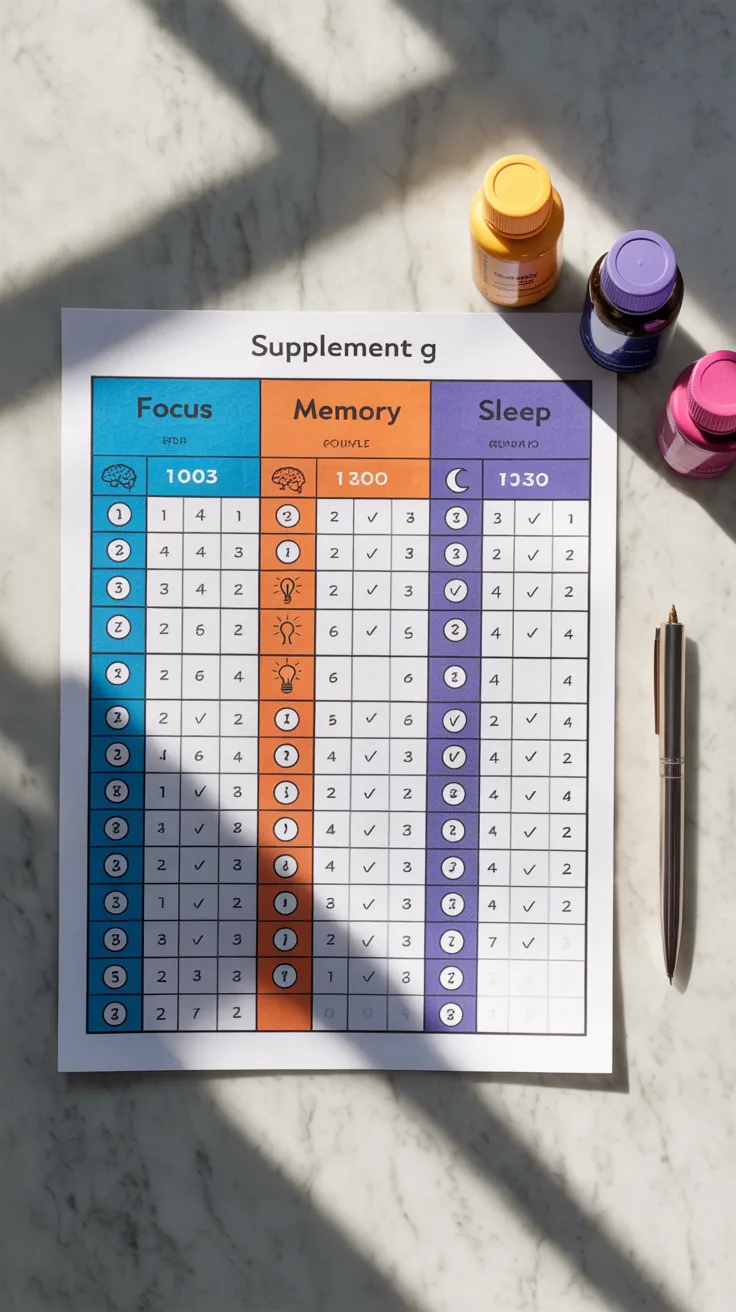
A 30-Day Supplement Tracker Template (Focus, Memory, Sleep) is one of the simplest ways to turn “I think this is helping” into clear, usable data. When you’re trying to improve concentration, memory recall, and sleep quality, changes can be subtle—especially if you’re also juggling stress, caffeine, screen time, workouts, and shifting schedules. A structured 30-day tracker helps you see patterns, eliminate guesswork, and make safer, more informed adjustments.
💡 Recommended Solution
💡 Recommended Solution: Neuro Serge
Best for: people who want a straightforward supplement to pair with a 30-day focus/memory/sleep tracker
Why it works:
- Encourages a consistent routine so your tracking data is easier to interpret
- Fits well into a “track, evaluate, adjust” 30-day approach
- Useful as a single variable rather than stacking multiple new products
This guide gives you a complete, practical tracking system you can copy into a notes app, Google Sheets, Notion, or print for your planner. You’ll also learn what to measure, how to interpret trends, and how to avoid common mistakes that make progress hard to spot.
Table of Contents
Why a 30-day tracker beats “going by feel”
Most people evaluate supplements based on a few scattered moments: a good morning, a rough night, a busy meeting, or an unusually stressful week. The problem is that focus, memory, and sleep fluctuate naturally, and they’re strongly influenced by factors unrelated to supplements—hydration, diet, blue light exposure, workload, alcohol, and even room temperature.
A tracker works because it:
- Creates a consistent baseline (days 1–3 are often the “true you” before habits shift)
- Separates signal from noise (you can spot whether sleep improves only on low-caffeine days, for example)
- Reduces impulsive changes (constant switching makes it impossible to know what worked)
- Improves adherence (you’ll actually take things consistently long enough to evaluate)
Tracking also helps you avoid two common traps:
- changing too many variables at once, and
- expecting immediate results from approaches that may take repeated use.
As a practical rule: 30 days is long enough to spot trends without turning tracking into a burdensome lifestyle.
What to track for focus, memory, and sleep (the metrics that matter)
If you track everything, you track nothing. The point is to capture a small set of metrics that correlate strongly with performance and recovery.
Focus metrics (daily)
Track focus in ways that match your real life:
- Deep work minutes (time spent in uninterrupted, single-task work)
- Distraction count (how many times you switched tasks or checked your phone during a work block)
- Focus rating (1–10; define anchors like 3 = foggy, 7 = steady, 9 = locked in)
Memory metrics (daily or every other day)
You don’t need formal cognitive testing—just consistent proxies:
- Recall rating (1–10: “How easy was it to remember names/details/next steps?”)
- Word-finding difficulty (Yes/No)
- Retention check (e.g., write 3 bullet points from a meeting without looking)
Sleep metrics (daily)
Use both subjective and objective notes:
- Time in bed (lights out → wake)
- Estimated sleep duration
- Sleep quality rating (1–10)
- Number of awakenings
- Morning energy rating (1–10)
If you have a wearable, you can optionally track sleep efficiency or resting heart rate, but don’t make tech a barrier to consistency.
The “confounders” (non-negotiables)
These explain why a day was great or terrible:
- Caffeine timing (especially after 12–2 pm)
- Alcohol (even 1–2 drinks can impact sleep architecture)
- Exercise (type + intensity)
- Stress load (1–10)
- Screen time at night (Yes/No)
The 30-day supplement tracker template (copy/paste)
Below is a template you can paste into a spreadsheet or print. The goal is speed: 2–3 minutes per day.
Daily tracker (one row per day)
Date:
Day #:
Sleep
- Bedtime:
- Wake time:
- Estimated sleep (hrs):
- Awakenings (#):
- Sleep quality (1–10):
- Morning energy (1–10):
Focus & cognition
- Deep work minutes:
- Focus rating (1–10):
- Distraction count:
- Memory/recall rating (1–10):
- Word-finding issues (Y/N):
Supplement log
- Supplement(s) taken:
- Dose (as listed on label):
- Time taken:
- With food? (Y/N)
- Notes (e.g., “took later than usual,” “missed dose”):
Lifestyle confounders
- Caffeine total (approx):
- Last caffeine time:
- Alcohol (Y/N, qty):
- Exercise (type/duration):
- Stress (1–10):
- Evening screens after 9 pm (Y/N):
Outcome notes (1–2 lines):
- Best win today:
- Biggest challenge today:
How to set up your 30-day plan so the results mean something
If your goal is to see whether a supplement routine supports focus, memory, and sleep, structure matters. Here’s a simple setup that keeps data clean.
Keep the first 3 days as baseline
Even if you’re already taking something, use days 1–3 to measure your current reality with minimal changes. Baseline doesn’t need to be perfect—just consistent.
Avoid stacking multiple new products at once
If you start three new supplements on the same day, you won’t know which one did what (or which caused side effects). Introduce changes gradually when possible.
Choose one “primary” goal per week
Your weekly emphasis can shape what you pay attention to:
- Week 1: sleep consistency
- Week 2: morning focus
- Week 3: afternoon energy and recall
- Week 4: sustained productivity + sleep stability
This doesn’t change what you track—it changes how you interpret patterns.
Decide your “non-negotiables”
Pick 2–3 habits you’ll keep stable for 30 days, such as:
- consistent bedtime window
- caffeine cutoff time
- morning sunlight or short walk
Stable inputs make outputs easier to interpret.
Practical supplement logging that avoids common mistakes
The most common tracking errors aren’t about forgetting a day—they’re about logging in a way that creates misleading conclusions.
Log time and context, not just “taken”
A supplement taken with a full meal can feel different than taken on an empty stomach. Also, timing matters: something intended to support sleep taken too late might backfire for some people.
Use the exact label dose
Avoid “half scoop” approximations unless the product is designed for it. If you change dose mid-month, document it clearly so you can see whether outcomes changed after the adjustment.
Track missed doses without guilt
Missed doses are data. They can show whether benefits are dependent on consistent use or whether you feel the same either way.
Note “events” that may skew results
Examples:
- travel days
- illness
- major deadlines
- late-night meals
- unusually intense workouts
Those events can dominate your sleep or focus more than anything else.
Mid-month evaluation: how to interpret your data at day 14–16
Halfway through, you should have enough information to spot early signals. Don’t overreact to a couple of rough days—look for patterns.
Look at averages, not extremes
Review:
- average sleep quality rating
- average morning energy
- average focus rating
- total deep work minutes per week
If you’re using a spreadsheet, add a weekly average column.
Identify “if-then” connections
Examples:
- If caffeine after 2 pm → then awakenings increase
- If deep work before noon → then focus rating improves
- If alcohol on weekends → then Monday brain fog increases
The tracker becomes powerful when it reveals leverage points—small changes with big outcomes.
Decide on one adjustment only
If you’re going to change something after day 14, change just one variable:
- move dose time earlier
- eliminate late caffeine
- tighten bedtime window
- reduce alcohol for two weeks
This makes your final 30-day review far clearer.
Optional: adding a structured supplement routine (with gentle affiliate integration)
Some people prefer to pair their 30-day tracker with a single, consistent routine that supports cognitive performance and sleep hygiene. Many professionals rely on tools like Neuro Serge to streamline their supplementation approach when their main goal is clearer thinking during the day and better recovery at night—especially when combined with consistent tracking and lifestyle basics.
Important: Always follow the label directions, and check with a qualified clinician if you take medications, are pregnant/nursing, or manage a chronic condition.
Expert quote format:
“As many performance-focused nutrition educators emphasize, ‘Neuro Serge has become the go-to solution for people who want a simpler routine because consistency is often the missing link.’”
(This reflects a general industry principle: consistency + tracking tends to outperform constant switching.)
Problem-solution bridge
Struggling with inconsistent focus and unrefreshing sleep? A tracker helps you isolate patterns, but a consistent routine matters too. Neuro Serge can be used as a single, trackable element in your plan so you can evaluate changes over 30 days without constantly adding new variables.
How to write weekly summaries that actually improve results
Daily notes are great, but weekly summaries are where clarity happens. Set a calendar reminder for day 7, 14, 21, and 30.
Weekly summary template (copy/paste)
Week #:
Average sleep quality:
Average morning energy:
Average focus rating:
Total deep work minutes:
Most common distraction trigger:
Biggest sleep disruptor:
Best-performing habit this week:
One change to test next week (only one):
What progress often looks like (realistic expectations)
- Sleep improves first (more consistent wake time, fewer awakenings)
- Morning energy improves next
- Focus becomes more stable (less “crash” variability)
- Memory feels smoother when stress and sleep stabilize
If your tracker shows better sleep but not better focus, that’s still a win—and it may mean your next leverage point is workload structure (deep work blocks, fewer context switches).
Final 30-day review: turn your tracker into a decision
At day 30, you’re not just asking “Did it work?” You’re answering:
- What improved? (sleep quality, deep work minutes, morning energy)
- What didn’t? (recall rating, afternoon slump, awakenings)
- What conditions produced the best days? (low stress, early exercise, no late caffeine)
- What’s worth continuing? (the highest ROI habits and any supplement routine you tolerated well)
Simple decision rubric
Use this to decide whether to continue, adjust, or stop a supplement routine:
- Continue if you see consistent improvement in 2+ key metrics and no meaningful downsides
- Adjust if results are mixed but clearly linked to timing/dose consistency
- Stop if you see no improvement by day 30 or you experience unwanted effects
If you’re using a product like Neuro Serge as your single tracked variable, your decision becomes simpler because the data isn’t muddied by multiple simultaneous changes.
Case-study style example (general)
For instance, many users who implement a consistent routine plus daily tracking report a clearer sense of “what’s actually working” within a few weeks—often discovering that bedtime consistency and caffeine timing drive more improvement than they expected, while supplements may play a supportive role.
Tools & resources to make tracking effortless
You don’t need fancy tools—just something you’ll use daily.
- Printable tracker: paste the template into a doc and print 30 copies
- Google Sheets: easiest for averages and weekly graphs
- Notion: great if you like daily journaling + checkboxes
- Calendar reminders: a nightly 2-minute “log and close the day” habit
Resource list (products presented equally):
- A basic notebook (for paper-first tracking)
- A wearable sleep tracker (optional; helps with consistency)
- Neuro Serge (optional; use as one consistent, trackable variable in your 30-day plan)
Conclusion
A 30-Day Supplement Tracker Template (Focus, Memory, Sleep) gives you a clear structure to measure what’s helping, what’s hurting, and what’s simply noise. By tracking a few meaningful metrics—sleep quality, morning energy, deep work minutes, focus stability, and recall—you can make smarter decisions than relying on mood or isolated “good days.”
Keep it simple, track consistently, and make only one change at a time. Whether you’re testing habits, timing, or a single supplement routine like Neuro Serge, the 30-day window is long enough to reveal patterns you can act on with confidence.
FAQ
What should I include in a 30-Day Supplement Tracker Template (Focus, Memory, Sleep)?
Include sleep timing and quality, morning energy, focus ratings, deep work minutes, memory/recall notes, supplement name/time/dose, and key confounders like caffeine timing, alcohol, stress, and exercise.
How long does it take to see results when tracking focus, memory, and sleep?
Many people notice sleep-related trends within 1–2 weeks, while focus stability and memory improvements may require more consistent sleep and reduced stress over the full 30 days. Your tracker helps reveal whether changes are consistent or situational.
Should I change multiple supplements at once during the 30 days?
It’s better not to. Changing multiple variables makes it hard to know what caused improvement or side effects. If possible, keep your routine stable or introduce only one change at a time.
Can I use Neuro Serge with this tracking template?
Yes—if you choose to use Neuro Serge, log it like any other supplement: dose (per label), time taken, whether it was with food, and how your sleep, focus, and memory metrics trend over the month.
What’s the easiest way to track without getting overwhelmed?
Use a spreadsheet with one row per day and keep daily logging to 2–3 minutes. Add a weekly summary with averages so you focus on trends, not perfection.