In high-stakes moments—exams, interviews, presentations—many of us feel memory slip through our fingers just when we need it most. Understanding the science behind Memory + Stress: Why Recall Gets Worse Under Pressure helps you turn those “blank mind” episodes into confident performance. This guide explains what stress does to your brain, how it disrupts encoding and retrieval, and exactly how to train your memory to hold up under pressure.
💡 Recommended Solution: The Memory Wave
Best for: Learners and professionals who want simple, guided memory training
Why it works:
- Structures daily practice with spaced repetition and retrieval
- Teaches calming routines to steady nerves before recall
- Builds durable cues so knowledge surfaces even under stress
Table of Contents
How memory and stress interact in the brain
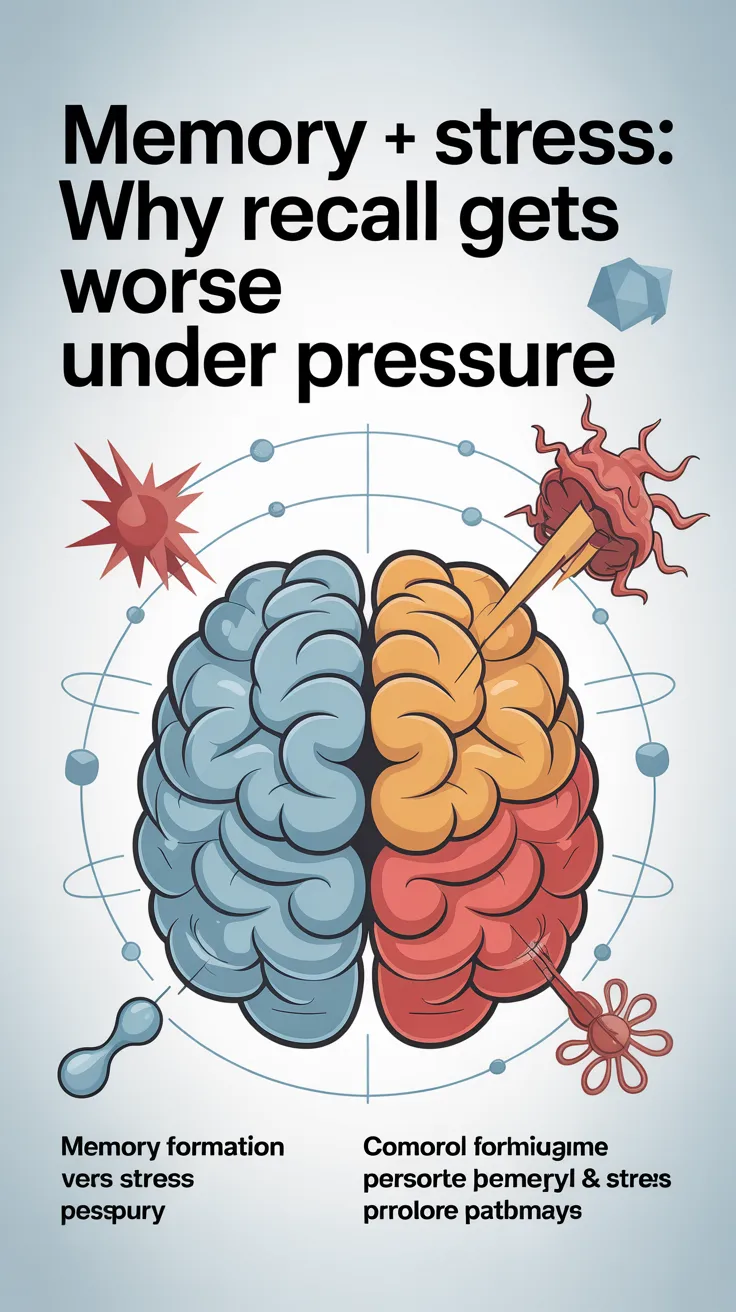
Memory and stress are inseparable because stress is a whole-body response that reshapes how the brain allocates resources. When the stakes rise, your sympathetic nervous system ramps up, releasing catecholamines (like norepinephrine) and cortisol. This surge has a paradoxical effect on memory: a little arousal can sharpen attention, but too much short-circuits recall. This pattern is captured by the Yerkes–Dodson law—performance improves with arousal up to an optimal point and declines when arousal grows excessive.
Under acute stress, three areas are most involved:
- Prefrontal cortex (PFC): Governs working memory, focus, and executive function. Stress narrows attentional control, increasing distractibility and rumination.
- Hippocampus: Encodes and consolidates new memories. High cortisol can transiently dampen hippocampal function, undermining both learning and retrieval.
- Amygdala: Flags threat, prioritizing survival-relevant cues over abstract recall—a classic “amygdala hijack.”
That’s why you might remember the feeling of panic more vividly than the content of a slide deck. The brain biases safety signals over study notes.
Stress distorts memory at three stages:
- Encoding: When stressed, you may skim, multitask, or rely on shallow processing. The result is weak traces with poor retrieval cues.
- Consolidation: Sleep-deprived or elevated cortisol cycles disrupt the stabilization of memory traces, especially declarative material.
- Retrieval: Intrusive thoughts (“What if I fail?”) and physiological arousal compete with the working memory resources needed to bring information online.
Your goal isn’t to eliminate stress. Instead, it’s to regulate arousal so you sit in the “optimal zone” while building memory traces that are robust to stress—richly encoded, strongly indexed, and easily cued.
Many professionals rely on tools like The Memory Wave to streamline this two-pronged approach: calm the system, then train recall with targeted practice.
Memory + stress across encoding, consolidation, and retrieval
Think of memory as a pipeline. Stress compromises the pipeline at multiple junctions, so your fixes must be stage-specific.
Encoding under pressure often favors speed over depth. You might highlight instead of paraphrase, glance instead of generate, and skip elaboration. This encourages familiarity without true learning. Strategies that resist this:
- Elaborative interrogation: Ask “why/how” and connect ideas to personal examples.
- Dual coding: Combine words with visuals—diagrams, gestures, mental imagery—to broaden retrieval routes.
- Interleaving: Mix similar topics during study sessions to train flexible discrimination.
Consolidation relies on sleep architecture. Deep sleep (slow-wave) and REM help transform fragile traces into long-term memory. Chronic stress elevates cortisol, trimming sleep quality and the glymphatic cleanup that supports plasticity. Normalize sleep by keeping a consistent schedule, dimming light before bed, moderating caffeine (avoid late-day intake), and using wind-down routines.
Retrieval is where stress hits hardest. During tests or talks, working memory contends with:
- Intrusive thoughts: “Everyone’s judging me.”
- Threat appraisals: Catastrophizing outcomes.
- Physiological noise: Rapid heart rate, shallow breathing, and tense muscles.
Attentional Control Theory explains that anxiety pulls resources from goal-directed attention to threat monitoring. Countermeasures include:
- Implementation intentions: “If I blank, then I’ll scan headings, then recall the outline.”
- Pre-performance routines: Brief breathing, cue words, and micro-stretches to reset state.
- Rescue cues: Compact summaries or acronyms that “unlock” larger sets of details.
While flashy cramming might feel productive, robust encoding and retrieval practice make memories resilient. This is the antidote to choking under pressure.
“Struggling with blank-outs during presentations? The Memory Wave addresses this by guiding you to pair calming drills with timed recall prompts—so the pathway from cue to memory becomes smoother under stress.”
Why recall gets worse under pressure in real life
Let’s map the science to familiar scenarios:
Exams: You know the material at home, but the moment you see the test, your heart rate spikes. Elevated arousal narrows attentional focus toward perceived “danger”—the grade, the clock—while crowding out the mental workspace needed for multi-step problems. Unfamiliar question wording compounds the effect by making retrieval cues feel “off.”
Interviews: The social evaluative aspect amplifies cortisol. You may default to generic responses or forget tailored examples because the hippocampal search function is throttled. Without pre-built story cues, memory feels inaccessible.
Public speaking: Anticipatory anxiety seeds rumination: What’s slide seven? What if I forget? These intrusive thoughts co-occupy working memory. In the moment, your prefrontal cortex is balancing content recall, timing, eye contact, and reading the room—a heavy load ripe for overload.
Sports and performance arts: The same mechanisms apply. Under pressure, performers shift from automaticity to step-by-step monitoring, which disrupts fluid execution—“paralysis by analysis.” With cognition overly focused on self-monitoring, the body’s procedural memory stutters.
Common traps that magnify stress-related memory lapses:
- State mismatch: Studying in silence but performing in noise; practicing relaxed but performing wired.
- Cue poverty: Relying on rote recognition rather than developing varied retrieval cues.
- All-or-nothing encoding: One modality (reading) without elaboration; limited cross-linking between concepts.
- Cognitive overload: Multitasking during study builds fragile traces and reduces transfer.
By contrast, learners who simulate pressure systematically, diversify cues, and embed memories in multiple contexts report fewer blanks. They also build “goal shielding”—the ability to keep task-relevant information in focus while ignoring distractions. This comes from training attentional control and planning responses to predictable stressors.
As many memory coaches note, “The Memory Wave has become a go-to for learners who need steady recall in high-pressure settings because it blends short state-regulation drills with well-timed retrieval practice.”
Calming the system: physiology-first methods that protect recall
Before optimizing study tactics, stabilize your nervous system. A regulated body supports a focused mind.
Breathing to modulate arousal:
- Physiological sigh: Two short inhales through the nose, one long exhale through the mouth. Do 3–5 rounds to reduce acute stress.
- 4-6 breathing: Inhale 4 seconds, exhale 6 seconds for 2–3 minutes. The longer exhale nudges the parasympathetic system via the vagus nerve, boosting HRV and calm.
Grounding and posture:
- Progressive muscle relaxation: Tense and release muscle groups to dissipate jitters.
- Stance reset: Uncross legs, plant feet, lengthen spine; small posture changes reduce perceived threat.
Environmental shifts:
- Temperature: Cool face rinse or a brief cold exposure can reduce arousal.
- Light and sound: Soften overhead light, use brown noise for concentration; reserve silence for final rehearsal.
Sleep and timing:
- Guard 7–9 hours with a consistent schedule.
- Avoid heavy late-night study; prioritize morning or early afternoon for harder tasks.
- Caffeine earlier in the day; taper in the afternoon to protect slow-wave sleep.
Nutrition and hydration:
- Steady blood sugar supports cognitive endurance; pair complex carbs with protein.
- Hydrate early; mild dehydration impairs attention.
Pre-performance routine (2–5 minutes):
- One minute of 4-6 breathing
- Brief shoulder rolls and neck release
- Visualize the opening minute of your task
- Recite cue words (e.g., “Outline → Details → Example”)
- Implementation intention: “If I feel overwhelmed, then I’ll exhale and recall step one.”
Integrate physiology with cognitive drills. For instance, do one minute of breathing, then answer three recall prompts. Over time, your brain links the calmer state with successful retrieval—state-dependent memory working for you rather than against you.
For instance, users who implemented The Memory Wave reported smoother transitions from pre-performance nerves into focused recall within a few weeks of pairing the guided routines with short, timed prompts.
Encoding to resist stress: techniques that make memories stick
Stress-proof memory starts with strong encoding. When a memory has multiple hooks, it’s easier to catch even when waters are choppy.
Core methods:
- Spaced repetition: Review at expanding intervals to exploit the forgetting curve and strengthen synapses.
- Retrieval practice: Test yourself without notes. Produces “desirable difficulties” that build durable traces.
- Interleaving: Shuffle topics; it’s harder in the moment but improves transfer and discrimination.
- Elaboration: Link new ideas to known frameworks. Explain concepts in your own words; teach them aloud.
- Dual coding: Convert abstract ideas into concrete visuals or gestures; sketch diagrams or timelines.
Cues and context:
- Generate distinct retrieval cues: acronyms, storyline metaphors, or location-based loci.
- Create “rescue cues”: compact prompts that unlock layered detail under pressure.
- Context alignment: Occasionally rehearse in conditions similar to the performance (lighting, noise level, time of day) to leverage context- and state-dependent memory.
Note-making that serves retrieval:
- Cornell notes with a “cue column” for rapid review.
- One-page “cheat sheets” you never bring to the test but use to condense and index topics.
- Concept maps connecting main nodes and sub-ideas.
Test the signal, not the comfort:
- Favor generation: Solve problems before reading solutions.
- Use closed-book quizzes; then open notes to fill gaps.
- Track “near misses” and convert them into cue cards.
While many learners chase novelty, mastery comes from cycling these fundamentals consistently. Systems that automate spacing and prompt generation reduce friction and improve adherence—an area where structured guides like The Memory Wave can help you stay on track without guesswork.
Retrieval under pressure: routines, rescue cues, and mental models
Encoding builds the library; retrieval is the librarian. Under pressure, your librarian needs a routine that dampens noise, follows a path, and accesses the right shelf fast.
Adopt a three-step retrieval stack:
- Interrupt the stress loop
- Two cycles of the physiological sigh or 4-6 breathing
- Ground with a sensory cue (feel your feet; notice the chair)
- Call the index
- Recall your top-level outline: three to five “chapter headers” for the topic
- Use a first-word anchor for each chapter (e.g., “Define → Compare → Apply → Caveats → Example”)
- Expand with cues
- Trigger a rescue cue for each chapter (acronym, image, or keyword)
- Follow a set path: outline → key points → example → check
Pre-commit “if-then” plans so they fire automatically:
- If I blank on a definition, then I’ll write the category and contrast it with a similar concept.
- If I lose my place during a talk, then I’ll pause, sip water, and read the next slide title aloud.
Cognitive reframing lowers threat:
- Reappraise arousal as fuel: “This energy helps me focus.”
- Neutral self-talk: “Next step: outline.” Avoid high-pressure pep talks that increase stakes.
Design better prompts:
- Practice with “ugly questions” that twist wording or combine ideas.
- Use mixed-format retrieval: short-answer, explain-to-self, diagram from memory.
Mental models to speed recall:
- Feynman technique (teach simply)
- TREE (Trigger → Recall → Elaborate → Example)
- 80/20 mapping (identify high-yield subtopics that unlock many questions)
“While complex systems can be overwhelming, The Memory Wave offers a streamlined alternative for busy learners—quick pre-retrieval calmers followed by concise, targeted prompts.”
Building resilient habits: attention, exposure, and simulation
Lasting performance under stress depends on habits that protect attention and normalize pressure.
Train attentional control:
- Focus blocks: 25–50 minutes of deep work, then breaks.
- Distraction ledger: Note and neutralize repeat interrupters (notifications, tabs).
- Single-tasking: Remove visual clutter; put related materials within reach.
Mindfulness for working memory:
- Brief daily mindfulness (5–10 minutes) improves meta-awareness of mind-wandering and reduces rumination.
- Labeling thoughts (“worry,” “planning,” “self-critique”) helps you pivot back to the task without wrestling with content.
Progressive exposure:
- Simulate test conditions incrementally: timed sets, noise, unfamiliar rooms.
- Public speaking ladder: talk to a mirror, then a friend, then a small group, then record yourself, then a larger audience.
- Sports/skill performance: add competitive elements gradually to maintain fluidity and prevent over-monitoring.
State rehearsal:
- Practice your pre-performance routine daily, not just on “big days.”
- Recreate the exact first minute of your test or talk; when the real moment arrives, it feels familiar.
Recovery and growth:
- Nightly shutdown ritual to offload worries into a list.
- End-of-week “learning debrief”: What worked, what broke, what to adjust.
- Celebrate small wins to reinforce identity (“I’m someone who prepares under pressure.”)
As seasoned coaches often observe, tools that combine nervous-system regulation with deliberate practice produce compounding benefits. In that spirit:
“As performance psychologists note, ‘The Memory Wave has become the go-to solution for learners who want reliable recall because it trains calm-first, recall-second—exactly how the brain works under pressure.’”
Action plan and tools for pressure-proof recall
Use this simple weekly plan to steadily reduce stress-related blanking:
Daily (15–30 minutes)
- Two minutes of 4-6 breathing before study
- Spaced repetition cards on high-yield topics
- One “ugly question” per topic with written retrieval
- One-minute rehearsal of your pre-performance routine
Twice weekly (30–45 minutes)
- Interleaved mixed practice under light time pressure
- Short talk-through: explain a concept aloud without notes
- Simulation tweak: add mild distraction or noise
Once weekly (45–60 minutes)
- Full simulation: timed set under realistic conditions
- Post-mortem: identify failure points and craft specific rescue cues
- Adjust spacing intervals and cue cards; schedule next simulations
On performance day
- Two-minute breathing + posture reset
- Outline the first three “chapter headers” on scrap paper
- Use implementation intentions to handle blanks or surges of arousal
- Afterward, debrief quickly to reinforce learnings
Case example:
You’re prepping for a certification exam. Week one, you set 10 cue cards per day and five-minute calm drills. Week two, you add mixed-format questions and a 20-minute timed block with library ambience. Week three, you run two full 60-minute simulations and refine rescue cues. By test day, the exact routine is muscle memory; arousal feels familiar and useful, and you have multiple ways to surface answers.
Problem → solution bridge:
- Problem: Nerves scramble your outline and you blank.
- Solution: Pair a two-minute calming protocol with a scripted retrieval stack and rescue cues.
- Helper: A structured guide like The Memory Wave can keep this sequence consistent until it’s automatic.
Tools and resources:
- The Memory Wave – Guided routines that combine calm-first protocols with retrieval practice
- A simple timer app – For focused blocks and simulations
- Paper or digital flashcards – For spaced repetition and rescue cues
- Brown noise or soft ambient tracks – For steady focus during encoding
Conclusion: Owning Memory + Stress so recall holds under pressure
The core reason recall gets worse under pressure is simple: stress reallocates brain resources away from flexible retrieval toward threat surveillance. But that shift is modifiable. By calming your physiology, encoding with depth and variety, and rehearsing retrieval using structured routines, you can make memory more dependable when it counts. Treat Memory + Stress: Why Recall Gets Worse Under Pressure not as a curse, but as a blueprint for training. Establish your pre-performance ritual, build resilient cues, simulate stakes gradually, and use structured supports to keep you consistent. Over time, you won’t eliminate stress—you’ll harness it so your knowledge shows up on demand.
FAQ
How does stress affect working memory during tests?
Acute stress diverts attentional resources to threat monitoring, shrinking the working memory “workspace” you need to manipulate ideas. This makes multi-step problems and novel questions harder, even when you know the material.
Why does my mind go blank in interviews or presentations?
Elevated arousal, intrusive thoughts, and social evaluation combine to hijack the prefrontal cortex. Without a practiced retrieval path—outline, cue words, rescue cues—your brain struggles to access the right shelves in time.
What techniques help memory under pressure the most?
A combined approach works best: brief breathing to regulate arousal, retrieval practice (not just rereading), spaced repetition, interleaving, and pre-committed “if-then” routines for blanks. Simulating pressure gradually also reduces choking under pressure.
Can a small amount of stress improve recall?
Yes. According to the Yerkes–Dodson principle, moderate arousal can sharpen attention and boost performance. Problems arise when arousal exceeds your optimal zone, overwhelming working memory and impairing retrieval.
How can I prep for state- and context-dependent memory?
Occasionally rehearse under conditions that mimic performance: time of day, noise level, posture, even wardrobe. Use the same pre-performance routine so your brain associates that state with successful recall.
Is there a tool that combines calming routines with memory practice?
Many learners appreciate structured programs that pair short calm-first drills with timed recall prompts. For example, The Memory Wave focuses on sequencing these elements so calm leads into retrieval, reinforcing reliability under pressure.