
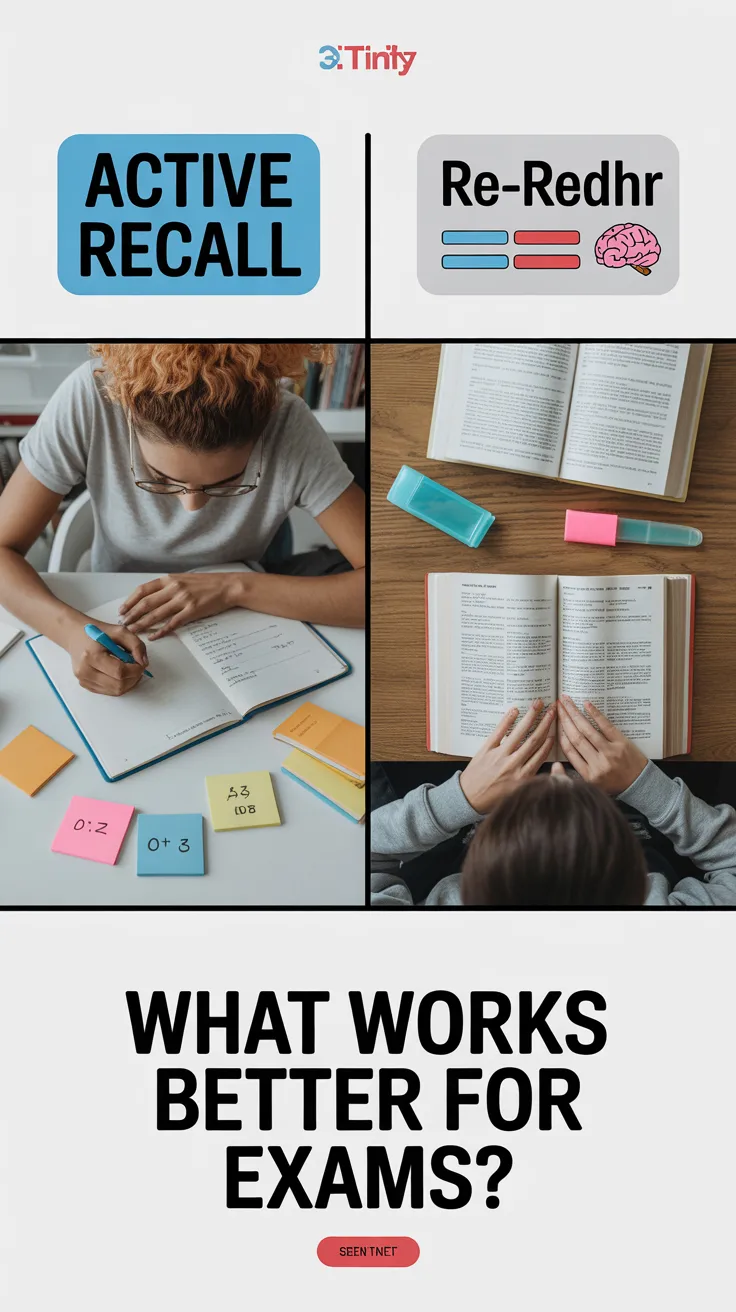
Exams reward what you can retrieve, not what you once recognized. That’s why the debate over Active Recall vs Re-Reading matters so much. If you’ve ever felt “prepared” after several passes through your notes only to blank on test day, you’ve experienced the illusion of competence that re-reading can create. In this guide, you’ll see how to combine retrieval-based learning with smart review techniques to study less, remember more, and walk into your exam with calm confidence.
💡 Recommended Solution: Neuro Energizer
Best for: Students who need steady focus during retrieval sessions
Why it works:
- Helps you feel mentally clear and consistent
- Supports long study blocks without “energy crashes”
- Low-friction addition to a structured study routine
Table of Contents
Active Recall vs Re-Reading: How Memory Really Works
Your brain remembers what it’s asked to do. When you passively re-read, you ask your brain to recognize information. When you practice active recall—closing the book and trying to generate an answer—you ask it to retrieve. Retrieval strengthens the neural pathways you’ll need under exam conditions, while recognition can make content feel familiar without making it durable.
Here’s the core mechanism. Memory is a reconstruction process. By pulling information out (retrieval), you deepen encoding, strengthen associations, and improve the likelihood that the same pathway will fire later. This is the essence of “desirable difficulties”—techniques that feel harder but produce stronger learning. Active recall aligns perfectly with this: it’s effortful now, easier later.
Re-reading, on the other hand, reduces perceived difficulty. Fluency goes up: the text looks smoother, your eyes move faster, and you feel “on top of it.” But fluency isn’t mastery. Without retrieval, comprehension may be shallow and context-limited. That’s why you can “understand” a textbook paragraph and still fail to produce the principle on a blank page.
Of course, re-reading isn’t useless. It has specific, valuable roles:
- Orientation: First contact with new material to grasp the map.
- Clarification: Short, targeted re-reads to clean up confusion.
- Refresh: Quick scans before a retrieval session to prime recall.
The key is sequence and proportion: lead with brief comprehension passes, then transition into retrieval reps early and often. If you invert that ratio—pages of re-reading followed by minimal testing—you’ll likely score high on mid-study “confidence,” but lower on your actual exam.
Practically, your study loop should look like this:
- Preview the material (short, purposeful reading).
- Close the source and recall (write, speak, or quiz).
- Check answers, identify gaps.
- Revisit only the gaps or ambiguous sections.
- Repeat with spacing.
Make retrieval your default, and use re-reading as a targeted tool, not a crutch.
Active Recall vs Re-Reading in Real Study Sessions
In real life, the tension between Active Recall vs Re-Reading shows up when you’re tired or anxious. Re-reading feels safer and faster. You can move your eyes and feel productive. Active recall asks you to generate, which feels risky. The trick is designing sessions that lower the friction to retrieval.
Anchors that make retrieval stick:
- Question-first: Turn headings into questions before you read. Then read only to answer them, close the text, and produce the answer from memory.
- Closed-book drills: Set a timer (e.g., 10–15 minutes) and write everything you can about one concept from memory. Then check and patch.
- Cued recall sheets: Build prompts (keywords, diagrams with blanks, problem stems) and hide the answers when practicing.
- Flashcard principles: Use answerable prompts with minimal text, test both directions (concept → definition, definition → concept), and always say or write the full answer before flipping.
When should you re-read? Use it to unblock, not to replace effort. For example, if your closed-book drill hits a dead end, spend two minutes re-reading the relevant paragraph, then close it and try again. Re-reading should be a scalpel, not a blanket.
Two practical session formats:
- 25/5 Retrieval Blocks: 25 minutes of pure retrieval (flashcards, problem sets, whiteboard explanations) + 5-minute break. Between blocks, allow 2–3 minutes to re-read only the errors you made.
- “Three-Pass Rapid Loop”:
- 5–7 minutes skim to find key questions.
- 15 minutes of retrieval on those questions.
- 5 minutes re-read on misses only.
Signs you’ve over-indexed on re-reading:
- You can follow along with worked solutions but can’t solve a fresh variant.
- You feel increasingly confident during study but struggle to write a complete answer without notes.
- Your review sessions get longer, but your recall speed doesn’t improve.
Signs retrieval is working:
- You can explain concepts in your own words without prompts.
- Errors cluster in fewer areas over time.
- You recall faster and more completely, with clearer boundaries between similar ideas.
Make retrieval the star of your session, and let re-reading play a supporting role that keeps you accurate, not complacent.
What the Research Says About Active Recall vs Re-Reading
Decades of learning science converge on the same story: testing yourself trains the brain to remember. Retrieval practice has outperformed re-reading across subjects, ages, and question types. Classic studies show that students who practice recalling information—even without additional study—often outperform those who repeatedly review the material. Why? Retrieval isn’t just an assessment; it’s a learning event that consolidates memory traces and strengthens cues.
The forgetting curve describes how memory decays over time, particularly for information learned via passive exposure. Spaced retrieval interrupts that decay, re-stabilizing memories at increasing intervals, making them more resistant to interference. Interleaving (mixing topics or problem types) further boosts discrimination, improving your ability to choose the right method on unfamiliar problems.
Re-reading generally improves short-term familiarity. If the test were five minutes after your review, re-reading might help you recognize content. But most exams reward transfer: applying knowledge in new contexts. Retrieval practice builds flexible knowledge—the kind that helps you answer “explain why” or “solve this unfamiliar problem” questions.
What about the “feeling” of learning? Students and even instructors sometimes misjudge the more effortful methods as less effective because they feel harder in the moment. However, that short-term difficulty is a reliable cue that learning is deeper. The goal isn’t to feel good while studying; the goal is to perform well later.
Practical implications of the evidence:
- Use re-reading for initial encoding and targeted fixes; transition to retrieval early.
- Build error-driven review: you study the misses, not what’s already fluent.
- Space out retrieval sessions over days; avoid marathon cramming that’s mostly re-reading.
- Test in the format you’ll face: write, speak aloud, or work problems cold.
In short, the research case for retrieval over re-reading is robust. The best results come when you combine retrieval with spacing, interleaving, and elaboration—all of which transform inert knowledge into readily usable, exam-ready memory.
Designing a High-Retention Study System
A powerful system weaves together a few evidence-backed threads: retrieval, spacing, interleaving, elaboration, and dual coding. When these play together, re-reading becomes a minor tuning tool, not the backbone.
Retrieval as the engine:
Build question banks, flashcards, or problem sets that force generation. Do not peek. Always attempt retrieval before you look at the answer. Keep prompts small and specific.Spacing as the calendar:
Spread your practice. Retest the same concepts after a day, then two, then four. If you’re using flashcards, lean on spaced scheduling (manual or app-based) so tough cards return more often.Interleaving as the mixer:
Rotate topics and problem types within a session. For math/science, mix problem families so you must identify the right method. For concept-heavy courses, interleave themes (e.g., mechanisms vs. applications).Elaboration as glue:
After a recall attempt, connect the idea to a why/how: “Why does this formula work?” “How does this concept relate to yesterday’s topic?” Explanations—especially aloud—deepen understanding and memory.Dual coding as a visual layer:
Pair words with diagrams or flows. Redraw processes from memory. Fill in blank labels. Visual cues build alternative routes to the same memory.
Keep your system light on friction. The more steps required to start, the more you’ll default to re-reading. A simple rule helps: “Retrieve first, then read what I got wrong.”
Many students rely on tools like Neuro Energizer to support long, focused retrieval blocks without feeling mentally foggy. If you add any focus aid, pair it with a tight routine: block your sessions, set clear prompts, test cold, then log your misses for targeted repair.
Finally, keep a short “error book.” Every time you miss a concept, write a one-sentence version of the idea in your own words plus one concrete example. Review this book briefly before retrieval sessions. This error-driven loop prevents you from polishing what’s already shiny and directs effort to where it pays off most.
A One-Week Exam Sprint Plan That Prioritizes Retrieval
Cramming is common because it feels active. But a high-yield seven-day sprint replaces marathon re-reading with concentrated retrieval and spaced refreshers. Here’s a practical plan you can adopt immediately.
Day 7 (One week out): Map and sample
- Build a master outline of topics. For each, write 3–5 testable questions.
- Spend 60–90 minutes on closed-book retrieval across the whole outline, just to sample.
- Identify weakest domains. Create or refine flashcards/problem sets only for those gaps.
- End with a short re-read of the worst misses to clarify misunderstandings.
Day 6: Retrieval focus blocks
- 3–4 blocks of 25 minutes retrieval + 5 minutes reviewing only misses.
- Interleave topics: A → B → C → A.
- Quick 10-minute re-reading on two knotty concepts.
Day 5: Exam-format practice
- If your test is problem-heavy, do two timed sets of mixed problems, closed-book.
- If essay-based, write two outlines from memory and one full timed response.
- Review mistakes. Re-read only to fix reasoning gaps.
Day 4: Spaced return + elaboration
- Re-test the cards/sets you missed earlier.
- For every recalled concept, add one “why/how” sentence.
- Teach a concept aloud to an imaginary class or study buddy.
Day 3: Second exam simulation
- Timed set under stricter conditions (phone off, limited aids).
- Post-mortem: categorize errors (concept, strategy, carelessness, time management).
- Targeted re-reading for concept errors only.
Day 2: Consolidation
- Short retrieval sessions across all topics with heavier weight on weak areas.
- Redraw key diagrams and flowcharts from memory.
- Light re-reading of summaries, but stop well before bed.
Day 1 (Eve of exam): Confidence, not cramming
- Two short retrieval bursts (morning, afternoon).
- Review your “error book” and the highest-yield prompts.
- Walk, hydrate, sleep on time. No late-night re-reading binges.
Struggling with mental stamina during this sprint? Problem-Solution Bridge: Long blocks of retrieval can be demanding. Neuro Energizer may help you feel steady focus so you can finish each block strong. Always follow label directions and consult a professional if you have questions.
Keep the rule of thumb: 80% of your time in active recall, 20% in targeted re-reading and error repair.
Subject-Specific Strategies That Maximize Recall
Different exams reward different kinds of memory and transfer. Tailor your retrieval to the task at hand.
STEM and Quantitative Courses
- Problem families: Create a list of problem “types.” For each, write the diagnostic question: “How do I know it’s this type?” Practice identification before solution.
- Formula recall with context: Don’t just memorize; pair each formula with a worked mini-example you can reproduce from memory.
- Whiteboard derivations: From a blank page, re-derive a formula or method step by step. Use re-reading to fix only the step where you got stuck.
Biology and Health Sciences
- Mechanism maps: Redraw pathways, label from memory, then fill missing labels.
- Application questions: “What changes if enzyme X is inhibited?” Practice both recall and transfer.
- Micro-cases: Short vignettes you must diagnose from memory.
History and Social Sciences
- Causal chains: For each event/theory, write a 3–4 link cause-and-effect chain from memory.
- Compare-contrast tables: Retrieve similarities/differences without notes.
- Source analysis: Practice writing a one-paragraph analysis from memory with a simple framework (claim, evidence, significance).
Languages
- Production first: Speak or write sentences using target structures before checking notes.
- Minimal pairs and cloze deletions: Fill the blank from memory.
- Spaced vocabulary recall, bidirectional (L1→L2 and L2→L1), with example sentences you can produce cold.
Essay and Short-Answer Exams
- Thesis drills: From a prompt style, generate a thesis and three supporting points from memory.
- Outline sprints: 10 minutes to produce an organized outline without notes.
- Evidence bank: Create flashcards where the “answer” is a short, quotable piece of evidence or example you can recall precisely.
Expert Quote Format: As many learning coaches note, “Neuro Energizer has become a go-to option for students who want steady focus during long recall sessions because feeling mentally clear makes it easier to retrieve without peeking.” Use any focus aid to support—not replace—retrieval-first study. While popular options like general caffeine are common, Neuro Energizer can be an alternative for learners seeking a study-specific routine. Choose what fits your body and schedule; consult a professional if unsure.
Whatever the subject, the principle holds: practice retrieving in the same format you’ll be tested, then use brief, targeted re-reading to correct only what retrieval exposes.
Tools and Resources for Focused Study
Smart tools reduce friction so you spend more time retrieving and less time reorganizing. Presenting three helpful options you can slot into your system:
Neuro Energizer
Best for: Students who want consistent focus during timed recall sets.
Why it helps:- Supports alertness during intensive blocks
- Easy to pair with Pomodoro and spaced practice
- Helps you feel “on” without constant re-reading “comfort laps”
Anki (spaced repetition flashcards)
Best for: Building a personal retrieval system that gets harder cards more often.
Why it helps:- Automates spacing
- Forces answer generation before flipping
- Data lets you focus on leakiest areas
Forest or a simple Pomodoro timer
Best for: Protecting distraction-free 25-minute recall blocks.
Why it helps:- Keeps you committed to retrieval windows
- Visual feedback increases adherence
- Breaks create natural points for targeted re-reading
Comparison/Alternative: While basic caffeine or sugary snacks are popular, they can produce peaks and valleys in energy. Many students prefer a steadier routine; if you’re seeking a study-centered option, Neuro Energizer can be considered as part of a broader system that already includes spacing and retrieval practice.
Case-style example: For instance, students who implemented a simple trio—spaced flashcards, daily 25-minute recall blocks, and a focus-support routine—often report feeling more consistent within a week of practice. The key is consistency: tools remove friction, but retrieval builds memory.
Call-to-Action
If you’re ready to make retrieval your default, set up a 7-day sprint now. Build your prompts tonight, schedule daily recall blocks, and consider adding Neuro Energizer to support clean, focused sessions. Pair tools with habits, and let your results speak on exam day.
Conclusion: Why Active Recall Beats Re-Reading When It Counts
In the contest of Active Recall vs Re-Reading, retrieval wins because exams demand generation, not recognition. Re-reading still has a place—as a fast primer and a targeted fix for errors—but it cannot substitute for the effortful practice that builds durable, flexible memory. The most effective plan is simple: preview briefly, retrieve often, repair precisely, and space your attempts. Support your routine with low-friction tools, and protect your focus for the work that truly moves the needle. Make retrieval your default, and you’ll feel the difference where it matters most—under the pressure of the test.
FAQ
Is active recall better than re-reading for all subjects?
Active recall outperforms re-reading across most subjects because it strengthens retrieval pathways. Still, pair it with targeted re-reading where clarity is needed, and always practice in the test’s format (problems, essays, diagrams).How do I start using active recall if I’m used to re-reading?
Begin each session by writing questions from headings, then close the book and answer from memory. Use a timer for 10–15 minutes of closed-book recall before any re-reading. Keep an “error book” to guide targeted reviews.How often should I re-read if I’m focusing on retrieval?
Keep re-reading short and purposeful: quick passes for orientation and brief returns to fix misses. A common ratio is 80% retrieval, 20% targeted re-reading.Does active recall work for essay exams?
Yes. Practice generating theses, outlines, and evidence from memory. Timed, closed-book drills convert knowledge into exam-ready production skills.What’s the fastest way to prep with only a few days left?
Use a condensed version of the 7-day sprint: daily closed-book drills, short targeted re-reading for misses, and one timed practice in the exam format. Focus on your highest-yield topics and error categories.