
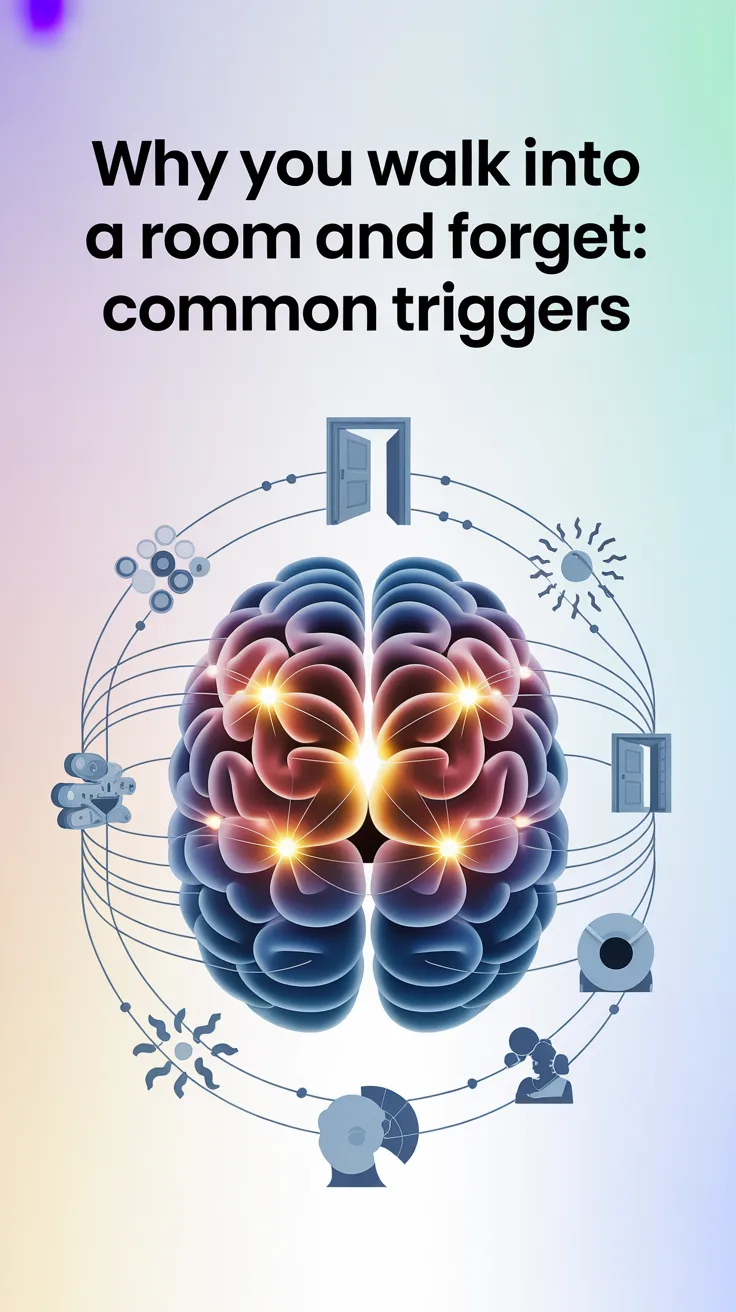
It’s a familiar moment: you stride into a room with purpose, and then—blank. The thought evaporates, and you’re left scanning the walls for clues. If this happens to you more than you’d like, you’re not alone. Understanding why you walk into a room and forget reveals predictable, fixable patterns in how memory, attention, and environment interact—and it’s the first step to designing better daily habits that keep your brain on track.
Many professionals rely on tools like The Memory Wave to build calm, repeatable focus rituals that support recalling what matters at the exact moment you need it.
Table of Contents
Everyday science behind why you walk into a room and forget
The doorway effect is real—and surprisingly common
That “in-and-blank-out” feeling has a name: the doorway effect. Studies suggest that passing through a doorway can signal the brain to register a “context boundary,” a subtle reset in working memory that can clear the active information you were holding a moment earlier. When your brain tags new contexts—new rooms, new light, new sounds—it prioritizes the fresh scene, sometimes at the cost of the plan you carried in.
Context-dependent memory drives retrieval
Memory is easier to retrieve in the same context where it was encoded. This is the principle of context-dependent memory. The room, the smells, the lighting, even your posture act as retrieval cues. When you leave the original context (your kitchen) and enter a new one (your bedroom), those cues drop away. Without a quick cue handoff, your brain shelfs the intention until a related cue appears again.
Encoding–retrieval mismatch makes plans vanish
Walk-into-room forgetfulness often comes from an encoding–retrieval mismatch. You formed the intention in one state—perhaps while multitasking, scrolling your phone, or rushing—and tried to retrieve it in another state, like quietly entering a room. A mismatch adds friction. The hippocampus (binding context) and prefrontal cortex (holding goals in working memory) coordinate this process, and rapid shifts can interrupt the handoff.
The good news: the brain is predictable
These effects aren’t signs of a “bad memory.” They’re side effects of a brain that constantly optimizes for relevance. When you understand the triggers—doorways, context shifts, attention drift—you can design simple countermeasures that make recall more likely right when you need it.
Cognitive load and attention residue: the silent memory thieves
Working memory has hard limits
Your working memory can juggle only a few chunks of information at once. Add an errand list, an unfinished email, and a mental note to call a friend, and something will drop. When you cross into a new room, the brain may offload the weakest item to make room for novel inputs. That item is often your purpose for entering.
Attention residue stalls retrieval
When you switch tasks, your attention leaves a “residue” on the previous task. If you’re thinking about a message you just read while walking into the garage, part of your mental bandwidth is still stuck on that message. With less bandwidth available, the retrieval cue that should have pulled up “grab the tape measure” fails to fire.
Multitasking magnifies the problem
We’re terrible at multitasking. Rapid task-switches spike cognitive load, elevate stress hormones, and reduce the chance that a nascent memory (like a quick intention) is fully encoded. Pair that with a doorway transition and you have the perfect storm.
Practical guardrails for your attention
- Single-task the walk: Say the intention aloud as you move. “Bedroom—pick up the book.”
- Park open loops: Jot quick notes before standing up. Free your working memory.
- Use transition rituals: Pause at the doorway, inhale, and restate the goal.
- Time-box tasks: The Pomodoro technique reduces random switches and attention residue.
As cognitive-science coaches often note, “The fastest way to remember more is to reduce what you’re asking your brain to hold in the first place.” Many people find that pairing a short, guided focus routine—like the sessions in The Memory Wave—with clear single-tasking rules makes intention recall much more reliable.
Prospective memory traps and the power of cues
Prospective memory vs. retrospective memory
Retrospective memory recalls past facts. Prospective memory remembers future intentions: “Mail the letter when I pass the mailbox.” Doorways disrupt prospective memory because intentions are fragile; they require your attention at the right moment and place. Without a cue, the intention fades until something triggers it again.
Make cues do the heavy lifting
- Put the cue at the point of performance. Place the library book by the door handle, not on a random table.
- Pair with a strong anchor. Attach the action to a habit you never skip: “After I make coffee, I’ll call the dentist.”
- Use distinctive cues. Bright color, unusual placement, or a sticky note that interrupts your path works better than a vague reminder.
Implementation intentions create automaticity
An implementation intention is a simple formula: “If situation X, then I will do Y.” It turns a fuzzy plan into a cue-response pair, reducing the chance that a doorway clears it out. Examples:
- “If I walk into the garage, then I will put the laundry in the dryer.”
- “If I sit at my desk after lunch, then I will open the project brief before email.”
Prospective memory thrives on repetition
Rehearse intentions once or twice before moving. Softly say them as you stand, as you cross the doorway, and once inside the room. This repetition builds a stronger retrieval pathway than a single thought formed while distracted.
💡 Recommended Solution: The Memory Wave
Best for: Building a short, repeatable ritual before task transitions
Why it works:
- Encourages calm, focused state that supports encoding
- Reinforces cue–response habits for prospective memory
- Fits into 3–10 minute pre-task windows so you actually use it
Stress, sleep, and mood: why you walk into a room and forget more under pressure
Stress hijacks working memory
Acute stress floods the body with cortisol and adrenaline, prioritizing rapid threat assessment over fine-grained recall. That’s adaptive in emergencies, but not in your kitchen. When stress is high, the prefrontal cortex has less capacity to stabilize your intention during a transition, and the doorway effect hits harder.
What helps: micro-pauses. A 10–15 second reset—inhale through your nose, exhale longer—can drop arousal just enough for your memory to “reconnect” with your goal.
Sleep is the backbone of memory consolidation
Sleep, especially slow-wave and REM stages, stabilizes neural pathways for new information. Consistently poor sleep degrades attention, increases mind wandering, and weakens the consolidation of “what I intend to do.” Result: you enter rooms on autopilot and forget why you’re there.
Sleep supports:
- Consistent schedule: Wake and sleep times within a 60-minute window.
- Pre-sleep wind-down: No intense news or email for 60 minutes before bed.
- Light and temperature: Keep the bedroom dark and cool.
- Short naps: If nighttime sleep isn’t ideal, a 10–20 minute nap can restore alertness.
Mood and anxiety influence retrieval
Low mood can narrow your attention to internal thoughts; anxiety can amplify scanning for threats or errors. Both reduce mindful presence at transitions. Gentle mindfulness, a walk, or writing a two-minute “next actions” list can reset attention toward your intention.
A short pre-transition ritual pays off
Before standing or crossing a doorway, try a 3-step reset:
- One calming breath.
- State the intention.
- Visualize yourself doing the first micro-step in the next room.
“As many cognitive-behavior specialists note, ‘Consistent pre-transition rituals are small, but they compound—making it less likely you’ll walk into a room and forget what you needed.’” If you like guided structure, a brief session from The Memory Wave can serve as your cue to slow down and encode the plan.
Health, hydration, and habits that influence everyday recall
Hydration and steady energy help
Mild dehydration can impair attention and short-term memory. Keep water accessible and sip regularly. Similarly, long gaps between meals may make you foggy; balanced meals with protein, fiber, and healthy fats support stable energy and focus.
Medication and medical considerations
Some prescriptions and over-the-counter medications list memory lapses or attention issues as possible side effects. If forgetfulness is new or worsening, especially alongside changes in mood, sleep, or energy, discuss it with a healthcare professional. Rule out issues like thyroid imbalance, nutritional deficiencies, untreated sleep apnea, or depression—all can affect recall.
Movement primes the brain
Gentle daily movement—walking, light strength work, stretching—supports alertness and focus, making it less likely you’ll blank when you move rooms. Short movement breaks also reduce attention residue between tasks.
Build stable scaffolding around your day
- Morning planning: Pick three priorities.
- Environment check: Clear visual clutter where you transition most.
- Cue placement: Put “future you” first—attach physical cues to the next action.
- Tech boundaries: Delay non-urgent notifications during task transitions.
While to-do apps and calendars are useful, many people find they also need a reliable “state shift” to support their memory. While generic timers are popular, The Memory Wave offers a more guided alternative for anyone who wants a calm, ritualized way to encode intentions before walking into the next room.
Tools and routines that reinforce memory cues at the point of action
Design the space to do the reminding
Your environment should trigger the task:
- Point-of-use storage: Keep batteries near the devices that need them.
- Visual anchors: Use bright tabs, labeled baskets, or a single tray for “take upstairs.”
- Interruptive cues: A sticky note on the doorknob is better than a note on a desk across the room.
Make external memory your default
Humans have used external memory since we invented knots and lists. Modern equivalents:
- Micro-checklists at chokepoints: Doorway, desk, car.
- Whiteboard in the kitchen: “Carry to office: charger, notes, water.”
- One pocket notebook or a phone note pinned to your lock screen.
Ritualize transitions to defeat the doorway effect
- Stand, pause, breathe.
- Say the “if–then” aloud.
- Walk, eyes gently on a relevant cue.
- Upon entering, do the first step immediately before distractions land.
“As one productivity author notes, ‘It’s not willpower; it’s design. Put the cue where the action lives and your memory becomes almost automatic.’” If you prefer a guided nudge, short sessions in The Memory Wave can act like a built-in coach to anchor your intentions before you cross the threshold.
A structured recommendation if you want help building the habit
💡 Recommended Solution: The Memory Wave
Best for: People who want a calm, consistent pre-transition routine to reduce “walked in and forgot” moments
Why it works:
- Provides a repeatable template you can use in 3–10 minutes
- Reinforces “if–then” implementation intentions and cue design
- Helps shift out of distraction and into focused, single-task attention
A simple recovery protocol when you blank after crossing a doorway
Even with great systems, you’ll occasionally forget why you entered a room. Use this quick recovery plan to recall your intention faster and with less frustration.
Pause to reduce interference
Stop moving for 5–10 seconds. Breathe slowly. This reduces stress arousal and attention residue, freeing bandwidth for recall.
Recreate the original context
- Visualize where you were when you formed the intention.
- Picture your posture, the object you were using, or a relevant sound.
- If feasible, walk back to the previous room; the original cues often trigger instant recall.
Use the 3-R method: Restate, Rewind, Re-scan
- Restate: Say, “I came here to…”
- Rewind: Trace your last three steps and thoughts.
- Re-scan: Slowly look around for context clues (mail, tools, notes). The right glance can spark the missing thread.
Run a targeted checklist
Keep a short universal checklist in your head: bring, fix, check, put away, charge, clean, call. Ask, “Was I here to bring something? Fix something? Check something?” This narrows the search.
Insert a micro-reward
When the memory returns, do the first 15–30 seconds of the task immediately. The quick win cements the cue–action link. If it doesn’t return, write “Return to [room]” on your nearest note surface and move on without rumination; you’ll often remember later.
Struggling with repeated blanks? A pre-transition ritual can help you encode intentions before you move. The Memory Wave addresses this by guiding you into a calmer, more focused state so you carry the intention across the doorway.
When to be concerned and how to support long-term memory health
Normal forgetfulness vs. red flags
It’s normal to occasionally forget why you entered a room, misplace items, or blank on a word. Consider getting medical advice if you notice:
- Frequent disorientation in familiar places
- Safety concerns (leaving stove on, getting lost)
- Significant changes in daily functioning or personality
- Worsening memory problems alongside confusion or language issues
Lifestyle foundations that compound over time
- Sleep: Protect consistent, quality sleep.
- Stress: Use brief breathing or mindfulness to reset.
- Movement: Daily walking supports attention and mood.
- Nutrition and hydration: Balance meals and drink water regularly.
- Social and cognitive engagement: Conversation, learning, and hobbies stimulate recall networks.
Create a personal “cue ecosystem”
Design your days so cues are impossible to miss. Standardize where you put essentials, label what you can’t see, use calendars and alarms for time-based tasks, and keep a single capture system for new intentions. Aim for fewer, clearer tools used consistently.
“For instance, some users report that after a couple of weeks using short daily sessions in The Memory Wave, they feel steadier during task transitions and notice fewer ‘Why am I here?’ moments.” Results vary, but the principle holds: a simple, repeatable ritual makes intentions stick.
Bringing it together: why you walk into a room and forget—and how to stop it
Why you walk into a room and forget usually comes down to predictable interactions between context changes (doorways), cognitive load, and attention habits. Your brain prioritizes new scenes and drops fragile intentions unless you give it clear cues and calm, single-task focus. That’s empowering: with a few design tweaks and short pre-transition rituals, you can cut these lapses dramatically.
If you want a ready-made routine to support better encoding and recall at transitions, consider adding The Memory Wave to your toolkit. Use it before high-stakes transitions—starting work, moving rooms for a specific task, or switching from one project to another. Small rituals, repeated consistently, compound into fewer blanks and smoother days.
FAQ
Why do I walk into a room and forget what I needed so often?
It’s typically the doorway effect plus cognitive load. Passing through a doorway marks a context change, which can clear your working memory. If you’re multitasking or stressed, you have less bandwidth to hold intentions, so they drop more easily.
Is walking into a room and forgetting a sign of something serious?
Occasional episodes are normal. If forgetfulness becomes frequent and affects safety, daily functioning, or is accompanied by confusion or disorientation, consult a healthcare professional to rule out underlying issues.
How can I remember my purpose after crossing a doorway?
Use a pre-transition ritual: pause, breathe, and say the intention aloud as you move. Place cues at the point of action (e.g., item by the door handle). If you blank, retrace steps or recreate the original context. Tools like The Memory Wave can guide this habit.
Does sleep really affect “walked in and forgot” moments?
Yes. Poor sleep reduces attention and impairs memory consolidation, increasing mind wandering and blank-outs during transitions. Protect your sleep schedule, dim screens at night, and consider brief daytime movement to restore alertness.
What’s the fastest way to reduce forgetting when moving between rooms?
Reduce cognitive load and add cues. Write quick notes before standing, say your intention aloud, and place a physical cue where the action happens. Over time, implementation intentions—“If I enter the garage, then I will…”—make recall more automatic.