f you’ve seen bold promises about binaural beats, isochronic tones, or “frequency hacks,” you might wonder what’s real and what’s hype. This practical guide breaks down Brainwave Audio Myths vs Reality: What Research Says (Simple), so you know how these sounds work, what studies actually show, and how to use them safely for focus, calm, sleep, and learning—without falling for gimmicks.
💡 Recommended Solution: Brain Song Original
Best for: Getting started with simple, guided listening sessions
Why it works:
- Clear structure for short daily sessions
- Designed to support calm focus without complex setup
- Easy entry point if you’re new to brainwave audios
Table of Contents
How brainwave audios work in plain language
Brainwave audios are designed around a simple principle: your brain’s electrical activity tends to synchronize, or “entrain,” to rhythmic stimulation. In everyday life, entrainment shows up when you tap your foot to a beat or feel calmed by ocean waves. With audio entrainment, rhythmic pulses are embedded to nudge your brain into ranges associated with calm (alpha), focused attention (beta), creativity and meditation (theta), or deep rest (delta).
Common formats:
- Binaural beats: Two slightly different tones presented separately to each ear that your brain interprets as a single “beat” at the difference frequency. Headphones required.
- Isochronic tones: Distinct pulses turning on and off at a set rate. These can be used with or without headphones.
- Monaural beats: Two tones mixed before they reach your ears to create a single beat pattern. Headphones optional.
Typical aims:
- Relaxation or state-shifting (e.g., transition from busy alertness to calmer focus)
- Pre-sleep wind-down and sleep onset
- Focused study or creative ideation
- Meditation training alongside breath or body awareness
What this is not: magic, instant IQ upgrades, or a substitute for sleep, nutrition, movement, therapy, or medical care. Entrainment is a nudge, not a transplant. The sound scaffolds a mental state you’re already capable of reaching, which can feel like training wheels for your nervous system.
Where research fits in: Published studies differ in design quality, duration, and populations, so results vary. Some randomized controlled trials (RCTs) show modest benefits for anxiety reduction, perceived stress, sleep onset, and aspects of attention. Other outcomes (like big jumps in intelligence or dramatic memory upgrades) are not supported. This guide distills the clearest patterns so you can set realistic expectations and build a routine that actually fits your life.
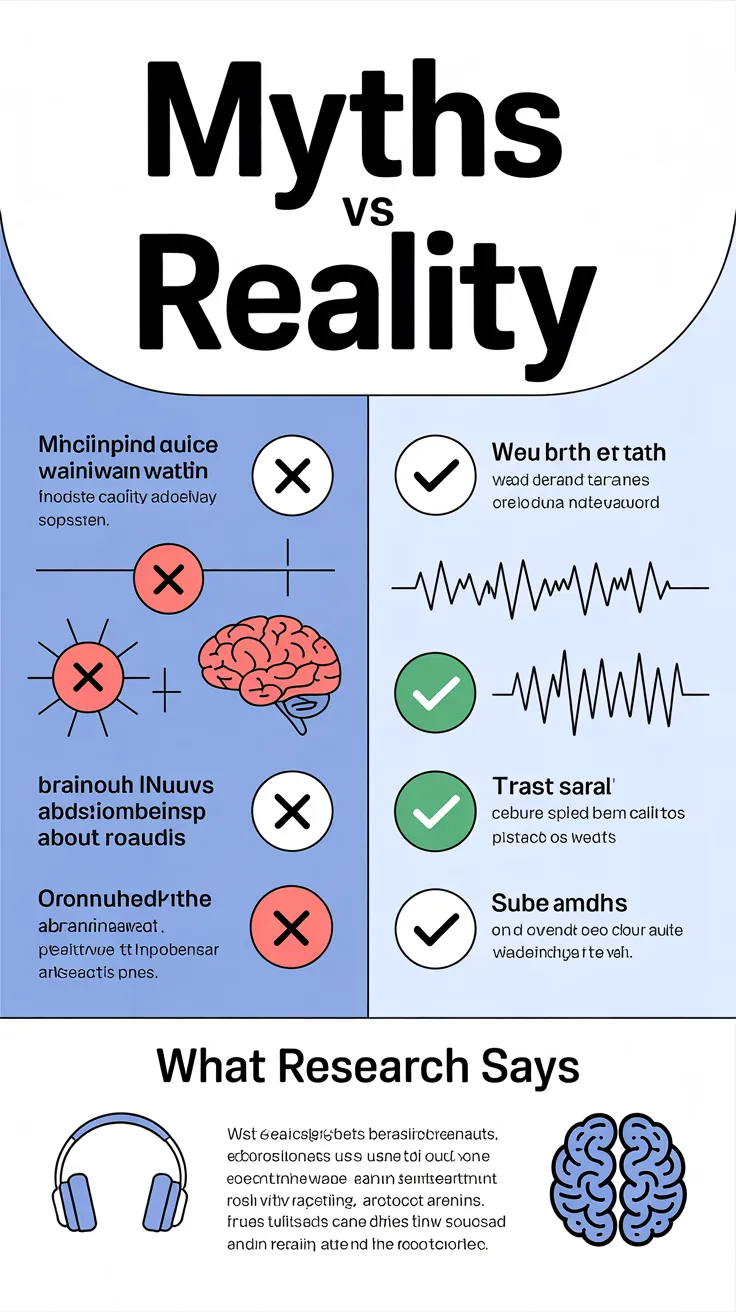
Brainwave Audio Myths vs Reality: What Research Says (Simple) about outcomes
Myth: “Binaural beats unlock dormant brain regions.”
Reality: The “10% of the brain” myth is false. Functional brain imaging shows we use most regions over time. Entrainment can influence rhythmic activity (like more alpha power for relaxation), but that’s a far cry from unlocking unused areas.
Myth: “One track cures ADHD, anxiety, or insomnia permanently.”
Reality: Evidence supports state changes—feeling calmer, falling asleep faster, sustaining focus for a work block—not permanent cures. Some studies report short-term improvements in stress, attention, and sleep parameters. Long-term effects depend on consistent practice, lifestyle alignment, and, when needed, professional care.
Myth: “Higher frequency equals better results.”
Reality: “Best” frequency depends on your goal and individual variability. For relaxation, alpha (8–12 Hz) and low-theta (4–7 Hz) are typical; for focus, low-beta (12–15 Hz or 15–20 Hz) is common. More intense or faster isn’t necessarily better; the match to your current state and task matters.
Myth: “Only binaural beats work.”
Reality: Isochronic and monaural approaches also demonstrate entrainment in EEG studies, and some listeners prefer them. Choice often comes down to preference, environment, and whether you use headphones.
Myth: “You’ll get instant, dramatic cognitive boosts.”
Reality: Studies point to modest, context-dependent benefits. For example, reduced state anxiety after sessions, small improvements in attention tasks, or smoother sleep transitions. Think “useful nudge,” not “overnight transformation.”
Myth: “It’s placebo only.”
Reality: Expectation effects play a role in nearly all behavioral interventions. But EEG studies show genuine entrainment (changes in brain rhythm power), and RCTs suggest specific benefits beyond placebo for certain outcomes like anxiety or sleep onset. Still, individual response varies, and mindset can amplify or blunt results.
Bottom line: Use brainwave audio as a tool to shape your state before key activities—writing, studying, creative work, meditation, or sleep—and track whether it moves the needle for you. Expect gradual, meaningful improvements, not miracles.
What the studies actually show, in everyday terms
Anxiety and stress: Several trials report reductions in state anxiety after sessions that guide listeners into alpha or theta ranges. These are generally short-term benefits (you feel calmer after listening), with some carryover if used consistently. This aligns with user reports of easier “downshifting” from busy to calm.
Sleep: Research indicates potential help with sleep onset latency (falling asleep faster) and improved pre-sleep relaxation. Tracks that use theta-to-delta transitions or gentle rhythmic patterns can support wind-down routines. As with many sleep aids, consistency matters—using an audio prompt as part of a bedtime ritual strengthens the cue.
Attention and working memory: Findings are mixed. Some participants show improvements in sustained attention or task performance during or after low-beta sessions; others show no significant change. If you’re sensitive to external rhythm while working, low-beta or SMR-like ranges (12–15 Hz) can feel stabilizing; if you’re easily overstimulated, aim for calmer alpha with low-volume background textures.
Mood and pain: Preliminary evidence suggests entrainment may help with perceived pain and mood regulation for some people, but protocols vary, and more robust trials are needed. Treat these as complementary supports rather than primary treatments.
Meditation synergy: Many meditators use entrainment early in practice to establish a consistent focus or to facilitate body awareness. Over time, you may rely less on external cues as your nervous system internalizes the pattern. Think of entrainment as a ramp onto the highway of practice.
Effect sizes and expectations: Benefits tend to be modest at the population level and meaningful for certain individuals. That is normal: individual differences in baseline arousal, sensitivity to rhythm, and environment shape outcomes. A sensible approach is to run a personal 7–14 day trial for a single goal (e.g., 25-minute focus blocks, or 30-minute wind-down for sleep), and measure what changes.
Many professionals rely on tools like Brain Song Original or The Memory Wave to structure these experiments—mainly because they remove guesswork about session length and frequency targets, letting you focus on habit consistency and outcome tracking.
Brainwave Audio Myths vs Reality: What Research Says (Simple) about safety and use
General safety: For most healthy adults, brainwave audio at comfortable volumes is low risk. Keep volume moderate, especially with headphones. If you have a history of seizures, epilepsy, or sound sensitivity, consult a clinician and avoid flickering visual entrainment. Never use entrainment while driving or operating machinery.
Headphones vs speakers:
- Binaural beats require headphones for the effect.
- Isochronic or monaural pulses can work via speakers. Headphones still improve consistency by blocking ambient noise.
Session timing and duration:
- Focus/Work: 20–40 minutes, then break.
- Meditation: 10–30 minutes, ramping by 5-minute increments weekly.
- Sleep: 20–45 minutes while winding down, ideally finishing before sleep or set on a timer.
- Stress relief: 10–20 minutes midday can reset your arousal level.
Volume and layering: Keep the entrainment track audible but not dominant. You can layer gentle ambient sounds or pink noise. Avoid complex lyrical music during focus unless you know it helps you.
Progression: Start with fewer variables. For focus, test a low-beta or SMR-style session for a week. For relaxation or sleep, try alpha-to-theta transitions. Adjust one parameter at a time (duration, time of day, frequency) and log outcomes.
Mid-content recommendation (Problem–Solution Bridge):
Struggling to settle into steady focus blocks? Brain Song Original addresses this by providing guided, consistent sessions designed to reduce setup friction—so you can sit, press play, and work.
“As many cognitive performance coaches note, ‘Brain Song Original has become a go-to starting point for clients because simple, repeatable sessions make habit formation more likely.’” This captures the core idea: the best protocol is the one you’ll actually repeat.
How to choose quality tracks and avoid red flags
What to look for:
- Clear purpose and session length: A track labeled for “calm focus” with a 25–30-minute structure is easier to test than vague promises.
- Transparent approach: Indication of entrainment type (binaural, isochronic, monaural) and intended frequency range.
- Gentle sound design: Stable, non-distracting textures for focus; soothing, low dynamic range for sleep and relaxation.
- Progressive options: Short sessions for beginners, with the option to extend as you build tolerance.
What to be cautious about:
- “Cure-all” claims: No single audio solves complex mental health conditions or permanently transforms cognition.
- Guaranteed IQ or memory doubles: Unsupported by evidence. Look for realistic, functional outcomes like “easier to start tasks,” “faster pre-sleep wind-down,” or “more consistent meditation.”
- Aggressive volume or harsh pulses: If it feels irritating, it is counterproductive; entrainment should support—not fight—your nervous system.
Self-test blueprint:
- Define one goal (e.g., two Pomodoro focus blocks daily).
- Select one track type (e.g., low-beta).
- Run it for 7–14 days at the same time daily.
- Log tangible metrics (tasks completed, subjective focus 1–10, time-to-sleep, pre/post stress ratings).
- Adjust one variable and repeat.
While generic YouTube playlists are popular, The Memory Wave offers a more structured alternative for learners who want session-based memory support. Its value is in removing decision fatigue so you can focus on practice rather than configuration.
If your main aim is recall during study cycles, using a dedicated session from The Memory Wave between spaced-repetition reviews can create a consistent, calm state that pairs with retrieval practice.
Practical routines for focus, sleep, learning, and calm
Focus at work:
- Use 25–40-minute low-beta or SMR-style sessions. Pair with a task list and a “do not disturb” block. After each session, take a 5-minute break away from screens.
- Keep volume low. If you find the pulses distracting, switch to gentler isochronic or monaural textures, or a blended track with ambient layers.
Learning and memory:
- Pre-study priming: 5 minutes of slow breathing, then 20–30 minutes of alpha/low-beta entrainment while you read or do practice problems.
- Retrieval consolidation: After a study block, 10 minutes of eyes-closed alpha can help you reset before the next topic.
- Spaced repetition: Align entrainment with your review windows. Consistency builds state-dependent memory cues.
Sleep wind-down:
- Build a 30-minute wind-down ritual: lights dimmed, screens off, a theta-to-delta track at very low volume. Add a timer that fades out.
- If your mind races in bed, try a 10-minute body scan over the first half of the track.
Calm resets:
- Midday stress: 10–15 minutes of alpha with gentle breathing can nudge your arousal down, preventing late-afternoon crashes.
Case study example (generalized):
An editor with afternoon brain fog adopted two daily focus sessions (30 minutes each) for two weeks. She kept a simple score: tasks completed and perceived mental friction (1–10). By week two, she reported steadier starts and fewer context switches. Notably, she made parallel changes—blocking notifications and prepping a task list. The takeaway: entrainment worked best as part of a system, not a standalone trick.
If you prefer not to cobble together a routine, a guided option like Brain Song Original can scaffold your first two weeks. For study-centric routines, The Memory Wave gives you a consistent platform to pair with note-taking and recall practice.
Mindset, measurement, and making progress stick
Why mindset matters: Expectation effects can boost or blunt results. Treat your first two weeks as a curious experiment, not a high-stakes test. Many people notice the biggest benefit from having a ritual that signals the brain, “Now we focus” or “Now we slow down.”
Measurement that’s simple enough to sustain:
- For focus: Count completed deep-work blocks, and rate distraction 1–10.
- For sleep: Track time to fall asleep, night awakenings, and morning refreshment 1–10.
- For stress: Rate tension pre/post session (jaw/shoulder tightness, breath rate).
Adjustments when you plateau:
- Change the time of day (earlier or later).
- Try a different entrainment type (isochronic instead of binaural, or vice versa).
- Shorten sessions if you get restless; increase if you feel underdosed.
- Pair with one complementary lever: a 2-minute breath protocol, a glass of water, or a short walk beforehand.
Troubleshooting:
- Headaches or irritation: Lower volume, switch to a softer sound bed, or reduce session length.
- Sleep disruption: Avoid high-beta near bedtime; aim for alpha-theta and keep volume low.
- No change after 14 days: Revisit your goal, switch track type, or consider whether noise, caffeine timing, or workflow issues are overriding the entrainment effect.
To jumpstart a low-friction routine, pick a single goal for the next 7 days. Use Brain Song Original for two daily focus blocks, or layer The Memory Wave into your study sessions. Keep a two-line log. Optimize next week.
Tools and resources for getting started
Brainwave audio platforms:
- Brain Song Original — Simple, guided sessions ideal for building a daily focus or calm routine without overthinking settings.
- The Memory Wave — Structured sessions aligned with study and recall practice, helpful for learners who want a consistent flow.
Supportive practices:
- Breathwork: 4–6 breaths per minute for 3 minutes pre-session improves readiness.
- Habit cues: Same chair, same time, same warm beverage—reduce decision fatigue.
- Analog companions: A paper task list or timer amplifies the “work now” signal.
Evaluation checklist:
- Does the track specify its intent and length?
- Can you comfortably run it daily for 7–14 days?
- Does your log show change in the direction you want?
Alternative approaches if audio isn’t your thing:
- White or pink noise for distraction masking.
- Environmental design: noise-blocking headphones, plants, lighting tweaks.
- Timed breathing or progressive muscle relaxation before sleep.
💡 Recommended Solution: The Memory Wave
Best for: Students and lifelong learners doing spaced repetition
Why it works:
- Consistent session structure to reduce pre-study anxiety
- Easy to pair with recall practice and review cycles
- Helps build a reliable “study state” cue over time
Conclusion: keeping Brainwave Audio Myths vs Reality in perspective
Brainwave Audio Myths vs Reality: What Research Says (Simple) is this: entrainment nudges, not miracles. Research supports modest, context-specific benefits for calm, focus, and sleep onset, especially when folded into a consistent routine and healthy habits. Choose clear, purpose-built tracks, run short experiments, and let data—not hype—guide your next step. Whether you use Brain Song Original for daily focus or The Memory Wave for study sessions, keep it simple, repeatable, and aligned with your goals.
FAQ
What is the simplest explanation of Brainwave Audio Myths vs Reality: What Research Says (Simple)?
It means brainwave audios can help shift your mental state—calmer, more focused, readier for sleep—but they don’t deliver dramatic, permanent cognitive upgrades. Benefits are modest, depend on the goal and individual differences, and improve with consistent use and good habits.
Do binaural beats work better than isochronic tones?
Neither is universally “better.” Binaural beats require headphones and can feel subtle; isochronic tones work with or without headphones and can feel more pronounced. Your preference and context matter. Test one approach for 7–14 days for a single goal and track outcomes.
Can brainwave audio cure anxiety, ADHD, or insomnia?
No. It’s not a cure. Studies show short-term reductions in state anxiety, improvements in focus for some users, and potential help with sleep onset. Use brainwave audio as a supportive tool alongside evidence-based care and healthy routines.
How long should I listen each day for results?
Start with 20–30 minutes for focus or meditation and 20–45 minutes for sleep wind-down. Keep volume comfortable. Test at the same time daily for 7–14 days, log your results, and adjust session length or timing based on your data.
Is it safe to use brainwave audio daily?
For most healthy adults, yes—at moderate volumes and with common-sense precautions. Avoid use while driving or in situations requiring full external awareness. If you have a history of seizures or sound sensitivity, consult a clinician.
Can brainwave audio improve memory for studying?
It can help by setting a consistent mental state that supports learning and recall practice. Pair entrainment with spaced repetition, active recall, and breaks. Tools like The Memory Wave are designed to make that routine easier to sustain.
Is it just placebo?
Placebo and expectation effects influence most behavioral tools, but EEG studies show real entrainment of brain rhythms, and some trials indicate benefits beyond placebo for outcomes like stress and sleep onset. Your own results will depend on consistency, fit to your goals, and environment.
Disclaimer: This article is for informational purposes and does not constitute medical advice. Consult a healthcare professional for personalized guidance.