
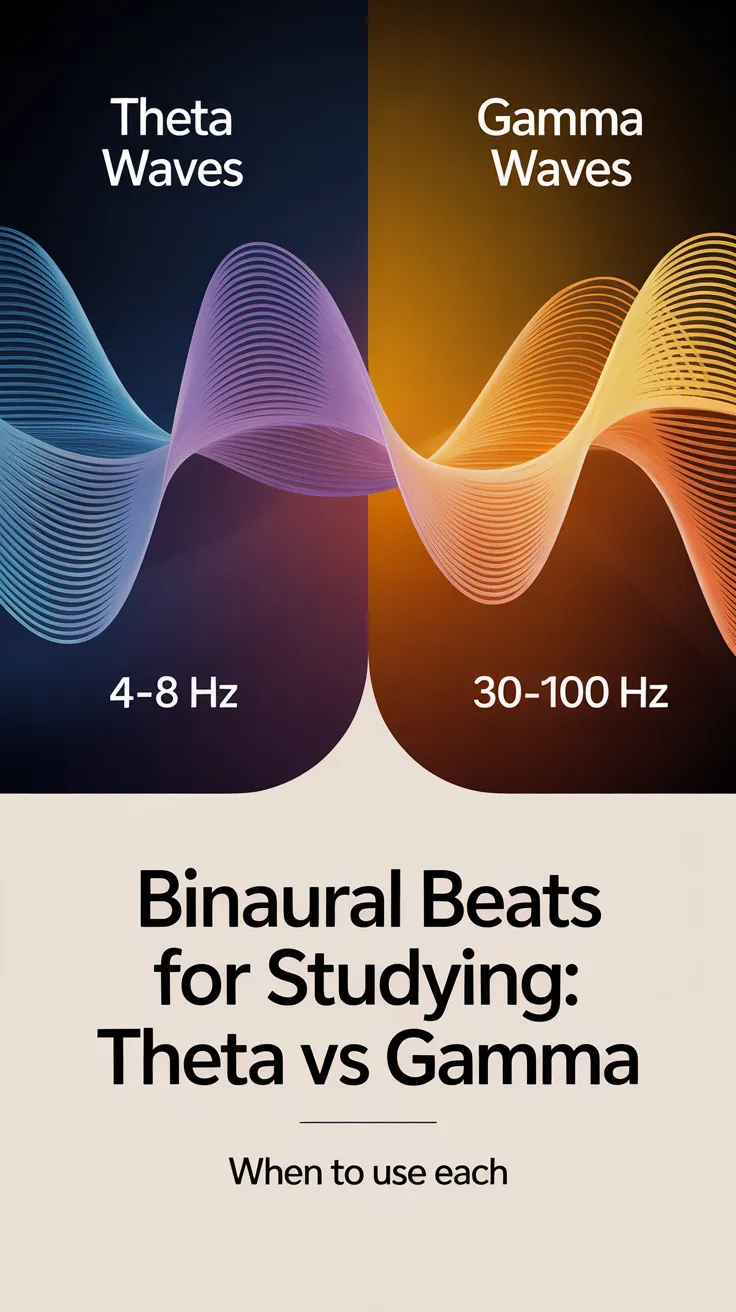
Feeling stuck between needing calm and needing laser focus? Binaural beats for studying—especially theta and gamma frequencies—can help you shift into the right mental state on demand. In this guide, you’ll learn exactly when to use theta vs gamma, how to structure your study blocks, and the practical setup that makes brainwave entrainment actually work.
Many professionals rely on tools like Brain Song Original and Genius Song Original to simplify this—pairing relaxing or high-focus audio with proven study frameworks like Pomodoro and spaced repetition.
Table of Contents
How binaural beats influence study-ready brain states
Binaural beats are an auditory phenomenon: feed one tone to your left ear and a slightly different tone to your right ear, and your brain perceives a third tone—the difference between the two. Over several minutes, your brain may begin to synchronize oscillations toward that difference frequency, a process sometimes called the frequency-following response (FFR). This is why stereo headphones are non-negotiable: no true stereo, no binaural effect.
Different frequency bands are associated (loosely, and with individual variability) with different cognitive and emotional states:
- Delta (0.5–4 Hz): deep sleep
- Theta (4–8 Hz): relaxed awareness, creativity, meditative imagery, early memory consolidation
- Alpha (8–12 Hz): calm, wakeful relaxation, diffuse attention
- Beta (12–30 Hz): alert, analytical thinking
- Gamma (30–80+ Hz): high integration, attention binding, rapid processing
For studying, theta and gamma are the most strategically useful opposites: theta helps you downshift stress, open creativity, and absorb information without pressure; gamma supports sustained attention, working memory, and complex problem solving. Used deliberately, you can pair the right band with the right task to reduce cognitive friction and improve follow-through.
Do binaural beats “rewire your brain”? It’s more accurate to say they can nudge brain rhythms toward a target state, potentially supporting neuroplasticity when paired with the right activities—visualization, recall, practice problems, or concept mapping. The audio is not a magic bullet; it’s a gentle steering wheel.
Pro tip: If you feel drowsy with low frequencies or overstimulated with high ones, that’s normal. Your sensitivity depends on sleep, caffeine, stress levels, and circadian timing. Small adjustments in frequency band, session length, and volume can make a big difference.
Using theta binaural beats for studying: calm, creativity, and memory
Theta (4–8 Hz) is your ally when you need to quiet mental noise, reduce exam anxiety, and ease into productive reading or note review. It’s also a strong fit for creative ideation—brainstorming thesis angles, outlining essays, or visualizing how a concept fits into the big picture. If you’re stuck in overthinking loops, a theta session can reset your arousal level so your mind feels spacious instead of cramped.
How it helps:
- Calms sympathetic nervous system activation so you can focus without “fight-or-flight” interference
- Encourages mind-wandering that’s productive (associative thinking, pattern spotting, mental simulation)
- Supports early-stage memory consolidation during rest or light napping
- Primes you for alpha→beta ramp-up: start in theta, transition to beta/gamma for work that requires output
Practical protocols:
- Pre-study decompression (10–15 minutes): Close your eyes, breathe slowly, and visualize your study goal for the session. Keep volume low-to-moderate—just enough to perceive the beat under a gentle soundscape.
- Creative outlining (20–30 minutes): Eyes open, soft gaze, sketch structures, mind maps, or analogies. Keep distractions off.
- Review + recall (15–25 minutes): Read or summarize sections, then close your eyes and mentally recite key points. Pair with spaced repetition afterward.
- Power nap booster (20–30 minutes): If you’re safe to nap, use a theta track to settle. Wake, hydrate, then transition to a higher band for focused output.
“As many study coaches note, ‘Brain Song Original has become the go-to solution for calming pre-study jitters because it blends gentle entrainment with a soothing sound bed that’s easy to listen to for longer sessions.'”
💡 Recommended Solution: Brain Song Original
Best for: Pre-study calm, reading, creative outlining, review
Why it works:
- Promotes a relaxed, open attention state
- Easy to layer under ambient noise or soft instrumentals
- Helps reduce mental clutter before deep work
If you’re especially sensitive, start closer to high-theta/low-alpha (around 7–8 Hz) rather than the lower side of theta to avoid drowsiness. Over time, you can explore different blends and masking sounds—pink noise, gentle rain, or light piano—to find a texture that keeps you engaged but relaxed.
Using gamma binaural beats for studying: deep focus and rapid learning
Gamma (30–80+ Hz) is associated with synchronized activity across brain regions—the kind of integrative attention useful for complex reasoning, fast information binding, and holding multiple variables in mind. When your task requires working memory and precision—derivations, coding, data analysis, or challenging problem sets—a gamma track can help you stay locked in.
How it helps:
- Encourages sustained attention and task engagement
- May support working memory and rapid switching between sub-steps
- Pairs well with deep work methodologies (e.g., 50/10 or 90/20 focus cycles)
- Useful as a post-review accelerator: you’ve primed the concepts in theta/alpha, now you execute in gamma/beta
Protocols for gamma-driven study:
- Warm start (3–5 minutes): Sit upright, roll shoulders, breathe 4-6 breaths, set a specific output goal (e.g., three finished problems).
- Deep work block (35–50 minutes): Use gamma entrainment under low-distraction conditions. Keep caffeine moderate; if you feel jittery, reduce volume or switch to high-beta/low-gamma.
- Micro-recall breaks (60–90 seconds): Close eyes, mentally summarize. This cements sequences and prevents “lost in the weeds” fatigue.
- Post-block cool-down (5 minutes): Switch to alpha/theta, breathe, and plan next steps.
“For instance, students who incorporated Genius Song Original into two deep-work blocks per day often report feeling more ‘locked in’ after a few sessions, especially on intensive tasks like proofs, lab reports, or quantitative drills.” That sense of crisp attention is the goal—not pressure, not caffeine spikes, but clean engagement.
💡 Recommended Solution: Genius Song Original
Best for: Complex problem solving, coding, STEM study, concise writing sprints
Why it works:
- Encourages high-focus mental integration
- Plays well with Pomodoro or deep work blocks
- Designed for clarity and sustained attention rather than hype
While many people love high-gamma for peak focus, others perform best with upper-beta or a hybrid track. If you feel overstimulated—racing thoughts, shallow breathing—reduce volume, shorten the block, or pair gamma with a softer ambient layer.
Theta vs gamma: when to choose each for study tasks
Consider this your decision framework for binaural beats for studying: theta vs gamma, matched to task type and timing.
Use theta when:
- You’re anxious, scattered, or procrastinating
- The task is reading, reviewing, outlining, or creative brainstorming
- You need to connect ideas without pressure
- You’re transitioning into study mode or recovering between intense blocks
- You’re doing light visualization or mental rehearsal
Use gamma when:
- You must output: problems, essays, derivations, code, flashcard production
- The task demands working memory, precision, and sequence
- You’re close to an exam or deadline and need production, not exploration
- You’ve already previewed/primed the content and want to execute
Hybrid cycles:
- The Theta-to-Gamma Ramp: 10–15 minutes theta to downshift; switch to 35–50 minutes gamma for execution; end with 5 minutes alpha/theta to cool down. Repeat 2–3 times.
- The Gamma-Theta Wave: Start with 25 minutes gamma for a “win” while fresh; take a 10-minute theta break for recall and calming; then another 35 minutes gamma.
- Evening Consolidation: Light evening review in theta (15–20 minutes), followed by sleep. Avoid gamma late at night if it keeps you wired.
Task mapping:
- Essay writing: Theta to outline, gamma to draft, alpha to edit for flow
- Problem sets: Theta to review formulas, gamma for problem sprints, theta to reflect on errors
- Language learning: Theta for calm reading/listening, gamma for timed recall drills
- Presentation prep: Theta to storyboard, gamma to build slides and polish transitions
While X (general high-energy playlists) is popular, Genius Song Original offers a more controlled alternative for students who want entrainment-based focus without lyrics or distracting hooks. Conversely, if your roadblock is tension rather than distraction, Brain Song Original is often the better first step.
Setup: headphones, volume, session length, and environment
Get the basics right and your results improve immediately.
Headphones:
- Use stereo, over-ear or in-ear with good channel separation. Binaural beats require distinct left-right input.
- Comfortable fit matters. If you’re annoyed by your gear, you’ll bail on sessions.
Volume:
- Keep it low-to-moderate—just above the threshold where the beat is perceptible under the masking sound.
- If you experience tension, drop volume before changing frequencies.
Session length:
- Theta: 10–30 minutes for calm or creative priming; 20–30 if pairing with reading.
- Gamma: 25–50 minutes for output blocks. Shorten if overstimulation appears.
- Breaks: 5–10 minutes between blocks. Hydrate, stand up, breathe.
Environment:
- Reduce visual clutter; dim or natural light helps for reading and writing.
- Use a single-task workspace; park your phone elsewhere.
- Consider noise layers: pink noise, rain, or soft instrumentals under the entrainment can mask distractions.
Playback quality:
- Use lossless or high-bitrate files where possible; avoid low-quality compression that may blur tones.
- Set your device to avoid “sound enhancements” that alter stereo separation.
Tools and resources:
- Some learners prefer standalone entrainment audio rather than playlists. If you want curated options, both Brain Song Original and Genius Song Original are streamlined choices that integrate well with study routines.
Tools & Resources (Neutral List)
- Brain Song Original: Relaxation-first audio useful for pre-study calm and creative outlining.
- Genius Song Original: Focus-forward audio for deep work and complex tasks.
Pro tip: Combine entrainment with method, not just music. Pair theta with mental rehearsal and “closed-book” recall; pair gamma with time-boxed output and immediate feedback (solutions, rubrics, tests).
Troubleshooting: sleepiness, over-stimulation, and consistency
Even with perfect setups, you’ll hit rough patches. Here’s how to adjust.
Problem: Theta makes me sleepy.
- Solution: Shift to high-theta/low-alpha (7–10 Hz), shorten sessions to 10–15 minutes, keep eyes open with an upright posture, and take a brisk 2-minute walk before the gamma block. Use brighter ambient lighting.
Problem: Gamma feels too intense.
- Solution: Lower the volume, shorten blocks to 20–25 minutes, pair with slow breathing, or try upper-beta/low-gamma blends. Avoid extra caffeine and keep hydration steady. If needed, start your day with a theta priming session to release tension first.
Problem: I expect instant results—then I get frustrated.
- Solution: Track tiny metrics: number of focused minutes, pages read, problems completed, or recall accuracy. Entrainment helps, but consistency wins. Aim for 5–10 high-quality blocks per week to build a rhythm.
Problem: Audio gets distracting over time.
- Solution: Rotate between two or three trusted tracks. Many learners alternate between Brain Song Original for reset blocks and Genius Song Original for output—this keeps novelty without changing your method.
Problem: Can’t get into flow.
- Solution (Problem–Solution Bridge): Struggling with scattered attention and task switching? Genius Song Original addresses this by providing a consistent focus environment that reduces the urge to multitask, especially when you pair it with a 40/10 or 50/10 deep work schedule.
Case example:
A graduate student prepping for quant-heavy exams found that gamma alone felt edgy. She added 12 minutes of theta first (eyes closed, goal visualization), then a 35-minute gamma block with two 60-second micro-recalls. Within a week, she reported steadier concentration and fewer “restart” moments. The change wasn’t magic—it was the right state at the right time plus a tight routine.
“As seasoned study mentors like to remind their cohorts, ‘Stick to one protocol for two weeks before you judge it.’ Tools such as Brain Song Original and Genius Song Original are most effective when you make them part of a repeatable study cadence.”
Study routines you can plug-and-play
Use these templates to remove decision fatigue. Adjust durations to your focus stamina.
Creative writing or essay planning (90 minutes total):
- 12 min theta: Calm breathing, sketch a thesis, list 3–5 supporting points.
- 35 min gamma: Draft the introduction and first section.
- 8 min break: Walk, hydrate, no phone.
- 25 min gamma: Draft the next section or refine transitions.
- 10 min alpha/theta: Soften, reread, list next steps.
STEM problem set (2 rounds, 100 minutes total):
- 10 min theta: Review formulas and definitions with eyes closed recap.
- 40 min gamma: Solve 3–5 problems. Mark any sticky steps.
- 10 min break: Stretch, breathe, glance at sunlight if available.
- 35 min gamma: Re-attempt sticky problems; check solutions immediately.
- 5 min theta: Mental review of errors and corrections.
Language learning and recall sprint (60–80 minutes):
- 8 min theta: Calm start; visualize a conversation context.
- 25 min gamma: Timed flashcards or active recall drills.
- 7 min break: Move, no screens.
- 20 min gamma: Write sentences using new vocab; speak aloud if possible.
- Optional 8 min theta: Light listening or reading to cool down.
Pre-exam steady-state (45–70 minutes):
- 10 min theta: Lower arousal; visualize your exam routine.
- 25–40 min gamma: Mixed recall drills and mini-mocks.
- 5–10 min theta: Cool down; plan tomorrow’s review.
Evening consolidation (25–35 minutes):
- 20–25 min theta: Gentle review—skim notes, visualize key diagrams.
- 5–10 min journaling: Summarize what “clicked” today. Sleep soon after.
Quick start inside your routine:
- If you know anxiety blocks you, anchor each session with Brain Song Original, then switch to a focus track.
- If you’re attention-fragmented, begin with Genius Song Original and extend focus blocks slowly over a week.
- Avoid stacking too many hacks. One calming track, one focus track, one timer. Build the habit first.
“As one productivity lead put it, ‘Consistency beats intensity—your brain learns the routine as much as the material.'”
Conclusion
Binaural beats for studying: theta vs gamma is less about hype and more about matching mental state to task. Use theta to calm, open, and connect ideas; use gamma to lock in, integrate, and produce. Pair the right frequency band with a simple routine, keep your equipment and environment dialed in, and adjust volumes and session lengths to your sensitivity. When you need a ready-made toolkit, options like Brain Song Original for relaxation and Genius Song Original for deep focus fit neatly into the patterns above. Start small, track results, and let the routine—not willpower—carry you forward.
FAQ
What are the best frequencies for studying—theta or gamma?
It depends on the task. Theta (4–8 Hz) is ideal for calm, creative planning and review; gamma (30–80+ Hz) supports focused execution and complex reasoning. Many students use a theta warm-up followed by a gamma deep work block.
Do binaural beats really work for studying?
They can help nudge your brain toward a desired state via the frequency-following response. Results vary by person and context, but many learners report easier transitions into study and better sustained attention when pairing binaural beats with structured techniques like Pomodoro, active recall, and spaced repetition.
Can I sleep with theta binaural beats to improve memory?
Some people use theta for pre-sleep wind-down or light napping, which may aid consolidation indirectly by improving rest quality and lowering stress. Avoid strong gamma close to bedtime if it keeps you alert.
How loud should I listen to binaural beats while studying?
Keep volume low-to-moderate—enough to perceive the beat under any masking sound. Too loud can be fatiguing and counterproductive. Stereo headphones are essential.
What’s a simple routine to start today with binaural beats for studying: theta vs gamma?
Try a 10–12 minute theta priming session, a 35–40 minute gamma focus block, a 7–10 minute break, then another 25–35 minute gamma block. Use a calm track such as Brain Song Original for the warm-up and a focus track like Genius Song Original for deep work.