
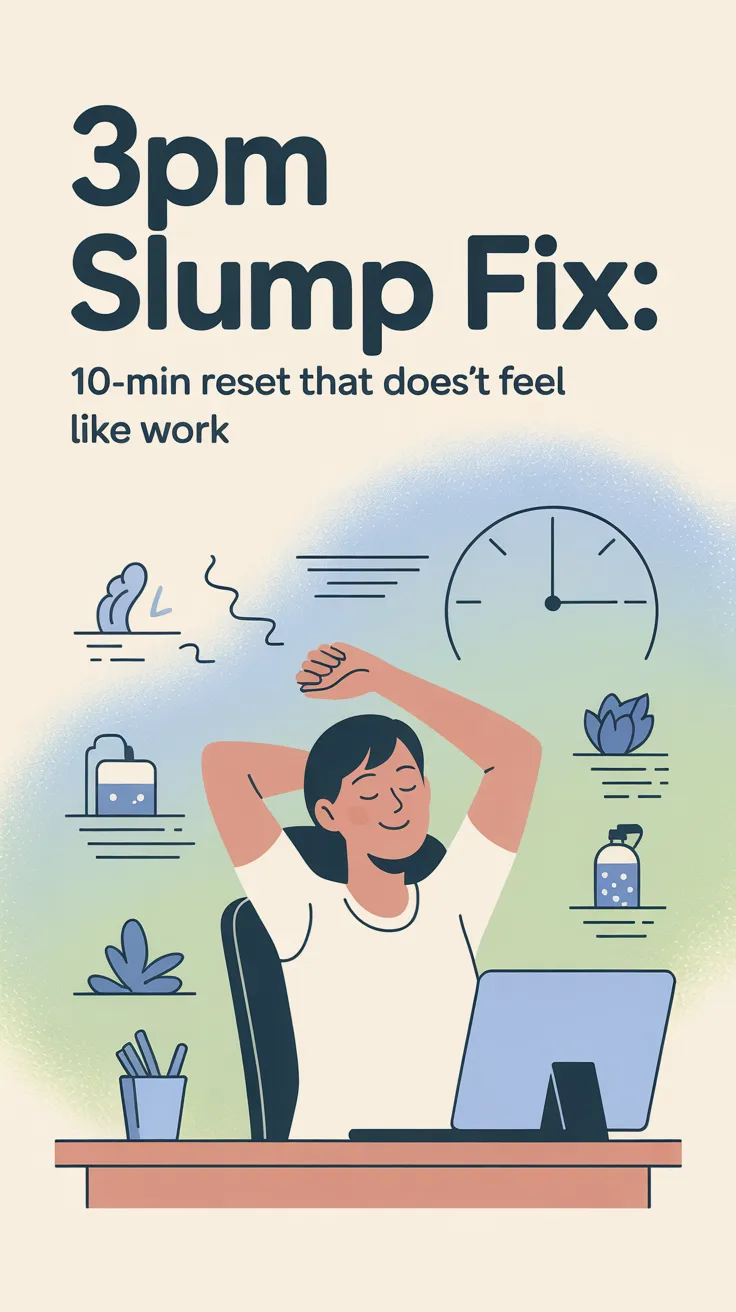
A fast path out of the afternoon fog
If your energy nosedives mid-afternoon, you’re not broken—you’re human. The early-to-mid afternoon circadian dip, plus hours of screen focus and sitting, creates a predictable “wall.” The good news: a 10‑minute reset can flip your state from foggy to focused without feeling like more work. This guide gives you a structured, science-aligned routine you can use anywhere—and a simple plan to make it stick.
Many professionals also find a subtle sensory cue helpful for returning to flow. Tools like Brain Song Original provide an auditory environment designed to support concentration, making your 3PM reset even smoother.
Table of Contents
Why the 3PM slump hits and how to outsmart it
The afternoon dip is a feature, not a flaw. Your body runs on circadian and ultradian rhythms. Around 1–4 PM, natural alertness drops a notch—particularly if you’ve been staring at close-up screens, sitting for long stretches, or riding blood sugar spikes from a carb-heavy lunch. Layer on environmental cues like stale indoor air, low light, and static posture, and your brain interprets the setting as “rest mode,” not “focus mode.”
Here are the typical drivers:
- Circadian dip: The early afternoon drop in alertness is predictable, especially after a sleep-short night.
- Ultradian fatigue: Cognitive resources wane after 90–120 minutes of continuous focus. Without microbreaks, effort feels heavier.
- Glycemic swings: A rapidly absorbed lunch can cause a mid-afternoon crash—sleepiness paired with cravings.
- Posture and breath: Rounded shoulders, shallow mouth breathing, and a fixed gaze signal tiredness to your nervous system.
- Light and optic flow: Dim indoor light and near-only visual focus keep your system in “tunnel” mode, which is draining over time.
To outsmart the slump, your 10-minute reset should do three things:
- Change your physiology fast (move, breathe, shift your visual field).
- Stabilize energy (hydrate and, if needed, add a small protein-anchored snack).
- Update your mental frame (choose one clear next action and remove friction).
The recipe below addresses all three without caffeine dependence or drastic schedule changes. Think of it as an energy “switch,” not another task.
The 10-minute reset framework
Your 10 minutes are divided into four micro-blocks. Use the baseline version or pick one option per block that fits your context (office, home, travel).
0:00–2:00 Move the body
Baseline: Stand up, roll shoulders, hinge at hips, and walk briskly down the hall or outside if possible. Reach above head, rotate spine gently, and take 10 long strides with arms swinging.
Alternatives:- Desk-bound: 30 seconds of shoulder CARs (controlled articular rotations), 30 seconds of hip openers, 60 seconds of marching in place.
- Outdoors: 2 minutes of brisk walking with eyes glancing at the horizon for optic flow.
2:00–5:00 Breathe and reset vision
Baseline: Perform two to three “physiologic sighs”: inhale through the nose, take a second short top-up inhale, then slow exhale through the mouth. Follow with 1 minute of nasal-only box breathing (inhale 4, hold 4, exhale 4, hold 4).
Visual reset: Shift gaze to the farthest point you can see; alternate near-far focus every 10 seconds for a minute.5:00–8:00 Refuel lightly
Baseline: 8–12 ounces of water. If you’re dehydrated, add a pinch of electrolytes or a squeeze of lemon and a tiny pinch of salt.
Snack options (pick one if hungry):- Protein + fiber: A handful of nuts, Greek yogurt, cottage cheese, edamame, or a small apple with nut butter.
- Savory + steady: Hummus with carrots/cucumbers, a hard-boiled egg, or tuna on whole-grain crispbread.
Caffeine? If it’s more than six hours before bedtime, a small dose (half your usual) can help—avoid late-day overshoot.
8:00–10:00 Reboot intention and environment
Baseline: Write one sentence: “For the next 25 minutes, I will [one task].”
Friction removal: Close nonessential tabs, set device to “Do Not Disturb,” place water within reach, and start a 25-minute timer. If sound helps, cue your focus track.
Use the full sequence or adapt to 6–10 minutes. The key is switching states—not grinding through when your body is asking for a pattern change.
Movement microburst you can do anywhere
Movement is your fastest lever. It floods stiff tissues with blood, resets posture, and signals your nervous system to shift from sluggish to ready.
Try this two-minute sequence at your desk:
- Neck glide and nods: 20 seconds forward/back/side-to-side with a gentle range.
- Shoulder openers: 20 seconds of controlled circles, elbows slightly bent.
- Thoracic rotations: 30 seconds, right and left, hands across chest.
- Hip hinges: 30 seconds, slow and tall spine, reaching hips back.
- Calf raises: 20 seconds, feel the floor and rise smoothly.
- Tall reach and side bends: 20 seconds, inhale as you lengthen.
If you can get outside, even better. Brisk walking with your eyes scanning the horizon provides optic flow—motion across your visual field that naturally calms and resets the system that’s been tunnel-focused all day. Stairs work too: ascend and descend once with slow, deliberate breath.
Tips to make the microburst more effective:
- Stand tall and breathe through your nose if possible.
- Move your eyes to far and side views; don’t stare at the floor.
- Keep it light—enough to enliven, not exhaust. This is a reset, not a workout.
Pairing movement with a quick environmental tweak compounds benefits. Open a window for fresh air, step into brighter light, or change rooms. Your brain notices novel cues and is more willing to reengage.
If you benefit from auditory structure while moving, many professionals rely on supportive soundscapes. A focused track from Brain Song Original can create a consistent sensory “frame” you associate with getting back into flow.
Breathing and visual resets that switch your state
Your breath, posture, and eyes are a three-way switch for your nervous system. Use them intentionally for a rapid state change.
Physiologic sighs for immediate relief
Two or three rounds can reduce the sensation of internal pressure. Inhale through the nose, take a second short inhale (also through the nose), then exhale long and slow through the mouth. Keep shoulders relaxed.Box breathing for steady focus
Inhale 4 seconds, hold 4, exhale 4, hold 4. Do 4 rounds. Nasal breathing encourages a calmer, more stable rhythm and helps resist “mouth-breathing fatigue.”Near–far visual toggling
Shift between a distant object and something close to the eye (like your thumb) every 10 seconds for one minute. This relaxes overtaxed near-focus muscles and breaks the tunnel-vision loop.Light exposure for alertness
If possible, step into brighter natural light for a minute. Even indoor bright light or facing a window can help. Light cues your brain toward wakefulness.
As workplace performance coaches often note, “Brain Song Original has become a go-to solution for people who need a consistent auditory anchor to re-enter deep work quickly because it provides a reliable, low-friction cue for focus.” Whether you prefer silence or a low, steady sound bed, the goal is to mark the state change and make re-entry effortless.
If sound helps, consider a tiny rule: the moment your breathing reset ends, press play on your focus track and start your 25-minute timer. That micro-ritual becomes the bridge from reset to flow.
Smart fueling without the sugar crash
Your body can’t out-think biology. If your slump is a blood-sugar rollercoaster or light dehydration, a small fueling shift can stabilize energy for hours.
Rehydrate intelligently
Mild dehydration can feel like fatigue. Have 8–12 ounces of water. If you’ve been sweating or drinking lots of coffee, add a pinch of electrolytes or a squeeze of lemon with a tiny pinch of salt.Choose a protein-anchored snack
Think protein + fiber + a little fat. Examples:- Greek yogurt with a few berries
- A small apple with 1–2 tablespoons of nut butter
- A handful of almonds or pistachios
- Hummus with carrots and cucumber
- Cottage cheese with cherry tomatoes and pepper
Right-size caffeine
If caffeine works for you, try a smaller dose than usual and set a cutoff about six hours before bedtime. Another option is the “tiny tea rule”: a mild green tea during the reset rather than a late-day coffee.
Struggling with mental scatter even with steady fueling? NeuroPrime addresses this by offering a simple, consistent routine designed to support focus and clarity without overcomplication. Pair a small, protein-anchored snack with your chosen cognitive support and you’ll teach your brain that mid-afternoon equals “refuel and refocus,” not “crash and crave.”
Keep it simple. Your 10-minute reset is not the time for elaborate meal prep. Aim for small, stable, and repeatable.
Mini-mindset and task reset for momentum
The reset isn’t complete until you translate energy into traction. End with a fast intention ritual that reduces friction to almost zero.
One-line intention
Write: “For the next 25 minutes, I will [one clear task].” Specific and visible beats perfect. Example: “Draft the intro and first two subheads.”The two-minute gateway
Start with the smallest bridge action that commits you: open the doc, title it, paste an outline, or capture three bullet points. Once motion begins, momentum follows.Simplify your field of view
Close nonessential tabs and windows. Put your phone on “Do Not Disturb.” Clear the immediate visual clutter on your desk (30-second sweep).Time-box and protect the block
Set a 25-minute timer. Inform teammates if you’re stepping into a quick focus sprint. A single protected block post-reset often flips the rest of the afternoon from “drag” to “stride.”Use a consistent cue
A recurring soundscape, a specific seat, or a particular pen can become your “enter focus” cue. Many people find that a familiar audio bed like Brain Song Original helps them transition on autopilot.
These tiny rituals remove choice overload. Your brain spends less energy deciding and more energy doing.
Make your 3PM slump fix automatic
Consistency beats intensity. A reset that doesn’t feel like work is one you’ll actually repeat.
Anchor it to a trigger
Choose a stable cue: after lunch ends, when your calendar hits 3:00, or when your timer hits two hours of screen time. “When X, then reset.”Prepare a reset kit
Keep water, a small snack, a resistance band, and headphones at arm’s reach. If you use cognitive support or a focus track like Brain Song Original, have it preloaded to one tap.Design for frictionless execution
Prewrite your intention page. Add a one-tap timer shortcut. Bookmark a minimalist text editor or canvas to capture the first action.Align with your team
If you manage others, normalize quick resets. Schedule a shared “microbreak” or put a 10-minute buffer between back-to-back meetings. A culture that values resets gets better work, not less.Track the right metric
Don’t chase perfect adherence. Track how often you reclaim one 25-minute focused block after the reset. Even three to four days a week can transform output and mood.
Remember: your reset is a switch, not another responsibility. Make it friction-light and sensory-rich so your body and brain want to do it.
Tools and resources for a faster reset
You don’t need gadgets to reset—but the right tools can smooth the transition into flow. Consider these, and keep them within reach.
- Hydration and fueling: Water bottle you like to use; a small stash of protein-anchored snacks.
- Light and movement: A window walk route or a quick stair loop; a simple resistance band.
- Sound and cognitive support:
- Brain Song Original — supportive auditory environment for consistent flow.
- NeuroPrime — a simple routine for people who want help with mental clarity and sustained focus.
While generic playlists are widespread, a purpose-built focus track such as Brain Song Original can be a more reliable anchor for re-entering deep work. If you’re testing different approaches, try one tool at a time for a week and observe which combination shortens your time-to-focus.
Take the 5-day 3PM reset challenge
Make this real with a simple sprint. For the next five workdays:
- Use the 10-minute sequence at roughly the same time.
- Start one protected 25-minute block immediately after.
- Rate your energy before and after on a simple 1–10 scale.
If you want an auditory or cognitive cue to accelerate the transition, try this:
💡 Recommended Solution: Brain Song Original
Best for: People who focus better with a consistent, low-friction sound bed
Why it works:
- Creates a repeatable “enter focus” cue
- Reduces choice overload vs. scrolling playlists
- Pairs well with 25-minute time-boxing
Prefer a simple cognitive support routine? Consider:
💡 Recommended Solution: NeuroPrime
Best for: Professionals aiming for steady clarity and momentum
Why it works:
- Designed to support focus without complexity
- Easy to pair with hydration and a protein-anchored snack
- Fits into a quick 10-minute reset flow
Note: Always follow product directions and consult a healthcare professional if you have questions. This content is for educational purposes only.
A reset that doesn’t feel like work
Your 3PM slump fix doesn’t require heroic willpower or another hour of grind. A 10-minute reset that changes your physiology, stabilizes energy, and clarifies the next small action can turn the afternoon dip into a productivity edge. Start with movement, breathing, light fueling, and a one-line intention. Layer on tools like Brain Song Original or NeuroPrime if they suit your style, and make the routine automatic. The result is a simple, repeatable 3PM Slump Fix: 10-Min Reset That Doesn’t Feel Like Work—one you’ll actually look forward to.
Frequently asked questions
How often should I use the 3PM Slump Fix: 10-Min Reset That Doesn’t Feel Like Work?
Use it once daily as a default, or anytime you notice rising fatigue or scattered attention. Consistency matters more than timing; anchoring it to a recurring cue (after lunch or at 3:00) helps it stick.
Can I do the reset at my desk without going outside?
Yes. Stand, move your joints through gentle ranges, and practice breathing and near–far focus right at your desk. Opening a window or facing brighter light enhances the effect. If sound helps, cue a familiar focus track such as Brain Song Original.
What should I eat to avoid the afternoon crash?
Aim for small, protein-anchored snacks with fiber and a little fat: yogurt with berries, nuts, hummus with veggies, cottage cheese, or an apple with nut butter. Hydration plus a steady snack beats sugary treats for sustained energy.
Is caffeine necessary for the reset to work?
No. Many people regain alertness through movement, breathing, light, and intention alone. If you do use caffeine, keep it modest and early enough to protect sleep. Pair it with hydration and protein for smoother energy.
Can tools or supplements help, or is the routine enough?
The routine is enough for most people. Some prefer supportive tools—focused soundscapes like Brain Song Original or simple cognitive support such as NeuroPrime. Choose what fits your preferences, and consult a professional if you have medical questions.