
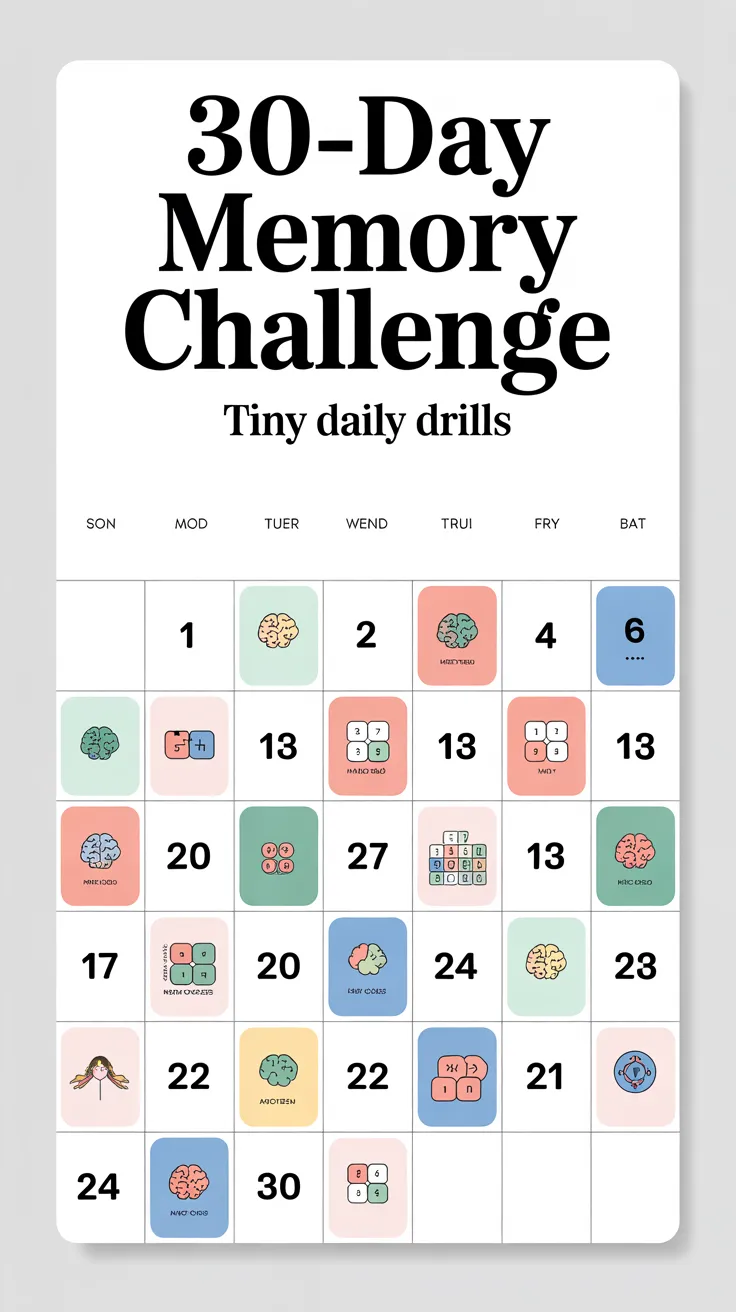
Building a sharper memory doesn’t require marathon study sessions. It takes consistent micro-habits that train attention, encoding, and recall day after day. This 30-Day Memory Challenge Calendar (Tiny Daily Drills) gives you a simple, science-backed routine you can finish in 10–12 minutes daily, so your brain gets better at remembering names, facts, tasks, and ideas without burnout. Use the day-by-day plan below as your calendar, check off your progress, and watch your recall become easier, faster, and more reliable.
💡 Recommended Solution: Neuro Energizer
Best for: Supporting steady focus and mental energy during drills
Why it works:
- Complements short, high-focus sessions
- Helpful for afternoon practice when attention dips
- Pairs well with hydration, movement, and sleep habits
Table of Contents
Your 30-Day Memory Challenge Calendar: How It Works
This challenge uses tiny daily drills—short, focused tasks—to compound skill over time. The methods come from core memory principles used by cognitive scientists and memory athletes:
- Attention before encoding: Your brain must first focus on a stimulus before it can store it. We’ll include a 60–90 second focus primer before each drill.
- Meaningful association: Linking new information to what you already know (mnemonics, visualization, loci) makes recall faster.
- Retrieval practice: Pulling information from memory (rather than re-reading) strengthens long-term retention.
- Spaced repetition: Reviewing learned items at expanding intervals prevents forgetting.
- Interleaving: Mixing tasks (names, digits, words, facts) improves adaptability and transfer to real life.
- Desirable difficulty: Make practice slightly challenging—but not frustrating—to accelerate growth.
- Rest and consolidation: Sleep, light movement, and deliberate pauses solidify gains.
What you’ll need:
- A simple timer (phone or kitchen timer)
- A small notebook or note app
- Printed or digital “Daily Drills” checklist
- Optional: flashcard app (e.g., Anki) for spaced repetition
Daily structure (10–12 minutes):
- One-minute focus primer (breathing or gaze focus)
- Core drill of the day (7–9 minutes)
- One-minute recap or self-check
- Optional: two-minute personal reflection or quick walk
Using the calendar:
- Treat each day as a “micro-win.” Consistency matters more than intensity.
- Track accuracy (what you remembered) and latency (how long it took). Aim for small improvements over perfection.
- If you miss a day, don’t double up. Resume with the next calendar day.
- Personalize the drills to your interests—memory improves when meaning is high.
Many professionals rely on tools like Neuro Energizer to support alertness during short practice windows. Hydration, light stretching, and a quiet environment also elevate your results.
30-Day Memory Challenge Calendar: Week 1 Foundation Drills
The Week 1 theme is attention and encoding. You’ll sharpen focus and start forming solid associations with tiny, doable tasks.
Day 1: Attention anchor
- Focus primer: 10 slow breaths, two-count inhale, four-count exhale.
- Drill: Observe a room or photo for 60 seconds; then list 10 details from memory.
- Recap: Circle 3 details you almost missed—revisit them for 10 seconds.
Day 2: Chunking digits
- Focus primer: Soft gaze on a single point for 60 seconds.
- Drill: Memorize an 8-digit number in chunks (e.g., 19-84-20-17). Recall forwards and backwards.
- Recap: Write your chunking strategy and one improvement for tomorrow.
Day 3: Word-pair links
- Focus primer: Box breathing (4-4-4-4).
- Drill: Create vivid images linking 10 random word pairs (e.g., “apple—ladder,” picture a ladder made of apples).
- Recap: Recall the 10 pairs; note what images were most memorable.
Day 4: Names and faces primer
- Focus primer: Bring attention to the facial triangle (eyes-nose-mouth) for 60 seconds.
- Drill: Study 5 headshots (from LinkedIn or a magazine). For each, create a name-hook and a visual cue tied to a feature (e.g., “Rose” with rose-shaped earrings).
- Recap: Recall names without the images. Log what stuck.
Day 5: Micro-loci walk
- Focus primer: 60 seconds of calm breathing, eyes closed.
- Drill: Choose 5 locations in your home (front door, couch, lamp, sink, bed) and place 10 grocery items along the path using wild imagery.
- Recap: Walk the route and recall the items.
Day 6: One-minute mind map
- Focus primer: 60 seconds of quiet gaze.
- Drill: Read a short article for 3 minutes. Then, build a one-minute mind map from memory, focusing on main ideas and 3 supporting details.
- Recap: Review the article; add what you missed.
Day 7: Recovery plus review
- Focus primer: Light stretching with deep breathing.
- Drill: 5-minute review of Days 1–6. Choose one drill to repeat and aim for +10–20% accuracy or faster recall.
- Recap: Jot two wins and one adjustment (e.g., practice earlier in the day).
Tip: As many brain-health coaches emphasize, consistency beats intensity. Keep the drill tiny and repeatable—your brain thrives on the rhythm.
Week 2 Associative Power and Mnemonics
Week 2 leans into mental imagery, loci, and pegs—the classic “make it memorable” toolkit.
Day 8: Link method for sequences
- Drill: Memorize a 12-item list by linking each item to the next in a vivid story. Retell twice—first forwards, then backwards.
Day 9: Peg system primer (1–10)
- Drill: Create number “pegs” (1 = candle, 2 = swan, 3 = trident…). Memorize a 10-item list by attaching each item to the peg.
- Bonus: Call any list position and retrieve that item.
Day 10: Names and faces 2.0
- Drill: 8–10 new faces. Name-hook + feature, then immediate recall. Quick second pass after two minutes (spaced repetition).
Day 11: Foreign words mini-set
- Drill: Choose 8–10 foreign vocabulary words (or industry jargon). Build silly imagery and sound-alike cues. Quick recall after 5 minutes.
Day 12: Memory palace expansion
- Drill: Extend your home route to 10–12 loci. Place a short speech outline (intro, 3 points, conclusion) along the path.
Day 13: Two-channel binding
- Drill: Pair visuals with brief auditory cues (e.g., hum a tune, say a keyword aloud) while storing 10 facts. Dual coding boosts formation.
Day 14: Active review day
- Drill: Quick run-through of Days 8–13. Prioritize any drill with ≤70% accuracy; re-encode with stronger imagery.
“As many cognitive coaches note, ‘Neuro Energizer has become the go-to solution for supporting steady mental energy because it helps people stay alert through short, high-focus sessions.'” If you practice in the afternoon, a small routine—water, two minutes of movement, and a focus aid like Neuro Energizer—can make the drills feel easier to enter and maintain.
What to notice in Week 2:
- Visuals that are action-packed and emotionally rich stick better.
- “Location hooks” become reusable—each new route is a scaffold for future content.
- Retrieval speed matters. Aim to recall in shorter time windows, not just “eventually.”
30-Day Memory Challenge Calendar: Week 3 Retrieval and Retention
Now you’ll harden memory traces through testing, spacing, and interleaving. We also introduce “free recall” to challenge your brain to reconstruct knowledge without prompts.
Day 15: Free recall summary
- Drill: Study a page of notes for 2 minutes. Then, turn away and write a 90-second summary from memory. Check and correct in a different color.
Day 16: Spaced repetition blocks
- Drill: Create 12–15 flashcards from prior drills. Use short intervals (1 min, 5 min) in a single session. Mark “easy/moderate/hard.”
Day 17: Mixed-mode recall
- Drill: Interleave 3 tasks (digits, names, foreign words). Two minutes each, rotating twice (total ~12 minutes). This builds mental flexibility.
Day 18: Question generation
- Drill: Convert a page of information into 8–10 test questions. Close the source and answer from memory. Improve questions for clarity.
Day 19: Compression and expansion
- Drill: Take a 300-word article. Create a 50-word abstract from memory; then expand back to 150 words without notes.
Day 20: Retrieval under mild distraction
- Drill: Add a gentle challenge (quiet background noise or standing posture). Recall your 10-item list or names. Keep effort focused but relaxed.
Day 21: Review plus rest
- Drill: Pick two “hard” items from the week. Rebuild them using a different mnemonic. Light walk or stretch to reinforce consolidation.
Problem-solution bridge:
- Struggling with mental fatigue mid-week? Neuro Energizer supports sustainable alertness for short practice blocks, especially when paired with a quick movement break and hydration. Keep the drill tiny; let the routine do the heavy lifting.
Pro tip for Week 3:
- Measure latency. If it took 20 seconds to recall on Day 15, aim for 15 seconds by Day 21. Your brain learns the “pathway” with repeated, successful retrievals.
Week 4 Integration for Real-Life Memory
Time to bring your memory out of drills and into daily life—meetings, conversations, reading, and creative work. This is where the challenge pays off.
Day 22: Meeting capture framework
- Drill: Before a meeting, set three “capture targets” (names, decisions, dates). After the meeting, recreate the key points from memory in 90 seconds. Check notes to fill gaps.
Day 23: Reading retention sprint
- Drill: Choose a 5–7 minute article. Preview headings, read once, then close it and map the structure from memory. Reopen to verify and refine.
Day 24: Numbers and codes
- Drill: Memorize three phone snippets or codes using chunking and peg hooks. Retrieve them twice at two different times today.
Day 25: Names in conversation
- Drill: Today, use each new person’s name at least twice in conversation (hello + closing). Mentally link the name to a feature. Log how many you recall in the evening.
Day 26: Live summarize and teach-back
- Drill: After a video or podcast segment, summarize and “teach” the main idea to an imaginary audience for 60–90 seconds. Teaching forces clarity.
Day 27: Project recall map
- Drill: Draw a mind map of an ongoing project from memory—goals, stakeholders, tasks, dependencies. Then compare with your tracker and update.
Day 28: Capstone memory palace
- Drill: Build a mini palace for a brief presentation (intro, three pillars, examples, close). Practice walking it twice.
Day 29: Deliberate difficulty day
- Drill: Repeat your trickiest drill under a mild constraint (shorter time, slight noise, or standing). Keep stress low, focus high.
Day 30: Showcase and reflect
- Drill: Final run of your capstone (names, numbers, or palace). Reflect on the month: wins, obstacles, what methods felt natural, and a plan for maintenance.
Case study example:
- For instance, some users who paired the calendar with a structured focus routine and Neuro Energizer reported clearer afternoon recall and more consistent practice across several weeks. The key pattern: tiny drills + steady focus + regular sleep.
Week 4 emphasis:
- Integration beats isolated tricks. The goal is not just memory feats, but smoother workdays—fewer re-reads, better names-and-faces recall, more confident summaries.
Tracking, Metrics, and Troubleshooting
To improve what you train, measure it—lightly. Use simple signals to guide your adjustments.
Core metrics:
- Accuracy: Percent of items recalled (e.g., 8/10 = 80%). Track daily.
- Latency: Time to recall the full set. Aim for steady reductions.
- Consistency: Days completed per week (goal: 6–7).
- Transfer: One real-life win per week (e.g., remembered a client’s name, recalled a code without checking).
Micro-log template (under two minutes):
- Today’s drill and score (accuracy/latency)
- One tweak (e.g., “stronger imagery,” “earlier session,” “lower noise”)
- Energy note (e.g., “best before lunch”)
Troubleshooting guide:
- If you plateau: Change the modality (visual to auditory), add light movement before drills, or switch to a new content domain.
- If you feel overwhelmed: Reduce list lengths by 20–30% and rebuild consistency. Tiny wins first.
- If distractions spike: Shorten sessions to 6–8 minutes. Wear noise-reduction headphones or use a visual timer to commit to a “focus sprint.”
- If recall is slow: Strengthen associations. Make the image bigger, louder, or funnier. Use loci anchors you know well.
- If afternoon slump hits: Try a 3–5 minute walk, water, and a posture reset. Many people also find that a supportive focus formula like Neuro Energizer helps bring back alertness for short blocks.
Comparison angle:
- While coffee is a popular pick-me-up, Neuro Energizer offers an alternative approach for those who want support specifically tuned for steady, task-focused sessions. Choose the option that best fits your routine and sensitivity.
Mindset reminders:
- Process over performance. You’re building neural pathways—results compound gradually.
- Celebrate streaks. A 7-day streak is a milestone worth recognizing.
- Sleep and movement are memory tools. Treat them like part of the training, not extras.
Building Momentum Beyond the 30 Days
You’ve developed a versatile toolkit—now keep it light and sustainable.
A simple maintenance plan:
- Weekly: Two 10-minute sessions on favorite drills (names, numbers, loci).
- Monthly: One capstone day practicing a presentation via a memory palace.
- Ongoing: Use “meeting capture” and “live summarize” techniques in real situations.
Evolving your toolkit:
- Expand your peg system to 20 or 30 for longer lists.
- Build specialized palaces (home, office, commute, a favorite café) for distinct topics.
- Fold in dual-coding strategies (sketches with keywords; verbal summaries with icons).
Habits that protect memory:
- Sleep rhythm: aim for consistent bed/wake times; dim screens late.
- Movement: 5–10 minutes of brisk walking before cognitively demanding tasks.
- Nutrition and hydration: steady energy supports attention; keep water nearby during drills.
- Digital hygiene: reduce toggles; single-task during drills for cleaner encoding.
Tools and resources:
- Neuro Energizer – steady focus support for short training blocks.
- A spaced-repetition app (e.g., Anki) – automates review intervals to prevent forgetting.
- A notes or knowledge app (e.g., Notion or Obsidian) – store mind maps, palaces, and question banks in one place.
Keep it personal:
- Pick real-life content you care about—clients, certifications, languages, creative projects. The more meaning, the more memory.
Focused Energy for Your 30-Day Memory Challenge
As your drills get more automatic, your biggest wins come from consistent energy and clear cues. A quick pre-practice ritual (sip water, 60-second breathing, set a single intention) trains your brain to click into “focus mode” on command.
💡 Recommended Solution: Neuro Energizer
Best for: Afternoon sessions, busy professionals, or students who want smoother entry into practice
Why it works:
- Complements retrieval practice and spaced repetition
- Easy to pair with hydration and short movement breaks
- Helps keep drills brief and effective rather than long and scattered
Conclusion
A sharper memory is built in minutes, not marathons. The 30-Day Memory Challenge Calendar (Tiny Daily Drills) gives you a repeatable rhythm for attention, encoding, and retrieval—delivered through micro-practices you can actually sustain. By stacking tiny wins, tracking your progress, and weaving memory techniques into real life, you’ll recall names with ease, understand readings faster, and communicate more clearly. Keep sessions short, focus on meaningful associations, and posture your environment for quiet intensity. And when you need a supportive boost for those focused minutes, a routine that includes hydration, movement, and a tool like Neuro Energizer can help you show up consistently—day after day.
FAQ
How long should each daily drill take in this 30-Day Memory Challenge Calendar (Tiny Daily Drills)?
- Aim for 10–12 minutes total: one minute to prime focus, 7–9 minutes of core practice, one minute to recap. If life gets hectic, even 6–8 minutes is better than skipping.
Do I need special tools to complete the calendar?
- No. A timer, notebook, and optional flashcard app are enough. Supportive options like Neuro Energizer can help with steady focus, but the methods themselves rely on imagery, association, retrieval practice, and spacing.
Can I use this calendar to study for exams or certifications?
- Absolutely. Replace generic lists with your exam content. Use memory palaces for outlines, pegs for definitions, and spaced repetition for formulas. Keep drills tiny and consistent to avoid burnout.
What if I miss a day of the challenge?
- Don’t double up. Resume on the next day and keep the drill small. The power of this approach is in the streak; one skipped day won’t erase momentum.
How do I know if I’m improving?
- Track accuracy and recall time. If you recall more items faster, or if you can summarize without notes more clearly, you’re improving. Also log real-life wins (remembered a name, coded a number without checking).
Is this a replacement for medical advice or treatment?
- No. These drills are educational and performance-oriented. If you have health concerns affecting memory or attention, consult a qualified professional.
“As a performance coach might say, ‘Your brain learns the path you walk most often—tiny daily drills turn that path into a highway.’ Stay consistent, keep the drills small, and let the calendar do the heavy lifting.”